Showing posts with label water tanks. Show all posts

Friday, December 15, 2023

The Only Known Photo of an Intact Midway Water Tank

Certain C&S water tanks have gotten lots of photographic attention during operation days and even during abandonment.  Some, however, never graced a single negative, or if they did, they haven’t surfaced or aren’t widely circulated.  Such has been the case with Midway Tank at MP 168.66 on the western slope of the route through the Alpine Tunnel, that is, until recently.

The very photogenic Tunnel Gulch Tank, 1960s- Dow Helmers photo

Tunnel Gulch water tank, a little over 4 miles upgrade from Midway, has appeared in many photographs.  While none of them are from operational days, the water tank, erected to replace the Woodstock tank destroyed by avalanche in 1884, has graced many photos after abandonment.  It seems to have intrigued visitors to the rail-less grade.  Numerous photos show how it, ever so slowly, tipped forward and letting its funnel drop and hang lifeless.  The water tank appeared destined to be a pile of wood and metal bands.  Thankfully, in 1959, the Mile-Hi Jeep Club saved her from ruin with a restoration that set her to rights again.

1905 photo of train leaving Midway Tank

Midway Tank, in contrast, has been camera-shy.  It is famously mentioned in the caption of an iconic 1905 photo of an eastbound C&S mixed train with its helper engine No. 57, piloted by Walt Parlin, just ahead of a combination car.  The train is pulling away after filling up for the strenuous climb to Alpine.  Yet, the photo does not actually show Midway tank. 

Midway Tank's Remains 2018, upgrade of the base

Following the end of service in 1910 between Quartz and Hancock, Midway Tank, while considered “practically new” by the railroad company, was left to the elements.  She collapsed over the years without any known photographic evidence.  Her discarded remains litter the ground to this day by her still-intact base.

Photo of Midway Tank intact

It was to my surprise, then, when a  photo of Midway Tank jumped out at me from my computer.  A few years back I purchased a bunch of old photos without captions or dates from eBay.  They are all color images of abandoned remains near Alpine Tunnel.  My guess was that they were from the 1950s or 1960s.  I barely knew one of the photos included a water tank since the structure was so overgrown with trees.  Yet, with a closer look, one can make out the metal tank bands that have slipped down at angles pointed at the grade.  The board where the spout once hung sticks out through the Aspen leaves.

The trees were actually what tipped me off that this was not another photo of Tunnel Gulch Tank.  Tunnel Gulch is always easily visible in a clearing of sorts, surrounded by lots of pine trees.  In contrast, the tank in my photo, as well as the site of Midway’s base today, is crowded with Aspens.  

Midway Tank base 2018-notice dense Aspen trees

Tunnel Gulch Tank 2018-notice pine trees

Tunnel Gulch Tank - notice pine trees and visibility

The tree difference helped solve another problem: the C&TS photo site has four photos labeled as Midway Tank, but the proliferation of pines and the visibility of the tank make it quite clear that the two showing an intact tank are mislabeled (Also Midway's pipe housing is in the back unlike Tunnel Gulch's which is in the front).  

One last hurdle remained for identification.  The trees were certainly a clue, but what about the rock slide just upgrade in the photo?  I watched back through GoPro footage I filmed in 2018.  While the Aspens were present at Midway, there was no telltale sign of that slide.  

I reached out to Bob Schoppe to see if he had any insight.  Sure enough he had the same photo, but it was reversed (It was also labeled with the day June 24, 1956).  If his was the right direction, that would put the rock fall downgrade from the tank.  I jumped back on my GoPro footage and sure enough, there it was.  My photo was backwards.

Here is the photo in its correct form.  Photo is facing downgrade.


Here is the rock fall in the photo above looking upgrade.  Midway Tank's base is just around the trees in the center.

So, there we have it: the only known photo of an intact Midway water tank.  Sadly, it is so engulfed in trees we can hardly make many determinations about the structure.  Hopefully, this article will inspire a reader to say, “What a sec!  I have a photo of that tank!” and bring another photo to light. 


Saturday, November 26, 2022

Video following the C&S Ry. from Tunnel Gulch Tank to Woodstock (Part 6)

I have a new video in a series of videos following the less-famous stretch of the right-of-way to the Alpine Tunnel from Pitkin to Woodstock.

Part 6 of this series follows the DSP&P/C&S route from the restored Tunnel Gulch Water Tank to the townsite of Woodstock.  A few rock cribbing walls (approximate locations) are pointed out.  The upper grade that leads to the west portal of Alpine Tunnel, while blocked from view by trees, is above to the left of the grade here.  The crossing of the Alpine & South Park toll (wagon) road is also pointed out.  Curiously, Part 5 was posted a year ago around Thanksgiving.  One year later, I finally came through with another part!

Enjoy and Happy Thanksgiving!

Kurt Maechner

Monday, May 24, 2021

Following the C&S from Midway Tank to rock wall (video)

Part 3 of this video series follows the DSP&P/C&S route from the ruins of Midway water tank to a large rock wall constructed to support the railroad's right-of-way on the mountainside.  The approximate site of Valley Spur as well as rock cribbing on the uphill side constructed by the South Park Line are also pointed out.  Quotes from historian and author of Historic Alpine Tunnel Dow Helmers when visiting in the 1960's, 53 years after abandonment, as well as quotes from Charles C. Squire, who recounts a trip in 1897, and a Denver newsman who rode the train in 1882 are interspersed.


Sources:
Gunnison Memories and Then Some by Tom and Denise Klinger
1918 Colorado & Southern Railway ICC Valuation Maps
Historic Alpine Tunnel by Dow Helmers
DSP&P by M.C. Poor

Thursday, April 8, 2021

Following the C&S from Quartz to Midway Tank (video)

My previous video followed the line from Pitkin to Quartz.

This video covers the stretch of DSP&P/C&S Railway right-of-way from the townsite of Quartz to Midway Water Tank, following in the "footsteps" of eastbound C&S mixed train 93.  

Besides photos at Quartz and trains leaving Midway Tank, I haven't found any photos of this stretch during its years of operation as a railroad.  While a few spots of rock cribbing are pointed out along the way, you will have to content yourself with the incredible scenery and the wonder that a railroad line could be built so high up on the side of a mountain overlooking a stunning valley.  Some spots make the precarious drop off to the right look quite frightening!

Friday, April 10, 2020

Alpine Tunnel and Alpine Pass by Drone

When I posted a video of the Alpine Tunnel engine house I included some drone footage filmed by David Moore who graciously allowed me to use the remaining footage that he had not already posted.  Many enjoyed the footage and at least one person asked if Dave had flown his drone over the pass from West Portal to East Portal.  Indeed he had.

This video includes the footage from that segment.  I included a few titles to designate important points of interest (such as the summit of the pass, Mount Poor, and various railroad remains) and put a couple before and after shots of the line during operation.

I can't get over the majesty of the area every time I look at Dave's footage.  I also can't get over the bravery (or foolishness-not sure!) of those who surveyed and built a railroad line over such treacherous terrain.

Enjoy!
Kurt

Sunday, January 12, 2020

Alpine Tunnel engine house video

I put together a video focusing on the Alpine Tunnel engine house including historical photos lined up with photos from our 2018 visit.  My favorite addition to the video is Dave Moore’s drone shots of the structure.

Ironically, I brought a drone with me on our trip, but due to the time constraints of getting our rental vehicle back, I didn’t have time to use it there.  However, I was glad to discover that Dave had done the very thing I set out to do, and much better as I was a newbie with a drone and would have been too afraid to fly it as high as he did.  Anyway, Dave graciously gave me permission to use his footage.  It was incredible work on his part and I hope to include more of his shots in subsequent videos.


When the Denver, South Park & Pacific built it’s daring route through Alpine Tunnel at over 11,000 feet, it knew its locomotives would need servicing facilities after the tremendous climb to reach the pass.  A stone engine house was built in 1881.  Inside was a water tank, turntable, inspection pit, and coaling platform.  The structure was destroyed in a fire in 1906 and never replaced.  Thanks to the efforts of many volunteers, particularly through The Passport in Time program, and the leadership of Ray Rossman of the National Forest Service, the remains of the engine house have been protected and stabilized.  Many, many others, such as Gene Candelaria, a stone mason, who did stabilization work on some of the walls in 2010, have also put their hands into this work.  New approach tracks, a restored tool shed, and a viewing platform have also been added.

Monday, November 18, 2019

Video of Highlights along The Road to the West Portal

In the video below I put together highlights of the C&S route from Quartz to just before the Alpine Tunnel station complex.

Included are:
-several rock walls other than the famous ones
-three water tank locations
-a remaining telegraph pole
-the Palisades
-avalanche damage to the rock wall
-split rock
-rock work along the right-of-way
-Sherrod curve
-and more


Friday, June 28, 2019

C&Sng 1952 in the Narrow Gauge News

This is part 3 of the C&S details found in Bob Richardson's Narrow Gauge News.  Part 1: 1949-1950 is here.  Part 2: 1951 is here. Below are C&S references in his newsletter from the year 1952.  I have underlined some points of particular interest.
*Photos here are just my additions, not from the newsletter.  

Central City 1964-Author's Collection

April

Old C&S 71 is no longer missing its bell…sheriff recovered it from teenagers who sold it for scrap

May

May Day saw workmen tearing down what was left of Jefferson tank on the abandoned C&S in South Park

The famous Chalk Cliffs of “South Park Route” fame rate a full page in color in “Colorado Wonderland’s” Summer issue

July

As an example, more people come to Colorado or one part of it to see Alpine Tunnel than come to see one much-advertised “monument.”

East Portal 1950s-John Hallinan Collection
Many summer visitors like to explore the routes of the abandoned Colorado narrow gauge routes.  Some have become roads, others require considerable hiking.  Top attraction is Alpine Tunnel, abandoned in 1910 by the Colorado & Southern.  A county highway turning off at Nathrop uses the grade most of the way to within about three miles of the debris-blocked east portal.  The west portal and abandoned buildings are reached either by going over the top of the mountain or by hiking from Quartz Creek camp ground some miles beyond Pitkin.  U. S. No. 285 is either on or alongside of much of the old South Park line from Bailey over Kenosha Pass, past abandoned Como roundhouse, depot, etc. and on thru South Park toward Buena Vista and Alpine Tunnel.

Five locomotives, two cabooses, a combine, coach and freight car are persevered and on display at Alamosa (No. 169 4-6-0 and our No. 346 No. 346 2-8-0), Durango (No. 315 2-8-0), Colorado Springs (No. 168 4-6-0), Idaho Springs (C&S 60 2-8-0), Central City (C&S No. 71 2-8-0, gondola and combine of C&S), Silver Plume (C&S 4-wheel caboose).  And plans are being carried out to preserve more of the rolling stock.

August 

Alpine Tunnel boarding house-photo inverted
Our staff photographer reports after a trip to Alpine Tunnel that snow still hides the west entrance and that the second floor has collapsed inside the old boarding house

September

On Aug. 25 the D&RGW filed application with the ICC to abandoned the narrow gauge lines west of Poncha Jct. to Gunnison and the branches from that place to Sapinero, Castleton and Crested Butte, 138 miles in all….Gunnison County plans to oppose the abandonment, which will remove 25% of the county’s total assessed tax valuation.

Coal traffic of the Baldwin Branch which Gunnison made no effort to keep when the Valley Line was up for abandonment, would help a lot up that way now.

October

THAT WRECK OF 346 AT KENOSHA PASS

The Mount Blanca & Western’s engine was among three loaned by the D&RGW to the
Colorado & Southern in 1936 and returned the following spring when that line abandoned its road to Leadville.  On July 25, 1936, #346 had helped a Denver-bound frt. To the summit of Kenosha Pass and then started down light.  Almost exactly a mile form [sic] the summit of the pass, the engine climbed the rails, cut the ties for perhaps 150 feet, then overturned on a sharp curve, suffering considerable damage.  Engineer Eugene McGowan could not jump as he got entangled in some cab piping, and he received a fatal scalding from a broken pipe.  The fireman had been thrown out of the gangway before the engine overturned.  The accident occurred about 300 feet west of Mile Post 75.  It was blamed upon too much speed and the fact that two of the engine’s four drives had no flanges.

The engine was returned to Denver, sent to the Burlington shops on a flat car, repaired and returned to service.  The present steel cab dates from this time.  Tires with flanges were installed on the two “blind” drivers by the D&RGW after the engine was returned to them.

Anyone having photos of the wreck or of this engine in use on the C&S, or additional data, are urged to contact us.

November

C&S stock car at CRRM-Chris Lane Collection
In 1938 and 1939 Victor Miller added 125 ex-C&S cars [to the RGS], and most disposed of by him when he lost that post.

In 1949 a 2-8-0, ex-Colorado & Southern No. 74 was acquired from a dealer.

One Goose is working on removal of rail around Dolores; while another is working about midway to Rico on a section of track isolated by washouts. Two cut down ex-C&S stock cars were hauled by truck to Millwood to replace the worn out flats used by that train.

Vandals have been at engine 74 at Boulder . . . engines worth so much in work, money and trouble are surely worth a few dollars a month of electricity to protect them with a bath of light?

Sunday, May 19, 2019

Ride the C&S over Boreas Pass - part 2 video

This is the second part to my family's 2018 trip over Boreas Pass.  In the video, I designate location with insets corresponding to Google Earth so you have a sense of where you are on the journey over the pass.  Several sites are pointed out as well including:
-Selkirk trestle
-Selkirk water tank
-Selkirk siding
-2 different wreck sites (one from the 1890s and another from 1936)
-Boreas snowshed
-Boreas summit (more detailed film at the summit and the facilities and displays there will be in a future video)

If you expand the description in Youtube I've also created timecode links to points of interest which allows you to jump to those parts without watching all the way through.

I hope you enjoy it!


Sunday, January 20, 2019

Saving the Alpine Tunnel Historic District in 1994

In April of 1994 Ray Rossman, East Zone Heritage Resource Manager for the U.S. Forest Service in Gunnison, filled out an important document that helped set in motion the tremendous restoration and historical work done to the Alpine Tunnel district.  That document was the "National Register of Historic Places Registration Form."  It was "for use in nominating or requesting determination for individual properties and districts."  I discovered this form online here.

In the form, Rossman names the stretch "along DSP&P railbed from Quartz to Hancock" as the "Alpine Tunnel Historic District."  The area is spelled out more specifically later as
"from the bridge crossing Chalk Creek at the Hancock townsite to the intersection of the railbed with the Cumberland Pass Wagon Road within the townsite of Quartz."  Also, "The boundary runs 100 feet on either side of the railbed centerline for approximately 13.8 miles.  Three hundred feet of the former Atlantic rail spur northwest of the east portal.  The district also includes the historic trail over Altman Pass."

The form is quite extensive, including a narrative description, a map, topographical details, a list of contributing and noncontributing structures and sites, a statement of historical, engineering, transportation, and informational significance, geographical data, present property owners along the route, and a photograph log (with accompanying photos).

It is an interest document to peruse.  I include below a few interesting excerpts with a few notable points in bold:

Alpine Tunnel station/telegraph office

The Mile-Hi Jeep Club recently restored the [Alpine Tunnel telegraph office] and removed the extension. The only deviation from the original construction is the replacement of the tar paper roof with steel roofing material. The building retains its historic integrity, is the best preserved structure at the station complex, and is a contributing building in the district.

Outhouse

"A two-hole outhouse/privy is located 35 feet west of the boarding house. The building has partially fallen over. This was the second outhouse constructed. Photographic evidence suggests the original structure was located directly west of the front entrance of the engine house."

The Storage Cellar

"A covered storage cellar is located 20 feet south of the boarding house. Entrance was gained though a covered walkway that extended from the front porch of the boarding house. Today the structure has lost its metal roof and the stone walls are leaning inward."

The Coaling Platform

"Forty feet south of the cellar are the standing timbers of a 16'x 32' coaling platform. Coated by creosote, the structure has remained in good condition. The eastern side has shown the most deterioration. The structure contributes to the district."

Future Plans (includes rebuilding the boarding house!)

"Future management plans for the Alpine Tunnel Station complex calls for the restoration of the coaling platform, outhouse and storage cellar. The ultimate goal calls for the restoration of the facility to its 1910 configuration including the rebuilding of the two story wooden boarding house."

Tunnel Gulch Water Tank

About a half mile downgrade a new water tank, the Tunnel Gulch water tank, was built after the avalanche. The Tunnel Gulch water tank. This structure was stabilized and restored by the Mile High Jeep Club. The tank is one of the best examples of the typical water tanks used along the South Park rail system. The structure contributes to the district."

The Tunnel Interior

"The interior, though not easily accessible, remains in moderately good condition. There are two minor rock falls and a major tunnel collapse within the tunnel. The most significant is a 300-350 foot section which collapsed and completely sealed off the eastern portal. The western portal, faced with locally quarried hand-cut granite stones, has been covered by talus debris and has suffered only minor damage. Several support beams throughout the tunnel have also collapsed. In addition, a white mold covers some of the interior redwood timbers. The original rails and ties extend the length of the tunnel. These rails represent the only portion of the entire DSP&P rail system that remains intact. Water covers a portion of the railbed at both ends where the tunnel is sealed off. The snowsheds that protected both portals have totally collapsed and decayed. The east portal was constructed directly into solid granite and required no external facing. The tunnel is a contributing structure in the district."

The Stone Section House

"The stone section house was an "L" shaped structure built in 1881. It functioned as the original boarding house for the assigned complex crew members. The initial construction measured 55'x 30' and had a 25'x 16' addition added to the northeast corner prior to 1896. The corner, window, door and sill stones are of native hand-cut granite. The walls were constructed with random sized native stone material. Based upon photo evidence this facility was abandoned by 1896. Today only foundations and segments of the lower walls remain visible."


More gems can be found throughout the document.

Curiously, there is a stamp on this document stating that it was received in 1996.  That is a roughly two-year gap between when Rossman completed it and it was received.  I'm not sure why this is.

Also, here is an interesting photo of a culvert in the form that I didn't know about.


Saturday, December 22, 2018

A NEW C&S water tower?!

If you told me that a new C&S water tower was to be built in Como in 2019 (roughly 80 years after it came down), I would have politely chuckled at you. 

Believe it or not, I just saw on the South Park Rail Society's Facebook page the following picture and post: "The preliminary design work for the replica Como water tower is complete. We will be starting the permit process shortly. With luck construction could begin this summer."


Sunday, March 4, 2018

West Portal on film in 1965

I found some great, old footage of a visit by Art Burrill, Dave Burrill, and Lloyd Lemons, to the Alpine Tunnel in the summer of 1965.


Here are some points of particular interest:

0:29 shows Tunnel Gulch water tank when it was in a precariously leaning, dilapidated condition.

The video moves to the station complex.  It's interesting to note that you were still able to drive right down the grade here.

1:11 Of particular interest to me is that you can see the remaining rails very clearly under the scattered snowshed timbers in front of West Portal.  On one of my visits in the 1990s these were still there, but someone had done a lot of digging to get to a small piece of it.  Later these tracks were removed when the forest service cleared out the snowshed timbers.


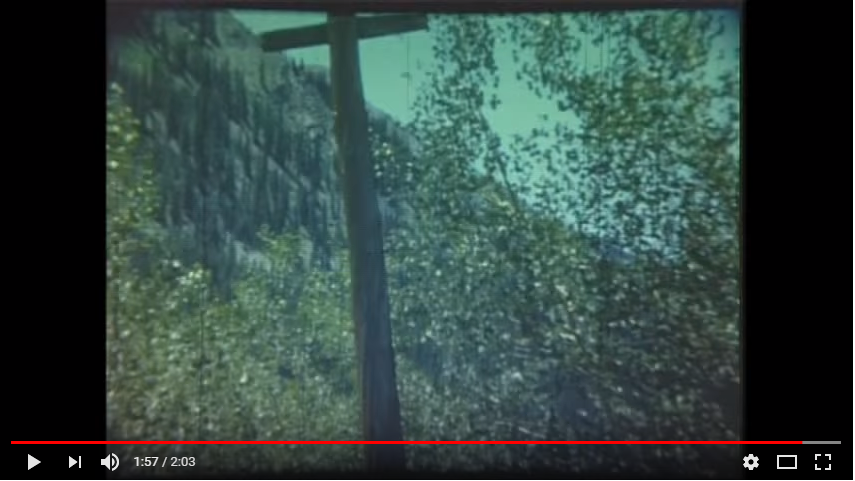
1:57 you get a quick shot of an old telegraph pole.  I don't know the location, other than it is on the western side of the pass, apparently a good distance past the palisades, assuming the video is chronological.

You can watch the video below.  Enjoy!

Sunday, January 21, 2018

The Fun of Water-Tower-Tipping!


We’ve all heard of cow-tipping, but have you ever heard of water tank-tipping? It seems that the C&S had!

In 1915 the line from Parlins to Pitkin and was being operated by the Denver & Rio Grande. On March 19th, the general manager of the D&RG sent a letter to the VP of the C&S complaining that the “C&S tanks at Gunnison and Parlins are in bad condition and likely to fall down unless repaired.” The letter concludes by saying in so many words: we’re giving them back to you since we don’t use them!

The C&S VP, in response, suggested the following approach: “I would like to ask if you could arrange...to have them jacked up and tipped over clear of the track in order to eliminate the danger of their falling and causing further damage. I believe the material in same is not worth saving.”

Can you imagine the creak, groan, and crash of a tipped water tank? While it’s not clear how they actually went about it, the C&S sent payment to the D&RG “for tearing down C&S tank at Gunnison.” The cost of this activity? $17.03.

Source: Daniel W. Edwards. A Documentary History of the South Park Line: Vol. 5. The Gunnison District, Part II, 2016. pp. 164-165

Photos: Midway Tank (above) from The Narrow Gauge Circle.
Hancock Tank (left) from "286 best Railroad water tanks."