One of the many reasons that narrow gauge railroading holds so much fascination is its struggle with the natural elements. Engineering required to traverse the Rocky Mountains is a marvel in itself, but a close second is fighting the powerful dragon known as snow.
One part of the old South Park Line that fought snow in the narrow gauge days was the line to Leadville. The segment from Leadville to Climax lives on as a standard gauge tourist pike called the Leadville, Colorado & Southern. Below are two clips of a LC&S diesel doing what its old narrow gauge relatives did a century ago: buck snow.
A wealth of railfan history exists in the archives of the Rocky Mountain Rail Report, the newsletter of the Rocky Mountain Railroad Club started in 1939. Here is some more miscellaneous South Park Line/C&S-related news from the 1980 editions.
1980
August
(C&S Diesel Plummets 60 feet Near French Gulch Water Tank)
LC&S collection photo. from High Line to Leadville by Doris B. Osterwald
BILL MAY, C&S ROUNDHOUSE FOREMAN at Leadville, is offering a substantial reward for the elimination of the pesky muskrats responsible for the recent upsetting of C&S Engine 6223, on the Leadville-Climax Branch. Seems as how these villainous critters tunneled around the culvert in the fill at French Gulch on the high country rail line, causing spring run-off waters to wash out said fill and leave the C&S track hanging high and dry. Imagine the surprise of the crew on the return trip to Leadville, when they approached French Gulch and found these conditions. Fortunately, the engineer and brakeman were able to unload in time to avoid injury, but Engine 6223 was not so fortunate and plunged 60 feet down the mountain. None of the cars in the short train chose to follow the engine. [Ed. Actually, one tank car partially went into the crevasse] All of this excitement took place on June 23, and it was not until June 29 that the 6223 was hauled back up the bank and onto the rails. A new fill has been constructed and the branch is back in operation with Engine 6219 handling the work. Now, if I can just find that old musket. [Ed. In a not-so-humorous follow-up, when 6223 was taken back to Leadville, the engine was shoved by 6220 onto the wye a bit too hard. The back end of the engine went off the end-of-track. Since the roadbed was slightly elevated, the engine played a game of see-saw]
LC&S collection photo from High Line to Leadville by Doris B. Osterwald
[Ed. The water tank seen in the photo was the tank that used to serve the narrow gauge engines on the route. Used until 1943 when the line between Leadville and Climax was standard-gauged, the tank was moved to the opposite side of the track in order to serve the C&S' standard gauge steamers. The tank remained in place even after dieselization. It still stands today. The Leadville, Colorado & Southern tourist trains still stop here to let passengers off to look around and see the tank.]
September
(Eye-Witness to Last C&Sng Passenger Run Shows Video Footage)
Helen McGraw Tatum thrilled the capacity audience at the August club meeting with her presentation, LAST RUN OF ENGINE #9. This nostalgic look at life on the South Park Division of the Colorado & Southern Railway presented not only train operations on the narrow gauge line, but also scenes of the communities served by the famous railroad. OSHA would just love the ice-cutting process and loading of the large blocks of ice into the narrow guage boxcars as seen in this 45-year-old movie. Cattle ranching, a July 4th celebration at Bailey, and views of everyday life in the area combined with some classic train shots for a most memorable evening.
[Ed. Below is a short clip from Tatum's film with shots of No. 9 and other C&S locomotives]
If you can track it down, the DVD of the whole video is available:
[The engine and both cars of the passenger train in the above footage still exist today. No. 9 is on display at High Line Railroad Park in Breckenridge. The coach 76 and RPO mail car 13 are on display in the museum building in Silver Plume by the Georgetown Loop Railroad. The video below tells the story of the two cars.]
December
(Signatures of Pictorial Supplement of DSP&P - 25 Cents!)
IN THE PRINTING OF BOOKS, several pages are printed at a time on one large sheet of paper, which is then folded to form a section of the book. These sets of 16 or 32 pages are called SIGNATURES, which are ultimately assembled and bound into the finished product. The Archives Committee of the Rocky Mountain Railroad Club will offer for sale at the December meeting, signatures from the club's 1959 publication, "Pictorial Supplement to Denver South Park & Pacific," by R. H. Kindig, E. J. Haley, and M. C. Poor. Containing 16 pages, these sections of the hard-to-find book are filled with interesting text and pictures on Colorado's most memorable narrow gauge railroad. Also available from the club's archives at the December meeting, will be a beautiful selection of 8"xll" color prints from the same publication. Ideal for your own collection or just in time for Christmas, signatures and prints are priced at only 25 cents per copy, on a first-come, first-served basis.
★ ★ ★ ★
SIGNATURES AUCTION - In cataloging the signatures from the "Pictorial Supplement to Denver South Park & Pacific," Assistant Archivist Keith Kirby has assembled three sets which comprise virtually complete copies of the book. In an effort to make these available to folks who might not own copies of the publication, these signatures will be sold as complete sets. At the December club meeting, two sets of the Pictorial Supplement signatures will be auctioned, with Erwin (Going, Going, Gone) Chaim conducting the sale. Here is a great opportunity to obtain one of the most popular Rocky Mountain Railroad Club books, while supporting the Archives Fund at the same time.
The Publications Committee made a concerted effort and sold over 350 copies of the Memorial edition of D.S.P. & P. Soft cover booklets that were published by the club, years ago, have been reviewed and will be reprinted in 1981, for free distribution to members.
A wealth of railfan history exists in the archives of the Rocky Mountain Rail Report, the newsletter of the Rocky Mountain Railroad Club started in 1939. Here is some miscellaneous South Park Line/C&S-related news from the 1980 editions.
1980
March
(South Park Railroader turns 96)
George Champion in Como, standing next to his jeep, 1961 Denver Public Library, Western History Collection, W.C. Steele photo, X-7525
BIRTHDAY GREETINGS go out to club member George Champion, who will be 96 years old on February 22. A South Park native, George was born at the Herman Litner Ranch, about a mile north of Jefferson. His father ran a store at Webster, Colorado, and as the DSP&P Railroad construction progressed, the family moved to Jefferson, and later to Como. George Champion grew up in Como, and after his school years, served his machinist apprenticeship in the Como roundhouse. Happy Birthday, George!
May
(Man Who Helped Poor's DSP&P Get Published Dies)
Charlie Ryland, 5th from left, Aug. 29, 1953 visiting the old Alpine Tunnel boarding house. Denver Public Library, Western History Collection, George A. Trout photo, Z-10963
ON SATURDAY MORNING, April 12, 1980, the Rocky Mountain Railroad Club lost one of its most illustrious members with the death of Charles S. Ryland, at age 62. Officers and members of the club offer their condolences to his wife, Elsie, daughter, Clare, and son, Fred. Contributions may be sent to the Charles S. Ryland Memorial Fund, Golden Library, 923 Tenth Street, Golden, Colorado 80401. The fund will be used to enhance the library's Western collection.
Charlie Ryland joined the Rocky Mountain Railroad Club in 1945, shortly after his return from service with the U. S. Navy in World War II. He became president of the club in 1947, and immediately tightened up the organization, eliminating from the mailing list the names of many who had not paid club dues for many years. He printed up the club's first membership roster, which included 90 dues-paying members. He arranged the club's first steam-powered excursion on the Rio Grande Southern, and our first trip over Marshall Pass and through the Black Canyon on the D&RGW. He was also instrumental in persuading the Denver & Intermountain officials to run private interurban trips for the club. Through his public relations expertise and publicity fostered by the excursions, club membership had grown to 225 at the end of his term as president.
It was Charlie Ryland who suggested to Mac Poor that perhaps the Rocky Mountain Railroad Club could publish his Denver, South Park & Pacific book, after it had been turned down by the Railway & Locomotive Historical Society because of the manuscript's great size, launching the club on the first of its many publishing ventures. For years, Charlie's basement printing press in Golden was the source of the club's beautifully embossed membership cards, excursion tickets, and give-away sheets and booklets for club trips. No one will ever be able to sum up the number of hours this good man unstintingly devoted to the club, and much or our fine reputation can be attributed to his efforts. Charlie will also be remembered for some of the club's most memorable and humorous monthly programs.
Charlie Ryland was a man of many hobbies, the most prominent being railroading, photography, writing, Colorado history, printing, and rock and gem collecting.
His first love was railroading, and he ardently rode the rails throughout the world. He probably traveled on more railroads than any other member. He will be sadly missed, but never forgotten by his hundreds of friends in this and the many other organizations that he served so well and so willingly.
(Ed Haley)
July (Club Hike of Gilpin Tram Grade)
AUGUST FIELD TRIP - Well, it's time to dust off the ol' walking shoes for the club's upcoming hike and field trip on Saturday, August 9. This year, we've decided to explore a portion of a rather unique but seldom thought about railroad that served one of Colorado's most important mining areas, Central City. The railroad was the 2 foot gauge Gilpin Tram, a line constructed in the late 1800's to serve the many mines in the Central City-Black Hawk area. Today, little remains of the railroad, however, winding grades, switchbacks and hand-made stone walls still provide tantalizing evidence of its once sprawling operation in the district.
Excursion train on Gilpin Tramway, 1880-1910 Denver Public Library, Western History Collection, W.C. Steele photo, Z-2042
Our hike will cover a little over two miles of a relatively scenic portion of the grade between Black Hawk and Central City. Out of view of the "touristy" part of the valley, the walk will take us up around Chase Gulch and high above Central City, where Ranniger's Roadbed Commissary will be waiting to serve lunch. After eating, downtown Central City's many shops and stores can be visited. In the early afternoon, a ride on the 3-foot gauge Colorado Central, behind their Three Truck Shay No. 14, will be in store with an opportunity to photograph the train out on the line.
The cost to participate in the hike will be $4.00 per person, and will include a handout, hot lunch, and a shuttle service from your car to the starting point of the hike. A reduced fare of $2.00 will be available for the Colorado Central, but those tickets should be purchased at the railroad station separately that afternoon. Exact meeting time and directions for the hike will be included with ticket orders, and please note that tickets for the hike MUST be purchased in advance. We look forward to seeing you there! Any questions can be directed to Darrell Arndt at 321-2723 (until about 10:30 P.M.).
(C&S Diesel Bucks Snow on Leadville High Line)
THE PERILS of mountain railroading in early spring showed themselves recently on the Leadville-Climax Branch of the Colorado & Southern Railway. On Wednesday, May 7, a large rock was discovered,
Engine 6219 and C&S caboose 10401 at Leadville roundhouse. Denver Public Library, Western History Collection, Bob Richardson photo, RR-1265
which had rolled down the mountain and was blocking the track about a mile above French Gulch Tank. After this obstacle was removed by the section crew, a long snowslide was found to have run down Prospect Mountain and across the line, high above the valley and just beyond the area of the Prospector Inn. On Thursday, May 8, Engine 6223 was run light from Leadville and plowed through this mass of trees, rocks and heavy wet snow, making five passes at the slide in the process. Engine and crew then returned to Leadville, picked up their train, and the regular round-trip to Climax was made without further problem.
The Leadville, Colorado & Southern got a little spotlight on the news a few weeks ago. The news spot below tells a little bit of the story of how this last stretch of the South Park Line survived after the Burlington Northern called it quits in the 1980s.
I'm sad to say I haven't had a chance to re-ride this one since I was a teen. Hopefully, on another trip out to Colorado, my family and I can travel along the old Leadville to Climax route again.
This segment was originally the end of the line from Denver of the Denver, South Park & Pacific. Later it became the Denver, Leadville & Gunnison and finally the Colorado and Southern. After all of the remaining C&Sng was abandoned in 1941-1942, the Leadville to Climax stretch held out until it was standard gauged in 1943. The C&S (under the CB&Q and later the BN) operated it through 1981 when the C&S was absorbed into the Burlington Northern completely. The line closed down in 1986 and, as the video points out was purchased by the Olsen's for $10. It has operated ever since as the Leadville, Colorado & Southern.
Above: a photo from my early 1990s visit to the LC&S. C&S standard gauge 641 is on display next to the old C&S Leadville depot. 641 was the last regularly scheduled operating (standard gauge) steam engine on a Class 1 railroad when it gave up the ghost in 1962.
This is what the C&S freight house looked like in the early 1990s. It has since been turned into an event center.
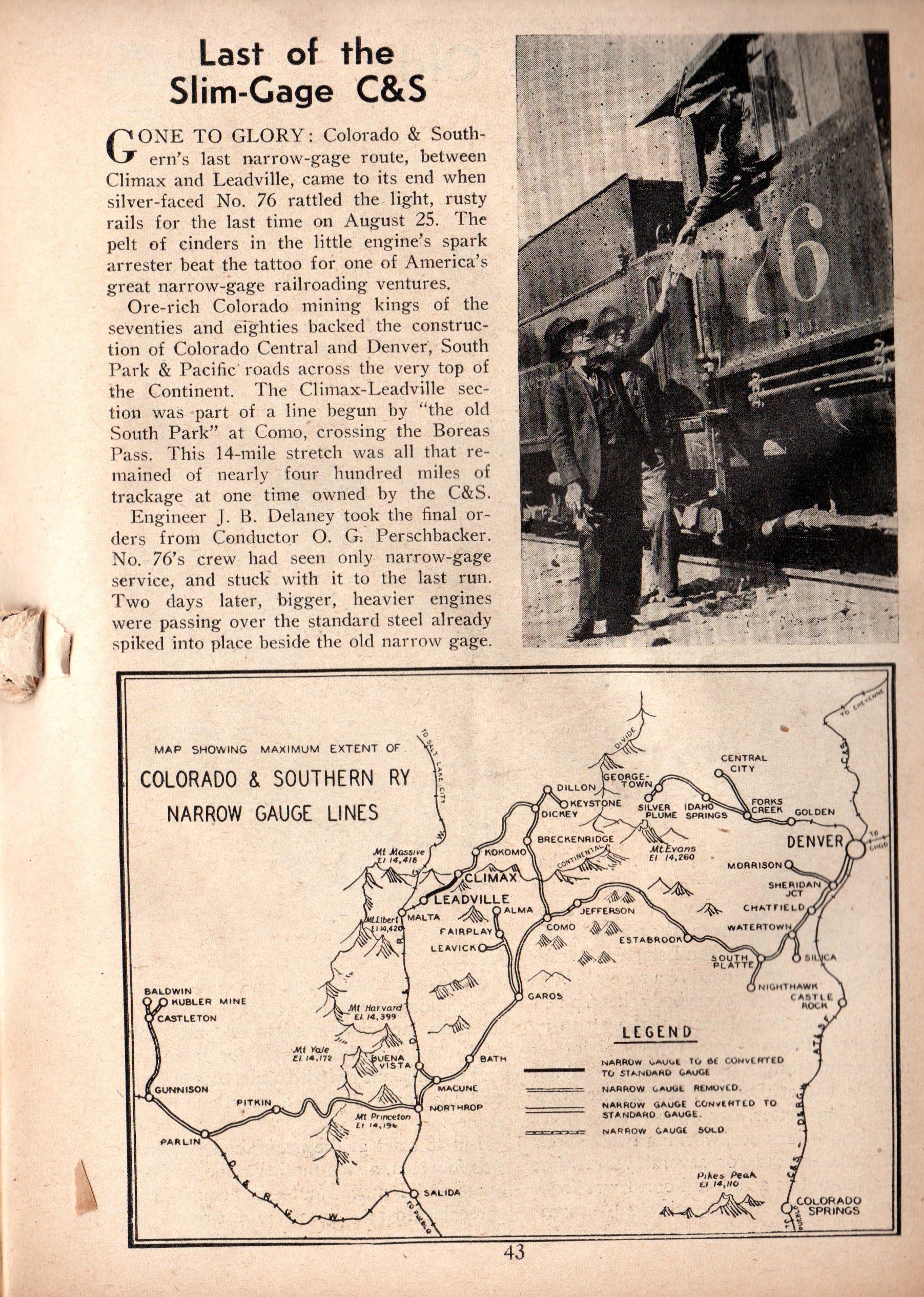
In the December 1943 edition of Railroad Magazine the publication reported the sad occasion of the final Colorado & Southern Railway narrow gauge run. Many of us are familiar with the well-publicized event (Even Life Magazine photographed it). I thought it was interesting to see an article from the time period itself. As the author wrote, on August 25th, 1943 the South Park Line had at last "Gone to Glory."
I wanted to bring attention to a great video called Excursion to the Thirties which includes a good stretch of C&S narrow gauge film footage.
I originally posted a clip from a Youtube channel that posted it. Later, I found out that the DVD is still commercially available. In light of this, I removed the video link.
The video is available for purchase at a number of sites including...
On August 11th, 1939 C&S 70 working in Idaho Springs.
C&S 69 running light past the Argo Mine
C&S 70 backing with a train of gondolas to Black Hawk
C&S 70 and train returning to Forks Creek
-you'll see the crew perform a flying switch with caboose 1003
-keep an eye out for the brakeman when he steps between the caboose and a rapidly approaching boxcar!
C&S 70 and train now eastbound heading for Golden
You'll see C&S 9 and 65 (with one as a midtrain helper) along with caboose 1003 traveling from Golden to Forks Creek on July 19, 1938. C&S 9 is now on display in Breckenridge.
Leadville Segment (1938)
Here you'll see...
the Leadville depot
the Leadville engine house
C&S 74 switching cars in the Leadville yards on July 6th, 1938 for the Molybdenum mine. The train then heads towards Climax with what appears to be caboose 1009. C&S engine 74 and caboose 1009 are both now at the Colorado Railroad Museum in Golden.
Boreas Pass Segment (1938)
Here you'll see..
C&S 71, 8 (dead), and 69 leave Breckenridge for Como on an equipment transport prior to abandonment. C&S 71 is now on display in Central City.
-Watch for two crew members riding the front of 71 apparently keeping an eye on the unmaintained track
C&S 73, westbound, with a scrap train traveling through Webster on July 19, 1938
The train climbing to the top of Kenosha Pass.
The train running through Kenosha summit. Track has been relaid at the summit near the site of the wye used to turn helpers.
Later in the day, the same train climbs eastbound up out of the South Park with 69 as helper
After reaching Kenosha summit, C&S 69 uncouples and backs up light to Como
A train on the South Park Line reached 11,250 feet again in 2023. The Leadville, Colorado & Southern Railroad, the highest adhesion railroad in North America, completed work this fall to allow its trains to reach this spot near Climax for the first time in six years.
The Leadville, Colorado & Southern Railroad operates on the original Denver South Park & Pacific grade that once stretched from Denver to Leadville, crossing three mountain passes, two of them over the Continental Divide. The railroad, eventually operated by the Colorado & Southern Ry., in time, sought to abandon all of its narrow gauge lines and succeeded in 1937 with one exception, a 14-mile stretch between Climax and Leadville needed to serve the Climax Molybdenum mine. Standard gauged in 1943, it ran until 1986, by then absorbed into the Burlington Northern Railroad. Purchased by Ken and Stephanie Olsen in 1987 and still a family-run business, the LC&S has operated a tourist train on the line continually since 1988.
The railroad owns the track to within a mile of the top of Fremont Pass, but the last few miles have been inaccessible for the last six years. Track from a segment known as Devils Tail Tangent at MP 140.4 had “slid down the hill over the years,” according to Sean McBride, an LC&S engineer. This necessitated the turnaround spot for their trains to be at MP 140 near the old French Gulch water tank. As an aside, the French Gulch Tank once served narrow gauge engines but was moved to the other side of the tracks after the line was widened. It still stands today.
Sliding track at Devils Tail Tangent-all photos Sean McBride
Work on Devils Tail Tangent. Climax in distance.
After track work
McBride explained to me that the crew lifted the track at Devils Tail, roughly six feet higher in at least one spot. After this, he says, “we did some profiling and surfacing between there and the end of the line.” The line ends in the center of what is known as Stork Curve. With this section refurbished, LC&S trains can now reach 11,250 feet, a height not accessible since 2017.
End of LC&S track at Stork Curve
Stork Curve. A mile ahead (east) of the caboose is Climax.
Stork Curve
Out of curiosity, I asked if the track remains from Stork Curve to the mine. McBride explained, “Technically the tracks do still reach Climax and are still in the ground on Climax property as I understand. We used to own to the front gate at the top of the pass but a few years after Climax reopened they bought back about a mile of r.o.w. from us, so that now the highest we can take the train is Stork Curve.”
C&S fans are thrilled with the rebuilt segments of the railroad such as the Georgetown Loop and the Como complex, but unlike those lines, tracks and trains have never left the ground between Leadville and Climax, and while they may be standard gauge, the LC&S has kept the South Park’s High Line alive nearly 130 years after tracks first conquered these mountains.
A wealth of railfan history exists in the archives of the Rocky Mountain Rail Report, the newsletter of the Rocky Mountain Railroad Club started in 1939. Here is some more miscellaneous South Park Line/C&S-related news from the 1978 editions.
1978
July
(High altitude car testing on Leadville-Climax branch)
GP 40X No. 90000 with EMD Test Car at Malta, Colorado prior to movement to Climax, Colorado for high altitude testing. After leaving Climax on the Leadville - Climax branch, the train passes French Gulch Tank. A remnant of the days of steam, the tank still holds water after all these years. February, 1978.
August
(Club to Walk the Argentine Central and Ride the Loop)
ROCKY MOUNTAIN RAILROAD CLUB DAY AT THE GEORGETOWN LOOP HISTORIC MINING AREA - Whether you wish to use your feet or your seat, Saturday, August 26 will be THE day to visit the Georgetown Loop Historic Mining Area, when the club will hike a portion of the Argentine Central Railroad bed and ride the rails of the Georgetown, Breckenridge and Leadville Railway.
We have made special arrangements for an all-day unlimited ride ticket on the GB&L. A full freight consist will be used, with the train departing Silver Plume on the hour from 10:00 A.M. to 5:00 P.M., and on the half-hour from the platform at the lower end of track. If all goes well, there will be steam powered double heading on several of the afternoon runs, with photo runs on the 4:00 P.M. and 5:00 P.M. trips. Your $5.00 ticket (regular one- ride fare is $3.50) or $2.50 child's ticket (ages 5-15 inclusive) will provide the holder with unlimited rides throughout the day. The railroad is now 2 ½ miles long, and has been extended almost to the abutment of the high bridge. The train does stop to let off and pick up passengers who desire to tour the Lebanon Mine, which just opened this year. $1.00 tickets for this tour may be obtained at the railroad's ticket offices or at the mine.
The other portion of the day's activities will consist of a hike from Silver Plume over the old roadbed of the Argentine Central Railway. When the railroad was constructed, the Argentine Central was the highest adhesion railroad in the U.S., climbing 16 miles to the top of Mt. McClellan (over 13,000 feet) on 6 percent grades and numerous switchbacks. Built in 1905 for freight and tourist service, the line gained national fame but never the¬ less, survived only until 1918. Our walk will leave Silver Plume, about 1/3 mile west of the Silver Plume depot on the south side of 1-70, at 9:00 A.M. Leading the group, will be Dan Abbott, Argentine Central enthusiast and author of the book STAIRWAY TO THE STARS. The hike is about a four-mile round trip over a roadbed that is in remarkably good condition, with no cross¬ country up-hill type hiking involved. Although the railroad has been gone for almost 60 years, an occasional spike or trace of a tie can still be found, several interesting mine loading structures still stand, and stone walls and a "terraced" 15-foot-high stone retaining wall in excellent condition can be seen.
Good walking shoes are recommended, of course, and a pair of binoculars might even come in handy on this leisurely hike. It will take about two hours to reach Pavilion Point, our destination high above Georgetown. There, hot foot and cold drinks will await our arrival as Ranniger's Roadbed Commissary will be in full operation next to the old stone chimney, and the last remnant of the Pavilion that was once situated there. After hearing and observing the train operating in the valley, one-thousand feet below, and engaging Jim's delectable Ballast burgers and accompaniments, everyone will then head back down grade for an afternoon of riding the GB&L. A charge of $3.00 per person for the hike will provide for a handout and map of the Argentine Central, as well as the hot lunch. We ask that you order your tickets in advance, or pick them up at the August meeting, so Ranniger's Roadbed Commissary can plan ahead and that we will have ample handouts. Railroad tickets ($5.00 adult, $2.50 child 5-15) need not be ordered in advance, but should be purchased at Silver Plume depot on August 26. Just mention that you would like a ticket for the Rocky Mountain Railroad Club Day.
We think this should be a real fun time, so come on up and take the walk, ride the train, or both. Bring the whole family. Friends and guests are welcome, of course. Any questions, call Darrell Arndt at 321-2723, till 11:00 P.M.
September
(Argentine Hike review and doubleheaders on the Loop)
GREAT WEATHER greeted the participants of the club's Argentine Central hike out of Silver Plume on August 26th. Led by Dan Abbott, the group negotiated some 2 1/2 miles of grades and switchbacks to reach Pavilion Point, where Ranniger's Roadbed Commissary was ready and waiting to do business. Plenty ofJ im's tasty Ballast burgers, home-cooked beans, chips, cookies and lemonade were provided to eliminate the hunger pains. Whether sitting under the trees, or out on the point where one could look down the valley on Silver Plume and the Georgetown Loop 1,000 feet below, the old stop on the railroad provided a very scenic spot to enjoy lunch. Upon return to Silver Plume, many took the opportunity for a ride on the Georgetown, Breckenridge and Leadville Railway, or several rides with the unlimited ride ticket. Doubleheading was done on a number of runs, with a photo run on the 5:00 P.M. trip. Don Smith and members of his German Band provided music on the train, much to the delight of the passengers. We would like to thank all those whose efforts and contributions made the day so enjoyable, especially Dan Abbott, Ranniger's Roadbed Commissary, Lindsey Ashby and his crews, Roy Altenbach, Centennial Publications, and Don Smith and friends!
October
(Dick Kindig shares slides of the C&S Clear Creek Line)
It was no surprise that Dick Kindig came through with a very interesting program of slides. We saw the Southern Pacific's famous narrow gauge operation in California, then the West Side Lumber Company while it was in operation. Of particular interest to those of us who never saw it intact were scenes of the C&S line in Clear Creek Canyon. Views included the Forks and at the High Bridge on the Georgetown Loop. Dismantling shots of the narrow gauge line were also shown. Rio Grande Southern selections included Lizard Head Pass, trestles and activity at the Ridgeway depot. The San Juan was quite a passenger run, and views of it along its route were well received. We certainly do thank Dick for sharing some of his photographic encounters with us. He provided memories for some, and an education for others who had not experienced first hand, a segment of the West's more colorful period of railroading.
November
(Mill Gulch Bridge in Platte Canyon Removed)
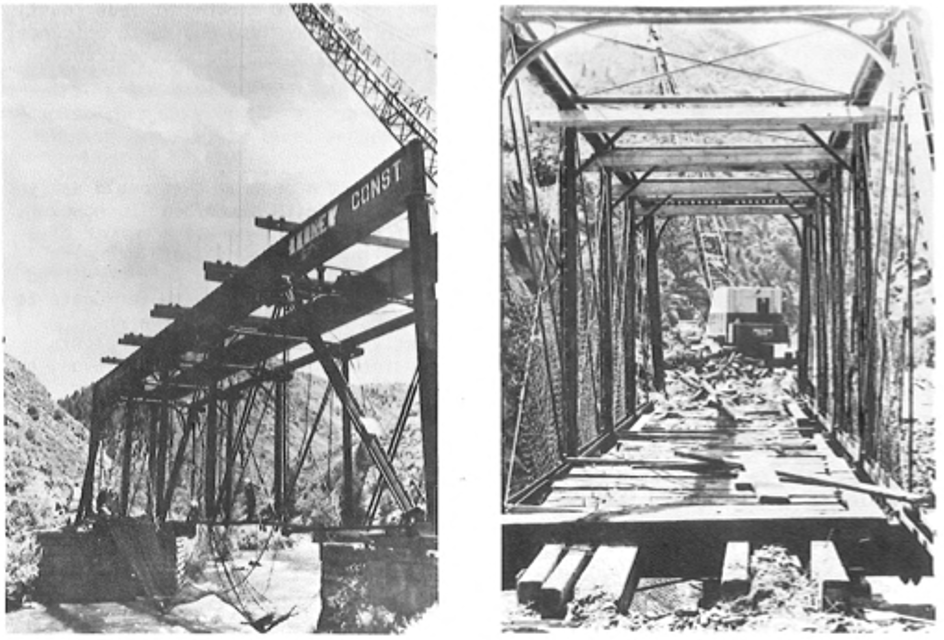
THIS WAS THE SCENE in the Platte Canyon this summer, when crews began to dismantle the Mill Gulch Bridge (or as it is now often referred to, the Keystone Bridge).
Mill Gulch Bridge in the process of removal. Photos from Rocky Mtn. Rail Report Nov. 1978
The Denver Water Department is in the process of widening the narrow gauge roadbed farther into the canyon, to permit access by heavy construction equipment, so the bridge had to be replaced. The large girders at the top were used to support the structure as it was carefully taken apart. They were then lowered onto the abutments to become the main supports for the new bridge. The old bridge is now in storage, and is to be given to the Forest Service, who has indicated it will be used near the Keystone Ski Area. The 10-mile long Platte Canyon was the only major canyon in the foothills near Denver, that had been available for hiking, biking, fishing, etc., with no competition from the automobile. It was closed to all public access this summer, and it may be years before it is open again. This bridge was a highlight on the club's Platte Canyon Bunion Pounder walk/ride trip last year.
(ed. Mill Gulch Bridge today)
(Calls to paint coach on display with C&S 74 in Boulder)
AFTER MANY YEARS of contending with the elements, the narrow gauge display in Boulder's Central Park is sorely in need of some attention in the way of paint. This year, the city decided to have the locomotive No. 30 painted, but the coach and caboose were left untouched. So the Boulder Historical Society has taken it upon itself to try and get the coach painted before bad weather sets in. It is in need of assistance, however, in the form of either time or money. Mike Rowe is the coordinator on the project, and will set up a work day in November, and would appreciate hearing from anyone who could spare just a little time on a yet-to-be-determined Saturday or Sunday to help get the job done.
When a date is set, he will then notify those interested. Paint will be provided, of course, and plans are to return the coach to a Pullman green color. Mike can be reached during the day, at the Boulder Historical Society, 449-3464, or at home in the evenings at 442-2164. The more who can help, the quicker it will go on this worthwhile project.
December
(Shay No. 8 comes to the Georgetown Loop)
COLORADO AND THE GEORGETOWN, BRECKENRIDGE & LEADVILLE RAILWAY gained another steam locomotive recently, with the arrival of ex-West Side Lumber Company's 3-foot gauge Shay Locomotive No. 8 at Silver Plume on October 12. The locomotive was trucked all the way from Banks, Oregon, and presented some challenging problems during the move, Parts had to be removed to get it down to a truck-able load, and it took several weeks to make the journey (and a truck with 11 axles and 66 tires!!). It is hoped to have it operational on the Georgetown Loop by the middle of next summer.
A wealth of railfan history exists in the archives of the Rocky Mountain Rail Report, the newsletter of the Rocky Mountain Railroad Club started in 1939. Here is some miscellaneous South Park Line/C&S-related news from the 1978 editions.
1978
Feb.
(C&S Denver shops)
THE OLD C&S SHOPS at 7th Street in Denver are being demolished. The brick structures date back to the turn of the century.
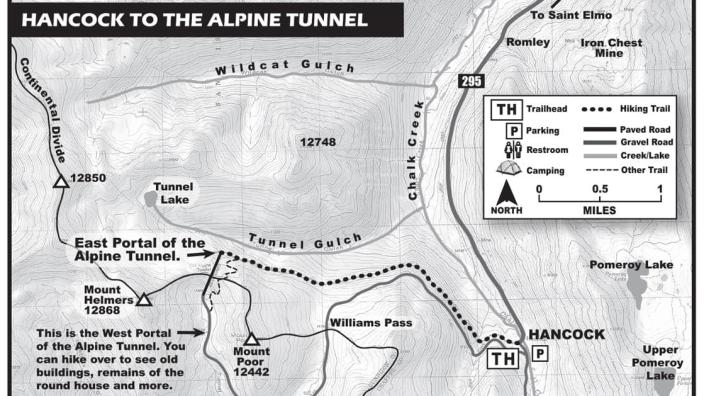
In recognition of the many years of labor, love and dedication to the preservation and documenting of the history of the Denver South Park & Pacific Railroad by Mac Poor and Dow Helmers, the United States Board of Geographic Names in Reston, Virginia has officially named two mountain peaks in the vicinity of the Alpine Tunnel in their honor. Mac and Dow were two of Colorado's most dedicated railroad historians, as well as fondly remembered club members.
Mount Poor
Both peaks are located 28 miles east-northeast of Gunnison in the Sawatch Range in Chaffee and Gunnison Counties, at one of the most historic rail crossings of the Continental Divide. Mt. Poor, named after Mac C. Poor (1902-1972), is 12,440 feet in elevation and has the Alpine Tunnel on its northwest slope. Mac authored the book DENVER SOUTH PARK & PACIFIC and co-authored the PICTORIAL SUPPLEMENT TO DENVER SOUTH PARK & PACIFIC, two of the most thoroughly researched, in-depth studies ever done on the railroad. His years of effort brought a part of Colorado's narrow gauge history into the reach of those of us who could not explore the DSP&P on our own, or who simply were not cognizant of the colorful rail history in the mountains west of Denver.
Mt. Helmers is named after Dow Helmers (1906-1976), and has an elevation of 12,858 feet. Alpine Tunnel is located on its northeast slope. Dow was, of course, an author and historian of the DSP&P, with his most popular work being HISTORIC ALPINE TUNNEL. He was an enthusiastic supporter for the preservation of the Gunnison region's rail history, and was a driving force in preserving what was left at the west portal of the Alpine Tunnel so that others could enjoy a part of the past.
The naming of these two peaks is rather an unusual event in that they had never been previously named. Most naming of peaks is usually the result of a change from one designation to another. These names became official on February 9, 1978. A great deal of thanks is due all who actively promoted this most appropriate form of recognition to these two individuals
[ed. Below are some views of Alpine Tunnel and Mount Poor and Mount Helmers]
.
(C&S Denver shops)
ONLY A MEMORY - Scattered debris and neatly stacked piles of salvaged bricks are all that remain where the main C&S shop building stood at 7th Street in Denver. Five stalls of the roundhouse remain, the building being used by a private industry.
June
PROGRAM NOTES:
"A DAY IN THE LIFE OF 641 and
"A C.&S.-G.W. EXCURSION"
For the June program, Ron Ruhoff will present two of his "Photo musical Adventures"that are sure to bring back many a fond memory. The movie, "A DAY IN THE LIFE OF 641" depicts steam locomotive No. 641 on its daily freight run over the Colorado & Southern Railroad from Leadville to Climax. This branch was one of the last regular steam operations in the U.S., and at an elevation of over two miles. The second program, "A C.&S.-G.W. EXCURSION," shows a Rocky Mountain Railroad Club excursion on freight-only lines north of Denver. A C.&S. steamer takes the train from Denver to Longmont, the Great Western 91 completes the journey over the sugar beet lines of northeastern Colorado.
Ron's reputation as a top photographer of the west, his long interests in railroads, and his talents at combining photos with music are well known and a clue to how fine the evening's entertainment should be!
[Ed. C&S 2-8-0 641 operated the formerly narrow gauge Climax to Leadville route until 1962. This was the last operating leg of the South Park Line, standard gauged in 1943]
July
As could have been predicted, Ron Ruhoff didn't disappoint a soul at the June meeting with his "double headed" 16 mm programs "A C&S-GW EXCURSION" and "A DAY IN THE LIFE OF 641." The full day's activities with a Rocky Mountain Railroad Club steam excursion north from Denver on the C&S and the GW was depicted from the moment the engine pulled out of the roundhouse in Denver until it disappeared into the twilight in an outstanding sunset scene at the end of the day. The sole C&S steam locomotive at Leadville was shown in the second program as it began its daily routine of making up a train in Leadville under a backdrop of snow-covered mountain peaks. With its consist assembled, the train climbed along the mountainside to Climax. After completing its chores at the highest point reached in the U.S. by an adhesion railroad, it turned around and returned to Leadville at the end of the same day. Both movies were accompanied by symphonic music, expertly coordinated to enhance the moods of the various sequences. Our thanks to Ron for presenting his record of some memorable Colorado railroad history.
A wealth of railfan history exists in the archives of the Rocky Mountain Rail Report, the newsletter of the Rocky Mountain Railroad Club started in 1939. Here is some more miscellaneous South Park Line/C&S-related news from the 1975 editions.
1975
Part 2
July
(First Bridge Complete on Georgetown Loop)
THE FIRST ANNUM, RAILFAN WEEKEND AT THE GEORGETOWN LOOP took place on Saturday and Sunday, June 21 and 22. Engine No. 44 operated with a five car freight and the diesel ran with two passenger cars throughout both days to offer a ride that has not been possible for many years. The track is completed down to the first crossing of the creek and preparations are well under way to lay rails across the second bridge. The depot at Silver Plume is on its foundation and SeeBees are working on the platforms. To hear the barking exhaust of the engine working up the grade and the steam whistle echoing through the valley was enough to even give camera lenses the goose bumps. Needless to say, the operation provided a very pleasant way to spend the weekend.
August
(Working Towards the Turntable Bridge on Georgetown Loop)
WORK IS CONTINUING ON THE GEORGETOWN LOOP PROJECT - Track is being layed in and cut between the two upper bridges and it is planned to have the turntable bridge approaches completed and track across it by the end of August. The railroad is offering limited service on the weekends for the present. The Silver Plume depot platform was also recently completed.
September
(Work at the Climax Molybdenum Mine)
A MAJOR STEP in the completion of the Henderson Project by Climax Molybdenum Co. took place on July 15, with the holing through of the 9.6 mile long Henderson Railroad Tunnel under the Continental Divide west of Berthoud Pass. The tunnel is said to be the third longest railroad tunnel in the world and will be used to transport molybdenum from a mine below Jones Pass to an ore processing mill in the Williams Fork Valley south of Parshall, Colorado. Total length of the double track, computer controlled, narrow gauge electric railroad is about 15 miles long. The tunnel begins at the mine which itself is located over 2,000 feet below the surface just west of the foot of Berthoud Pass. From there, the 30 car ore trains, each pulled by four 50-ton electric locomotives, will haul 42,000 tons of material to the mill each day. Molybdenum is used as a strengthening agent in the production of steel and makes possible the manufacturing of stainless steel.
(Ed. This is the mine that kept the final leg of the South Park narrow gauge running until August of 1943. The line was then standard gauged and the C&S was still operating this isolated branch between Climax and Leadville at the time of this newsletter)
The old Denver, South Park & Pacific depot at Bailey is no more. Around the first of June, the building was burned and bulldozed into dust. Attempt was made by several groups to save the building even though it was badly deteriorated, but the local fire department had other ideas.
(Alpine Tunnel Enginehouse Water Tank Collapses)
watertank remains (right) 2003
SLOWLY DISAPPEARING - The old water tank located in the corner of the engine house at the Alpine Tunnel collapsed into a pile of rubble last winter. The walls are still there, but the tank underframe is gone.
(Turntable Bridge Tested on Georgetown Loop)
IT'S GETTING THERE - The Georgetown Loop Historic Site is being prepared for the winter hibernation period. Most track work for this season is finished. Rails are now spiked down over the second (turntable) bridge. The bridge was "tested" by putting a locomotive on it, the diesel of course.
A wealth of railfan history exists in the archives of the Rocky Mountain Rail Report, the newsletter of the Rocky Mountain Railroad Club started in 1939. Here is some miscellaneous South Park Line/C&S-related news from the 1962 editions.
1962
March
(Argentine Central engineer)
Members of the Rocky Mountain Railroad Club were saddened to hear of the death, last month, of John Allen, 82, former conductor and engineer of the Argentine Central Railroad, the Shay-powered narrow-gauge line which operated out of Silver Plume. John Allen was always very obliging in giving interviews to members interested in this line, and we feel it was, indeed, a privilege to have been able to hear from him, first-hand, the story of this railroad. Too little do we realize how fortunate we are still to be able to listen to firemen and engineers who operated the engines during the "Golden Age of Steam".
May
(C&S Denver roundhouse)
In 1899 the Colorado & Southern Railway took possession of the Union Pacific, Denver & Gulf Railway and the Denver, Leadville & Gunnison Railway. As the C&S now had 148 locomotives, it is hard to believe they still had no shops of their own. To quote from the Annual Report to the Stockholders of the Colorado & Southern Railway Co, for the Fiscal Year ended June 30, 1900:
"The Company has had no general shops of its own, but thought it wise to continue the arrangement previously made by the Receiver for use of the Denver shops of the Union Pacific Railroad Company. Under the terms of the lease either company could cancel the same by giving nine month's notice. On December 26th, 1899, the Union Pacific Company having arranged a lease to The Pullman Company of the plant referred to, served notice upon this Company to vacate not later than January 1st, 1901. The erection of complete new general shops by this Company was thus made imperative, and construction was commenced in the spring of 1900. It is expected that the new plant will be ready for occupation by November 15th, 1900, and as it will be admirably located upon ground previously owned by the Company adjacent to the Denver freight yards, and not far from the freight station. Union Depot, and transfers to connecting lines, considerable economies in repairs and other operations are confidently expected. The amount appropriated by the Board of Directors for this work is $350,000.00, and while the necessity for this construction came at an inopportune time, so far as prices of material and machinery were concerned, yet it is a matter for congratulation that The Pullman Company is to inaugurate extensive work in Denver, and the return on this Company's new investment should prove very satisfactory on account of the saving in rental, as well as on account of the economy of modern machinery and favorably located buildings and tracks."
The construction mentioned above included provisions for a 40-stall roundhouse. And it is this very roundhouse which today is all but disappearing before our very eyes. Crews have been chopping away at it bit by bit these past few years until today there are only 5 stalls remaining. Not a very impressive monument to what was once a very extensive steam empire.
(Steam winds down in Leadville)
Colorado & Southern RR 2-8-0 #641 was the star of a recent television show which portrayed the trans-shipment of goods from Leadville to the Climax Molybdenum Mine.
C&S Road Foreman of Equipment (and staunch Club member) Mickey Hansen piloted the engine for the event. Plenty of work in the future for #641 was assured by the Climax Mines' recent announcement of a $20 Million development program. Unfortunately, how long the daily run of #641 will continue depends more on #641 herself--the old girl is just getting plumb wore-out. Fact is, the citizens of Leadville are already discussing where to set her this summer after she is retired-whether in a park or by the court house - sort of like putting up a tombstone before the patient is dead.
The Leadville-Climax run in the wintertime is anything but a "milk-run". The total snowfall of over 300" there this winter has left so much ice that derailments are not an infrequent occurrence. Just a few weeks ago #641 herself was on the ground for a couple of days. Routine switching by itself is a constant challenge at such altitude, due to the ice, snow, and frequent blizzards. Fighting derailments, in addition, really makes it tough.
(DSP&P Book-pricey!)
In view of recent publicity reporting sales of first edition ’’Denver, South Park and Pacific”, published by the Club in 1949, we believe it should be known that Denver area dealers in rare books are anxious to acquire copies. Anyone with a copy available can negotiate on standing offers in the neighborhood of $100 and up per copy, depending, of course, on condition - and bona fide inquiries are invited.
October
(The Last Run of C&S 641)
More unpleasant news – C&S 2-8-0 #641, which used to handle the Leadville-Climax run, has now been replaced by a diesel. Engine #828, an EMD 1750-HP SD-9, supplanted the 641, which made her last run September 12, 1962. Club member S. L. Logue of Leadville tells us that arrangements have been made to place the 641 on permanent exhibition on the east side of the C&S depot at Leadville, between 7th and 8th Streets, with dedication ceremonies tentatively set for October 8th.
Thus, Colorado soon will be without an operating standard-gauge steam engine, and we can be thankful we still have both the Rio Grande's narrow gauge and Bob Richardson's Golden City and San Juan #346 working under steam.
November
(Saving the Westall Monument)
Sixty-four years ago, on August 28, 1898, narrow gauge Denver, Leadville & Gunnison engine 195, with Billy Westall at the throttle, rounded a bend in South Platte Canyon just west of Dome Rock, plowed into a wash-in and overturned, fatally injuring Engineer Westall. For his heroism in staying with his train, the American Order of United Workmen erected a monument on the site of the accident on Labor Day, September 4, 1899.
The story behind this little known and sadly neglected historical marker has long been a mystery, even to people who live in the canyon, but this condition has now been remedied. On Saturday, October 20, 1962, five past officers of the Rocky Mountain Railroad Club devoted a day to the Westall Monument, accomplishing the following: A bronze tablet, prepared by and at the expense of one member of the group, was permanently attached to the base of the memorial. This plaque fully explains the events that occurred here and states that the tablet was placed by the Rocky Mountain Railroad Club. All joints in the rock memorial were carefully caulked; its foundation rock was restored where missing; a rock retaining wall was built along three sides and the area between this wall and the monument base filled with compacted earth and sodded; the entire area was cleaned up, weeds cut, papers burned and cans and other debris buried.
We hope that this good beginning will provoke a campaign to locate and mark historical railroad sites in our Rocky Mountains.
A wealth of railfan history exists in the archives of the Rocky Mountain Rail Report, the newsletter of the Rocky Mountain Railroad Club started in 1939. Here is some miscellaneous South Park Line/C&S-related news from the 1960-1961 editions.
1960
January
C&S 99201 at CO RR Museum, early 1990s
"Pictorial Supplement to Denver South Park & Pacific" is selling well, and the Book Treasurer Bryant McFadden reports that over 3000 copies had been sold early in February.
May
The regular monthly meeting of the Rocky Mountain Railroad Club will be held on Wednesday, June 8, 1960, at the Farmers Union Auditorium, East 16th and Sherman, Denver, at 8:00 P.M. We will see some of Otto Perry's interesting movies— some we have never seen before, including pictures of the Colorado & Southern standard gauge rotary on the Leadville-Climax line, photographed in action this year (Ed. This rotary, intended for use on the Alpine Tunnel route but found to be too heavy, was used on both narrow and standard gauge C&S lines, including Boreas Pass. 99201 was donated to the Colorado Railroad Museum by the C&S in 1972).
August
It is with pleasure that we can now announce the attainment of a goal toward which we began working some years ago—we have now paid the last of our obligations for our recent book, "Pictorial Supplement to Denver South Park & Pacific," by club members Kindig, Haley, and Poor. The three authors have agreed to donate all the profits from the sale of the remaining copies of this book to the treasury of the Rocky Mountain Railroad Club—an amount that will eventually add several thousand dollars to the club's funds. New members or others who are interested in obtaining a copy of this book may still secure copies from the club, at 2561 South Cook Street, Denver, 10, Colorado. Free brochures describing the book are also available at this address.
November
Our new book, "Pictorial Supplement to Denver South Park and Pacific" reached the break-even point by summer, and the remaining 300-odd copies will further improve the club's financial status as they are sold.
1961
January
If you are still thinking about obtaining a copy of "Pictorial Supplement to Denver, South Park and Pacific", you'd better get in motion. There are less than 300 copies available from the club.
February
Those of us who live around Denver have many times noticed the long lines of steam engines in the C&S yards, waiting to be scrapped. These engines have been photographed many times, and it was well known they weren't long for this world. Which they weren't. Only 3 engines (all CB&Q) remain in the scrap line — #4947, #4952, and #4994. All the rest have been sent to a scrap dealer in Houston, Texas. There were 18 in all, sent in 3 shipments with 6 locomotives in each shipment. The first shipment was sent between Christmas, 1960, and New Year's — the next shipment 3 weeks later — and the last shipment went the week of February 5, 1961. The C&S locomotives included in these shipments were:
#605 #804 #608 #805 #629 #806 #631 #807
#632 #808 (CB&Q 5509)
C&S SG 641 on display, early 1990s
#634 #809 #644
#647
#648
#904 #909 #914
This leaves only 2 C&S locomotives in usable condition in the vicinity; #638 and #641. #641 works the Leadville to Climax run, and #638 makes infrequent runs around Denver.
********
Not all Burlington engines wind up in the scrap line, however. Some of the old engines which escaped and are now on display are:
CB&Q #967 Built in 1899 — Minden, Nebraska (Pioneer Village)
C&S 71 1964
CB&Q #710 Built in 1909 — Lincoln, Nebraska (Pioneer Park)
CB&Q #3001 Built in 1930 — Ottumwa, Iowa (Ballingall Park)
C&S #9 Built in 1882 — Hill City, South Dakota
C&S #60 Built in 1886 — Idaho Springs, Colorado
C&S #71 Built in 1897 — Central City, Colorado
FW&D #304 Built in 1906 — Wichita Falls, Texas (City Park)
FW&D #501 Built in 1910 — Childress, Texas (Depot)
April
As a result of our recently receiving a number of requests for information concerning the Climax-Leadville run of the C&S, the following is offered to those desiring to view or photograph this standard-gauge operation! C&S 2-6-0 #641 is handling the run at the present time and will probably continue to do so for the remainder of 1961.
The runs from Leadville to Climax are usually made during the first parts of the week. The #641 is ready to go at 8:00 a.m., with the crew called for 8:00 a.m. Climax is reached by 11:30 a.m. Considerable switching is done here, after which the train returns to Leadville. (Ed. The Climax to Leadville stretch was the last remaining stretch of South Park/C&S narrow gauge, operating until August 1943 when it was standard gauged. The standard gauge branch was the last regularly scheduled steam operation by a Class 1 railroad in the US. The C&S dieselized the operation in 1962).
August
We are now about to close the sales book of the "Pictorial Supplement to Denver, South Park & Pacific". There are only about 60 copies remaining to be sold, out of the 4,000 printed, and orders are coming in every day.
C&S 1006 1960s
Colorado & Southern's narrow gauge caboose #1006, on display at Silver Plume, has been recently renovated. The C&S provided the materials, and a few devoted members of the NMRA provided the labor. The caboose was put up on rails, new doors and windows added, and the entire inside and outside was painted. (Ed. the caboose was put on display in 1941 near the Silver Plume depot where it sat on four pieces of wood. It appears to have been moved around a few times. When Mac Poor and Ed Haley visited the caboose in 1945, Poor described its condition this way: "There it sits on four crossties, forlorn and neglected, as if waiting for the inevitable end, which somehow seems close at hand." Thankfully, that was not the case and we are indebted to the various groups who re-rescued her throughout the years including today's Colorado & Southern Railway Society).