Showing posts with label C&S 71. Show all posts

Friday, December 20, 2024

C&S 71: Scrap Train to Casino

 In May of 2024 my our family took a road trip to Colorado. Our first goal was to pick up our oldest daughter who spent the year studying at Worldview at the Abbey, a biblical studies program. We decided to stay for nearly a month and enjoy the mountains and, of course, do a lot of C&S exploring.

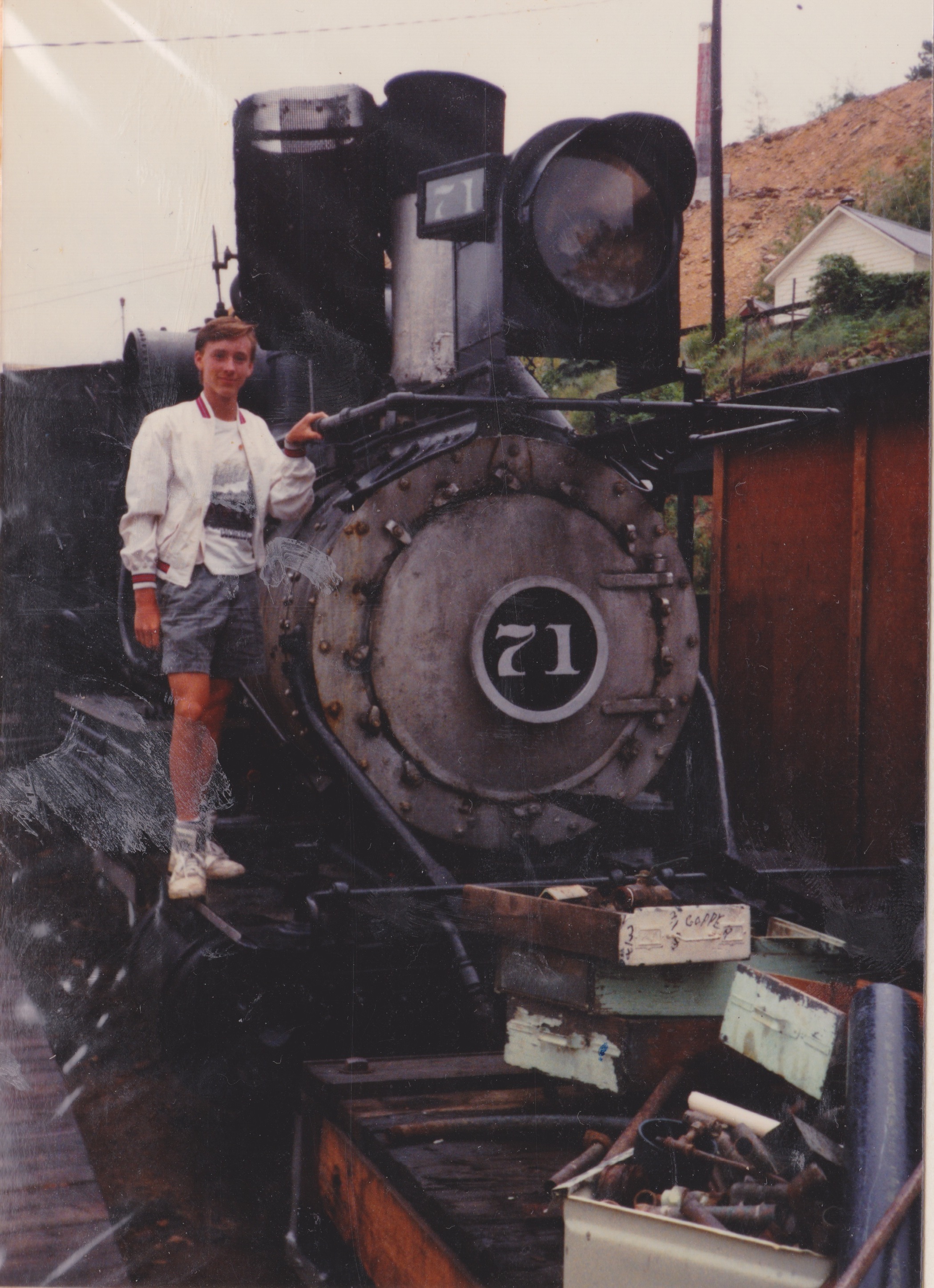
I hadn't been to Central City, home to C&S 71 and her train, since 1992. My first visit to No. 71 was in 1990 as a teenager. Our family had hoped to ride behind No. 71 as printed tourist guides at the time listed it as active (Here is a 1989 video showing her at work). Unfortunately, we arrived and only found this:


That is yours truly at age 14. I was happy to see No. 71, but disappointed that not a living soul was around and 71 was cold with a flatcar of junk on her prow. Our family returned in 1992 to find this:

I knew by this point that the tourist route that ran her was no longer in operation, but it was still sad and the engine was also in sad shape. Years later, through a lot of research I learned the story of the railroad's bankruptcy. The story of the Black Hawk and Central City Railroad will be included in my upcoming book (The book has been a long time in coming, but the publisher and I are nearing layout stage and working through captions and cover options now).

Despite visiting Colorado many times since 1992, I never made it back to Central City until this past May when I finally got to see 71's (and combine 20's) home since the late 1990s which you can see below.


There is a move afoot to resurrect the old twice-abandoned route of a Central City tourist railroad. They made big progress this year as can be seen below. There are also more recent updates on the project's website here. I have heard little else since that August 2024 update, so it's hard to know the status.


Sunday, November 10, 2024

Bill Raia C&S photo collection

 I found a site with a handful of nice C&S photos from Bill Raia's collection. There is a series of shots of C&S 71 pulling a train largely made up of gondolas through Clear Creek canyon in 1939. There is another of a wrecked engine, likely from Boreas Pass. There are also some excellent shots of former C&S No. 74 during its tenure on the Rio Grande Southern. Photos are available for purchase at Raia's SmugMug page.


Thursday, July 4, 2024

Happy 4th of July (37 years ago) in Central City

Happy Independence Day! 37 years ago today the Fourth of July of 1987 was the setting for the inaugural run of the Blackhawk and Central City Railroad. C&S 2-8-0 No. 71 was the star of the show, under steam and pulling passengers for the first time since 1941. The riders rode in C&S gondola 4319. It was a festive occasion, complete with dignitaries and people in period dress, to celebrate the values of our country and also the revival of a short stretch of railroad. Unfortunately, the line only lasted through the 1989 season. But for fans of the Colorado narrow gauge and the C&S specifically, it was an exciting, even if short-lived, new beginning.

The following article appeared in the Rocky Mountain Rail Report:


God bless America! Happy Independence Day!


Friday, June 7, 2024

Forks Creek today (video)

My family and I had a chance to visit the site of Forks Creek for the first time. The trails in Clear Creek have made access to some of these areas very helpful. We parked our car near highway tunnel 5 and hiked the path which begins on the grade. The grade shortly after the start once crossed Clear Creek (the abutments are still there). We followed the trail around until we reached Forks Creek.

Most photos of the area in railroad times were taken from the water tank side, but the path is on the opposite bank. The only recognizable shape from C&S days is the rock/mountain between the divisions of Clear Creek. Using this, I attempted to match up a 1939 Jackson Thode photo of C&S 71 and two gondolas on the wye. The photo can be found in Tom and Denise Klinger's amazing book, Clear Creek District Memories and Then Some.

Enjoy!

Kurt


Below is Forks Creek today. We are walking roughly around the area where the section house and bridge to the other side once stood.


Below is a map showing Forks Creek today. It overlays the RR grade (solid line) and today's walking path (the dotted line).


Saturday, February 24, 2024

Footage of the C&Sng in the 1930s

I wanted to bring attention to a great video called Excursion to the Thirties which includes a good stretch of C&S narrow gauge film footage.  


I originally posted a clip from a Youtube channel that posted it. Later, I found out that the DVD is still commercially available. In light of this, I removed the video link.

The video is available for purchase at a number of sites including...

Walthers

Railfan Depot

Trainfan Video Depot

In the video you'll see:

Clear Creek segment (1938 and 1939)

Here you'll see...

On August 11th, 1939 C&S 70 working in Idaho Springs.

C&S 69 running light past the Argo Mine

C&S 70 backing with a train of gondolas to Black Hawk

C&S 70 and train returning to Forks Creek

    -you'll see the crew perform a flying switch with caboose 1003

    -keep an eye out for the brakeman when he steps between the caboose and a rapidly approaching boxcar!

C&S 70 and train now eastbound heading for Golden

You'll see C&S 9 and 65 (with one as a midtrain helper) along with caboose 1003 traveling from Golden to Forks Creek on July 19, 1938. C&S 9 is now on display in Breckenridge. 

Leadville Segment (1938)

Here you'll see...

the Leadville depot

the Leadville engine house

C&S 74 switching cars in the Leadville yards on July 6th, 1938 for the Molybdenum mine. The train then heads towards Climax with what appears to be caboose 1009.  C&S engine 74 and caboose 1009 are both now at the Colorado Railroad Museum in Golden.

Boreas Pass Segment (1938)

Here you'll see..

C&S 71, 8 (dead), and 69 leave Breckenridge for Como on an equipment transport prior to abandonment. C&S 71 is now on display in Central City.

    -Watch for two crew members riding the front of 71 apparently keeping an eye on the unmaintained track

C&S 73, westbound, with a scrap train traveling through Webster on July 19, 1938

The train climbing to the top of Kenosha Pass. 

The train running through Kenosha summit. Track has been relaid at the summit near the site of the wye used to turn helpers.

Later in the day, the same train climbs eastbound up out of the South Park with 69 as helper

After reaching Kenosha summit, C&S 69 uncouples and backs up light to Como


Wednesday, October 18, 2023

The 5 Remaining C&S Locos - Update 9

  As my reading and research continues I want to continually update this article from its original form as published in The Bogies and the Loop.  Updates are in bold and underlined.   Thanks to recent research, this update includes new details related to C&S No. 9.

And Then There Were Five:

 The Stories of the Remaining Five C&S Locomotives 

By Kurt Maechner  

          On a cold winter morning in 1986 C&S 71 was hauled up onto a flatbed truck in Central City. The destination was the newly reconstructed portion of the Georgetown Loop route. The engine got away, but much to their surprise, when they tried to move the tender, they were met by a string of Central City residents barring its passage out of town. They gathered in protest like Greenpeace stopping a whaling ship. What is it about these little engines that pulled people out of bed to protect it? Why do we still haggle on internet groups about the fates of these relics of a bygone railroad? Perhaps they each say something about life, even about us. Maybe we can even learn from their stories.

         Five engines remain of the C&S from its roster of 69. Each has an intriguing story of how it outwitted the grim scrapper. These are their stories…and a little about what each says about life.


The Other 64 

    A vast majority of the C&S engines met the scrapper one way or another. 35 of the 69 were scrapped by the C&S itself. 29, though eventually scrapped, were sold or traded to various companies and lumber railroads including Morse Brothers, Hallack & Howard Lumber Company, Manistee & Luther R.R., Clarkson Saw Mill Company, B.G. Peters Salt & Lumber Company, Oak Grove & Georgetown R.R. Co., J.J. White Company, Ed Hines Lumber Company, and the Montrose Lumber Company. A few notable exchanges include C&S 55 that was sold to the Milwaukee Road and operated on their Bellevue & Cascade narrow gauge line. Number 64 was moved to Mexico to run for the Sosa & Garcia Company. Two engines (no. 69 & 70) went to the White Pass & Yukon Route in Alaska. Finally, two of the C&S’ last and largest engines, no. 75 and 76 were eventually purchased, and converted to standard gauge, by the Central Railway of Peru to be used for the Cerro de Pasco Copper Corp. There are several hearsay reports that one of the engines tumbled to the bottom of a canyon due to an unrecorded derailment. 

In 2017 I was contacted by Bob Whetham, author of In Search of the Narrow Gauge.  During
a trip to Peru in 1965 he stumbled upon what he and others believe to be the remains of either C&S 75 or 76 in a scrap yard in Huancayo.  He noted at the time that he "remember[ed] the canted cylinders which were very unusual."  His photo (right) shows the tender in the background and the boiler behind that tender (it is not the engine in the foreground). 

Mike Trent on the DSP&P forum commented, "I would state that I am quite certain, beyond a reasonable doubt, that this is #76's tender. I have spent quite a bit of time comparing this image to others of #76. This had a distinctive rivet pattern, and it seems to fit, right down to the bunker sides.  It seems likely that the boiler in the back is one of the two. The only other photo I have ever seen shows a boiler complete with piston valves with the steam dome cover removed in what appears to be a different location than this one. The boilers would be harder to distinguish....But I'm going to get on board that this is #76's tender."

Presumably, it was eventually scrapped completely at a later date.

     And then there were five.


71: All Roads Lead to Home  

       Do all roads really lead to Rome? In real life, all roads lead to home. In all its small positive and negative nuances, our home affects us more than any other influence in life. Whether we love it or have run from it, it must be reckoned with. One C&S loco was adopted by a town, and despite unsuccessful efforts to remove it, and successful efforts to abuse it, it remains affectionately at its adopted home.

       When the railroad finally received permission to abandon the South Park in 1937, the C&S, finding no buyers in 1938 for their surplus locomotives, began the process of scrapping them.  This began in 1938 with No. 5 and one month later consumed 65 and 58.  

     There was an attempt at saving at least one engine for posterity.  The railroad made an offer to any town along its line: A free narrow gauge locomotive to stuff and mount. This would have been engine 6.  Despite the number of people who protested the abandonment of the line, not a single town along its remaining rails took them up on the offer.  A memo to the Superintendent of Motive Power stated that "the scrapping of 6 narrow gauge engines, one of which we asked you to hold up anticipating that we could use the engine for historical purposes.  We now find that none of the towns is agreeable to accepting this engine.  You may therefore scrap engine 6."

     However, by 1941, one town (and eventually Idaho Springs), Central City, who had lost its railroad connection 10 years earlier, changed its mind and said yes, though it had to fight the management of the Burlington Route (now owner of the C&S) for many months to get it at this point.  By this time the Q didn't want to give away any assets, even if it was scrap value. Engine 71, that had the unfortunate privilege of being used on many scrapping operations on the line, was chosen. Along with gondola 4319 and combination car 20, it was taken to the end of track at Black Hawk in April of 1941. It was then hauled by truck and found a home on exhibit near the site of the Central City depot.

     There it would remain for a little over 45 years.


   She did receive some attention over the years.  During the 1950's or 1960's, the CB&Q sent someone along to spiff up the paint and, in the process, added the Burlington herald to the whole train.  A fence was also added to keep vandals out.  Rick Steele comments in the Narrow Gauge Forum that he scraped and repainted the engine and No. 20 back to the original C&S markings in 1970.

       Puffs of steam would return to the air in Central City, however, in 1968 as the Colorado Central Narrow Gauge tourist railroad laid track to Packard Gulch. They ran trains with two Central American locomotives. This group, along with the locos and rolling stock, eventually moved to take over operation of trains on the Georgetown Loop project in 1973. The Colorado Historical Society (CHS), who owned the track, had the idea of also taking 71 to Silver Plume to restore it and run it on the Loop. The engine was indeed taken to Silver Plume in 1986 which lead to much consternation in Central City. A town newspaper referred to the situation as the “Great Train Robbery.” When the CHS then tried to move the tender, this is when some city residents came out to stop it. Their town had requested the locomotive and they wanted to keep it. Following this incident, the engine was promptly returned home...sort of.

   For reasons I have yet to determine, around this time, instead of returning the engine to its display site in Central City, it was placed on display, along with the rest of its train, on a new stretch of rail in Black Hawk.  During the winter of 1987, a trucker by the name of Steve Clifford, who related his story in The Bogies and the Loop, happened to pass through Black Hawk when he noticed "a flimsy make-shift shed constructed over locomotive No. 71 and its tender."  This chance encounter led him to find out just what was going on (and also to him receiving a bid to transport the train on his truck back to Central City).


     Something was indeed going on.  Steam rose again from the bear trap stack of 71 from 1987 to 1990. Another organization stepped in to run the Central City line, this time named The Blackhawk and Central City Narrow Gauge Railroad, and No. 71 was their star. There is a lot of discussion on the efficacy of the running of the locomotive in these years. That being said, she did live again, if even for a brief moment of relived
history. The group certainly had big goals. A tourist guide from 1988 states the railroad as planning “to reach Blackhawk in the next five years.” This, unfortunately, was not to happen. The railroad folded and 71 sat again, still, with her gondola and combine until she was moved once again. 
  The Narrow Gauge Discussion forum states that at some point the land where the train had previously been displayed was sold, and so the train, minus the gondola, was transferred to the Couer d'Alene Mine on the opposite side of the valley in the early 1990s.  By 1996 a chain link fence had been erected around the engine .


Casinos came to the City of Central in 1991 and she was eventually placed high up with the combine on a display track by Grand Z Casino and Hotel. The gondola sits in a park near Eureka Street. There’s much consternation over her most recent appointment, but, let’s face it, she’s at least at home.


74: Being left behind may be a part of the plan 

     We are all prone to asking, “What might have happened if…” Regret and longing make us wonder if we had not been left behind by some person, job, or opportunity, would we have found what we really wanted? Then again, maybe being left behind was part of the plan, a far greater plan than our own. 74 may have wondered this as it sat lonely at Morse Bros. Machinery in 1948.

     World War II either saved or destroyed many an engine. Many of the unemployed locos were scrapped for the war effort. Others were used where needed. C&S 74 had the privilege of working with two sister engines on the last remaining narrow gauge portion of the railroad between Leadville and Climax. Molybdenum was a hot commodity in the war effort and Climax had a lot. So much, in fact, that they needed to standard gauge the line, which they did in 1943. Numbers 74, 75, and 76 were then placed on flatcars and shipped to Denver. They were sold to Morse Bros. Machinery and sat on their property for three years. That’s when a Peruvian railroad came looking for some narrow gauge motive power. They took 75 and 76. 74 was left behind to wallow away alone. Left behind.

     Two years later, though, another life awaited 74. In 1948, the Rio Grande Southern was wheezing out its last breaths. The Galloping Geese had bought it a few more years, but the light was fading. The Rocky Mountain Railroad Club knew their chance to see and ride the line was dwindling. They wanted to plan as many excursions as possible. When the club approached the RGS receiver about this, he remarked that it was too costly to lease a D&RGW engine to haul their trains. The Club countered by suggesting that they buy a locomotive. For whatever reason, they took the bait and purchased 74.

     One member of that railroad club was a man named Dr. John B. Schoolland. He was very interested in the Colorado & Northwestern Railroad which ran through his resident town of Boulder and discovered that 74 had started its career on that very railroad. Recognizing that the RGS was near its terminus, he set out to save the engine so it could be displayed in Boulder. The city’s community started various fundraisers that eventually ‘bought’ 74 and had her shipped via rail. 74 returned home in August of 1952 and was placed in Central Park along with a D&RGW coach and RGS caboose.

  The years were not kind as neglect and vandalism set in. Various community members and students worked to touch up the engine off and on. Unfortunately, the RGS caboose was destroyed via a student prank using dynamite and was replaced with a Rio Grande caboose. In 1979 the Boulder Model Railroad Club committed to taking care of the site. 

74 and her train were eventually moved a bit to a new curved track.  Mike Trent on the Rio Grande Southern Technical Page wrote, "In February 1982, the train was moved about 40 feet north of its original location to allow improvements to be made in the park and because the track under the train had deteriorated badly. Almost all ties under the engine were completely rotted away, and the weight of the locomotive had caused her to settle about three to four inches. The BMRC volunteers were called upon to help, and they did, in a big way. Rail was located and donated with the help of the Georgetown Loop Railroad and State Historical Society. The City of Boulder bought brand new ties, and the volunteers, along with some willing professional help, laid a curved section of track for the train's new home. Dr. Schoolland was present to help drive the 'Golden Spike.'"  For a few months after the move the engine was dressed up in C&S livery and even sported a fabricated Bear Trap stack before being returned to its original look as C&N #30.

In the early 2000s the Colorado Historical Society shipped it to a company to see if the engine could be restored for use on the Georgetown Loop Railroad. This was decided against, but 74 was cosmetically restored by the West Side Locomotive Company of Denver and returned to Boulder.  In 2012, she was leased to the Colorado Railroad Museum in Golden where she resides today.  Who could have guessed that being left behind in 1948 would have saved her for our enjoyment today?


9: Sometimes reinventing yourself opens new doors.  

     Most of us like to stay on the rails marked out for us. With change comes friction and we like to avoid it at all costs. But complacency can also destroy us. Some of us learn that to find life anew we must reinvent ourselves in some way: physically, occupationally, or spiritually. Sometimes that reinvention comes whether we like it or not. This is the story of little number 9, a mogul that has lived more lives than any other C&S engine.

     If ever there was controversy surrounding a C&S locomotive, number 9 takes the cake. Built by Cooke in 1884, the loco started out on the South Park Line. She had the honor of pulling the last scheduled passenger train from Denver to Leadville in 1937. She spent two more years on the Clear Creek line and South Platte branch, but an opportunity in 1939 put the engine out of the scrapper’s hand. From 1939 to 1940 New York hosted the World’s Fair. Many railroads sent representative trains. The Chicago, Burlington, & Quincy, which now owned the C&S, planned on sending one of their Cooke moguls as a narrow gauge representative.  Engines 5, 6, 8, or 9 were the options.  They settled on No. 6, leaving the others to be scrapped.  However, according to Narrow Gauge to Central and Silver Plume, "the suggestion was made that the 9 was in better shape and might well be used instead--which was in fact done."

   According to The Mineral Belt Vol. 2, "C&S 2-6-0 Number 9, Railway express and RPO car 13, and coach 76 were put on exhibit in Denver before being moved to the New York World's Fair in 1939.  Number 9 had just been run through the backshop and coaches were resplendent in new paint.  The 2-6-0 was the only engine of this wheel arrangement saved from scrapping."

     Evading the torch by inches, number 9 then was sent along with her two cars to the World's Fair. CB&Q then kept the little train in storage at their Aurora, Illinois shops until 1948 when Chicago held its railroad fair. The engine and her coaches were leased to the fair to be run as a quaint old time western train. Painted for the defunct Deadwood Central (which, incidentally, according to The Mineral Belt Vol. 1 was the railroad from which CB&Q 537 came from), labeled “Chief Crazy Horse”, and sporting a hack false balloon stack, the engine chugged around a small track pulling visitors.
     She was again stored until the Burlington loaned the engine and 3 cars in 1956 to the tourist hauler Black Hills Central in South Dakota.  According to the July 1956 edition of Narrow Gauge News, the line planned to use ex-White Pass & Yukon No. 69 for power, and intended No. 9 for standby power. The line simply put the engine on display. I have read in a few spots that some believe the engine was pulled
behind another engine and made to look operational by burning tires in the boiler.  Jason Midyette, author of a book on No. 9, pointed out that a 1912 law in South Dakota forbid the use of coal-burning locomotives anyway.  Since No. 9 was intended for backup use, maybe the Black Hills hoped to someday convert it to burn oil?

     Twenty-four years later, in 1981, the Colorado & Southern was finally absorbed into the Burlington Northern and the controversy began. By 1986 BN and the Black Hills Central entered a legal fight over the ownership of the mogul. The end result was that BN decided to send it home by giving it to the Colorado Historical Society. They had it stored on Morningstar siding near Silver Plume on the Georgetown Loop RR. It was relettered on one side in alignment with C&S days, though it still retained a red cab for some time. Its greatest surprise was yet to come.

     When the CHS, who owned the GLRR trackage, and the folks who owned and operated the railroad  reached an impasse in negotiations, a major debacle resulted. The end result was that the operator took all of the rolling stock and locos off the property and moved or donated them elsewhere. Still wanting to operate the railroad, the CHS, hunted for a new operator. However, they had no locomotives…except number 9. Both 74 and 9 were shipped away to check the feasibility of restoring one of them to operation. It was determined that number 9, using 74’s tender would be the best bet. In 2006 Uhrich Locomotive Works completed work on number 9 and sent her back to the Loop. It was an exciting day, yet, retained a bitter end.


     There was already an uproar over the changing of GLRR operators, but the furor was somewhat tempered by the excitement of seeing a real C&S loco run again. When number 9 was pulled out of service due to mechanical problems before the end of the season in 2006, many people’s anger erupted. Regardless of opinions on all sides of the issue, number 9 was traded to the town of Breckenridge. They had an old Sundown and Southern locomotive at their Rotary Snowplow Park. This engine seems to have had more promise to have the power to pull trains on the Loop and is being refurbished.
     The trade originally required that number 9 had to be operated. There were plans to build a short section of track in Breckenridge and run the loco off of compressed air. This has all changed and, after an impressive cosmetic makeover at Mammoth Locomotive Works, the engine was put on display in December 2010 between a rotary and a C&S boxcar at what is called Highline Railroad Park. Reinvented once again.


31: Age Matters 

     Popular culture (read: those trying to make money) bombard us with a belief that whatever is young and new is better. It wasn’t that long ago, however, when age was venerated, when being older made your opinion and insight valuable to others. Today, it seems, all it takes is being young, trendy, and having the ability make a hit song. C&S 31 comes from the former era and it holds a title: the oldest locomotive in Colorado; and that counts for something.

     C&S 31's story is not as storied as her other surviving companions, but it contains its curiosities just as well.  In the words of Jason Midyette who chronicled her story in The Bogies and the Loop, her "survival was more a result of random chance than any actual plan; had the C&S kept it, it would have been rebuilt and modernized (and ultimately scrapped) and had the locomotive been in better shape, it might not have been set aside for display in 1932."  

    Built in 1880, C&S 31 began its career as number 51 on the South Park Line. It later joined the Denver, Leadville, & Gunnison as 191 and finally the C&S as number 31 (though it was never renumbered in actuality). It served for 22 years on those lines until it was sold for $2000 in April 1899 (or 1902-sources vary), a year after the creation of the C&S, to the Edward Hines Lumber Company in Wisconsin and run as Washburn & Northwestern #7. In 1905 it was sold to the Robbins Lumber Co. in Rhinelander, which was bought in 1919 by the Thunder Lake Lumber Co. As a side note, one source said that the cautious owner of the line thought it was too heavy to be used unless the ground was frozen. Midyette states that "By 1932, No. 191 was completely worn out and seldom used."  It was retired that year and placed on display at Wisconsin's Rhinelander Logging Museum, next to the paper mill in town, moving there under its own power for the last time.  It was later moved to Rhinelander's Pioneer Park.  The engine remained on display for a little over four decades.


    The locomotive's time at Rhinelander was not kind.  The museum at the time pursued a philosophy that the more access the public has to history, the more likely they are to feel connected to it.  Consequently, the engine was fully accessible and climbable.  As a result, many parts went missing and the loco's condition diminished.
     
    At the beginning of the 1970's, Cornelius Hauck, co-founder with Bob Richardson of the Colorado Railroad Museum, learned of the existence of 191 and contacted the Rhinelander museum.  The logging museum was open to 191 moving to Colorado if a fitting replacement locomotive could be found for them.   Hauck discovered a Mexican railroad that owned a former Thunder Lake Lumber Co. engine was closing down.  This engine wasn't a trade or later purchase for the Wisconsin line, like 191, but was actually built new in 1925 specifically for the Wisconsin logger.  Hauck convinced the Rhinelander Museum to accept his offer that if he could get this engine to them, they would give him No. 31/191.
  
    Finally, in February 1973, Bob Richardson made the trek to Mexico to orchestrate the move of the Thunder Lake engine to Wisconsin and then oversaw the move of 191 from the Rhinelander museum onto a railcar for its move back home to Colorado. 

   Now back in her home state she was restored to her appearance as Denver, Leadville & Gunnison 191, including cutting back her smokebox to its length while on the South Park.  One very unique aspect of 51/191/31 is that, as stated in The Bogies and the Loop, she "received little in the way of updates and has remained a remarkably original example of an 1880's narrow gauge freight locomotive."  In addition to its authenticity, it is believed to be the oldest surviving locomotive in the state at over 130 years old.  One more curiosity to South Park fans is that the link and pin coupler installed on the pilot of 191 by the Colorado Railroad Museum was found along the grade to Alpine Tunnel, likely there as a result of some distant wreck.  In 2009 the engine received an entire cosmetic make-over at CRRM and has been proudly displayed on numerous publicity materials related to the museum. For at least a few of us, yes, age matters.

 60: Stay ready for work 'til the end.  

     For those who relish the goal to eat, drink, and be merry, life’s twilight years hold little promise. But for those who believe their lives hold a greater purpose, one that outshines occupation, we want to stay ready for work, whatever divine work this might be.  One of the five C&S survivors did just that.

     C&S 60 began her life on the Utah & Northern in 1886. She eventually joined the DL&G and ultimately the Colorado & Southern. A story concerning her latter days suggests that the engine was being used to scrap the remainder of the Clear Creek line in 1941 when, well, she just broke down in the town of Idaho Springs where the loco was subsequently donated to the city for display.  

     The "break down" story, however, is likely a myth.  The Colorado & Southern Railway Society, a historical preservation group that has taken on the mantel of caring for No. 60 and her coach, have studied the engine's service records at the Colorado Railroad Museum and there found evidence to discredit such a story.  

     Their research reports, "The C&S mileage records for 60 show she received a complete overhaul in April of 1936. She ran for a year till mid 1937 when she was stored serviceable in Leadville from mid 1937-January 1939.  The records contain monthly inspection sheets filled out for every month of her layup and which state she was stored serviceable in Leadville."

     There the diminutive consolidation lived out her remaining years ready to do the work she was born to do.  In fact, she had the chance to do just that one more time when in the early winter of 1939 she again plied the rails for 6 months.  She was stored again in June, but this time, as she awaited another fire in her belly, the mileage record demonstrates that it was not to happen again.

     The C&S Ry. Society, consequently concludes that "all of our research seems to support that the idea of the breakdown is a myth."  They theorize that "the story of the 'breakdown' seems to come from having one of her eccentric links disconnected.  We haven't determined why that is or when it was done.  However, from the records, and from physical inspection this far, 60 appears to be in excellent mechanical condition with only mild wear from her service time."

     In 1938 the C&S offered towns along its line a locomotive for display purposes.  No one took the bait.  Yet, a 1941 article in the Clear Creek Mining Journal calls No. 60 in Idaho Springs a "gift."  There is a bit of a complication in this gift, though.  Apparently, Clear Creek County argued, as long ago as 1936, that the railway had not paid a tax debt.  In 1941 the county accepted the locomotive as a settlement for this dispute.  Curiously, the town specified in the agreement that they wanted No. 60 to wear a snowplow.

     On Tuesday, May 13th, scrapper Rube Morris hauled the engine and a coach (no. 70) to Idaho Springs using engine 69.  The engine and her small train were on display on a small strip of land between Miner Street and Colorado Blvd.  At some point a log-cabin styled gift shop was built next to the train.  Some have referenced that the gift shop owner sometimes burned old tires in the boiler to simulate steam in order to garner customers.

   As in the case of engine 71 in Central City, it appears that the Chicago, Burlington, & Quincy Railroad sent a crew to spiff up the engines in the 1950s or 1960s and consequently repainted the engine with the Burlington herald on the tender and "C&S" under a smaller engine number on the cab.  When the paint scheme was returned to the original, as it is today, is unclear.

     Using temporary track, the train was moved forward on March 14, 1987 into what is now Harold A. Anderson Park, the spot where a few year earlier, an old school house was moved as well which serves today as Idaho Springs' city hall.  This is where she is today.  In the summer of 2015 the C&S Ry. Society completely needle scaled and repainted 60's smokebox with a graphite based paint mix to reflect its appearance while in operation.  They also added coal boards to the tender.


     In the early 2000s number 60 also was taken into consideration for operation on the Georgetown Loop.  Jason Midyette, one of the directors of the South Park Rail Society, explained that, "CHS (now History Colorado) did approach Idaho Springs in 2004 about using No. 60 on the Loop and Idaho Springs was seemingly favorable to the idea. In further discussions, it was brought to everyone's attention that 60 was the only surviving C&S narrow gauge locomotive that was completely original and essentially untouched from its days on the C&S. As returning it to operation would entail changes and replacement parts, a case was made that 60 should be preserved as a record of C&S practices which would be irrevocably lost if the locomotive was operated on the Loop. CHS and Idaho Springs decided that the locomotive should be preserved and it was no longer considered for operation.  
     Today number 60, with her coach, still sits proudly on the track looking ahead down the former right-of-way on Idaho Street.

     History has led these five locomotives down a trail as serpentine as the grades they once climbed. Where will history take us? It might, like 71, take us back where we came from. We might find ourselves left behind like 74, but it could turn out better than we expect. Maybe we’ll find ourselves in a situation that requires us to reinvent ourselves like number 9. For those of us who’ve earned our keep, we may need to remember that age matters like C&S 31. Yet, no matter what life brings our way, no matter when we might finally drop off the serviceable list like number 60, there’s a calling to keep doing the work we were created to do until we change trains at that great Union Depot that awaits us all.


References

Big Train Tours: Denver, Leadville & Gunnison No. 191 - Colorado's Oldest Locomotive.  Retrieved from https://www.youtube.com/watch?v=ct-Fzv-HPqs 

Bodiecalifornia.  (2010, 29 Nov.). C&S 9 – Where Is It Now?  Message posted to http://ngdiscussion.net/phorum/read.php?1,174896.

(n.d.) C&S Narrow Gauge Locomotive Data Retrieved from http://narrowgauge.homestead.com/.

“Central City’s Colorado & Southern Railroad.” (1990, Summer). Colorado Yesterday & Today: A Magazine of Adventures, 13.

Clifford, Steve. (October 2017). "Hauling C&S No. 71." The Bogies and the Loop, 9-15.

"Colorado & Northwestern #30" RGUSRAIL. Retrieved from http://www.rgusrail.com/cocrm.html

Colorado Steam. (1999-2010). Retrieved from http://www.steamlocomotive.com/colorado/.

Correspondence with the Colorado & Southern Railway Society via their Facebook page.  

Fritz, B. (2001). Surviving Steam Locomotives in Colorado.  Retrieved from http://wasteam.railfan.net/.

Griswold, P.R., Kindig, R.H., & Trombly, C. (1988). Georgetown and the Loop.  Denver: The Rocky Mountain Railroad Club.

Griswold, P.R. (1988). Railroads of Colorado: Colorado Traveler Guidebooks.  Frederick: Renaissance House Publication.

--> A Guide to the Exhibits at the Colorado Railroad Museum.  (2011). Retrieved from   www.coloradorailroadmuseum.org.

Hauck, Cornelius W.  Narrow Gauge to Central and Silver Plume.  Colorado Rail Annual no. 10. Colorado Railroad Museum, Golden 1972. 

History. (2011). Retrieved from www.coloradorailroadmuseum.org.

Jensen, Robert, F. Hol Wagner Jr., and Robert LaMassena. "Denver, Leadville, and Gunnison 2-8-0 No. 191." Colorado Railroad Museum Equipment Data Sheet No. 15.  Colorado Railroad Museum, 2010.  

Klinger, Tom and Denise.  C&S Clear Creek Memories and Then Some. 

Larson, Kurt.  "Washburn Northwestern Railroad." www.battleaxcamp.tripod.com. 2008.

Loop Communication Committee.  (2005, 27 April).  Meeting Minutes. Retrieved from www.savethetrain.org. 

Midyette, Jason. (2014). Colorado & Southern No. 9: One Short Season. The Ill-Fated Return to Service of a Narrow Gauge Locomotive. South Platte Press.

Midyette, Jason. (January 2018). "Sole Survivor: the last DSP&P locomotive."  The Bogies and the Loop, 9-13.

Midyette, Jason. Correspondence via email February 2020 concerning the Georgetown Loop's interest in C&S 60 in 2004.

Digerness, David S. (1977).  The Mineral Belt Vol. 1 Old South Park - Denver to Leadville - An Illustrated History, Featuring the Denver, South Park & Pacific Railroad, and the Gold-and-Silver Mining Industry. Sundance Books.

Digerness, David S. (1978).  The Mineral Belt Vol. 2 - Old South Park - Across the Great Divide.  Sundance Books.

Narrow Gauge Discussion Forum

National & State Registers. (1999-2010). Retrieved from www.ColoradoHistory.org. 

Pictorial Supplement to Denver South Park & Pacific: Abridged Edition.  (1986). Lakewood: Trowbridge Press.

Poor, M.C. (1976). Denver South Park & Pacific: Memorial Edition.  Denver: Rocky Mountain Railroad Club.

Rhinelander Logging Museum Complex. (2010). Retrieved from http://www.rhinelanderchamber.com/.

Richardson, Robert W.  Robert W. Richardson's Narrow Gauge News. Colorado Rail Annual No. 21

Ross, D. (2009). Colorado & Southern RR Steam Locomotives.  Retrieved from http://donsdepot.donrossgroup.net/.

Ross, D. (2009). Thunder Lake Lumber Co. Robbins RR.  Retrieved from http://donsdepot.donrossgroup.net/.

Schoppe, B. (2011, January). Greetings from the President. The Bogies and The Loop, 22.

Shreiner, T. (2009, 20 July). C&S 71 Video.  Message posted to http://groups.yahoo.com/group/DenverSouthPark/. 

Trent, M. (2011). Engine No. 74 – Back Home Again (1952-present). Retrieved from http://www.riograndesouthern.com/RGSTechPages/_bdwhite/index.htm Page.

Trent, M. (2011). Engine No. 74 – The Colorado & Southern Years (1921-1945). Retrieved from http://www.riograndesouthern.com/RGSTechPages/_bdwhite/index.htm Page.

Trent, M. (2011). Engine No. 74 – The Rio Grande Southern Years (1948-1952). Retrieved from http://www.riograndesouthern.com/RGSTechPages/_bdwhite/index.htm Page.

Trent, Mike (2017).  "Possible Photo of C&S 75 or 76 in 1965." Denver, South Park & Pacific Railroad Forum. Retrieved from https://groups.yahoo.com/neo/groups/DSP-P/conversations/topics/19725 


--> -->

Saturday, July 1, 2023

Central City 1977 footage

I found some interesting footage of Central City from 1977.  It shows the Colorado Central Narrow Gauge Railroad's boarding site apparently after hours or on a day off.  At first there are shots of C&S 71 and combine No. 20 on static display.  The focus then shifts to Shay No. 14 (this is the year that No. 40 followed No. 44 over to Silver Plume leaving No. 14 as sole power) and the rider cars for the tourist railroad there.  No. 14 arrived at the CCNG in 1974 from the defunct Camino Cable & Northern.  The Shay was purchased because of its ability to negotiate a sharp curve that the CCNG planned to construct to avoid rebuilding Mountain City trestle.

Saturday, May 6, 2023

The Swan Songs of Central City - Part 8


The Swan Songs of Central City

-Part 8

by Kurt Maechner

Here is Part 1
Here is Part 2
Here is Part 3
Here is Part 4 
Here is Part 5
Here is Part 6
Here is Part 7

Abandoned for the Third Time


Unfortunately, the Black Hawk and Central City Railroad entered into bankruptcy after just a short life.  While noted rail historians P.R. Griswold, Richard Kindig, and Cythia Trombly stated in a 1988 book they authored that it was “a joy to see and hear [71] operating on its short section of track,” this joy couldn’t keep it running.  It was not the first tourist railroad in history to flounder and, regardless of the causes, flounder it did.  After just three years and almost 55,000 riders, the line from Central City was abandoned for the third time in its history when in 1990 the Gilpin County Historical Society took the railroad out of the owner’s control.  

What remained in the aftermath was to deal with the now idle locomotive and rolling stock.  Dan Quiat took the lead and moved his two C&S cars, the “Colorado Yukon” and the flatcar, off the property to a storage location in Denver, leaving the original display train behind.  From 1990 to 1993, the engine, gondola, and combine sat disregarded at the old boarding site, its longtime former display location.  The property itself was now owned by Glynn Alegre, the man whose financial gift boosted the movement to return 71 to Central City from the Loop and to bring her back to operation in 1986.  In the early 1990s, other movements in town were soon to affect what Alegre did with his property.

Times were changing for Central City.  History and Opera Festivals alone, it seemed to some, could no longer keep the old mining town alive, and so gambling became its new hopeful savior.  

Casinos came to the City of Central 1991 and Glynn Alegre sought to sell the land on which 71 and her train rested to a casino and asked the Gilpin County Historical Society to move the train.  The Society, however, did not meet Alegre’s deadline, and the man who christened No. 71 on her inaugural day in 1987, felt compelled to pursue legal action against the society to get her moved.  Lest this cast a poor light on Alegre, it should be noted that he was not just a fair-weather friend to the train.  In fact, he sought to preserve aspects of the railroad after the BH&CC’s bankruptcy.

1993 at the Couer d'Alene Mine museum
Thankfully, the case was settled and the Society transferred No. 71 and coach 20, minus gondola 4319, to yet another display track outside of a mining museum on the opposite side of the valley.  The museum was housed in the Couer d'Alene Mine which was restored in 1994. 


In the fall of 1995, there was once again talk of resurrecting the train or at least moving it.  The Gilpin County Historical Society welcomed propositions, to which both Central City and Black Hawk responded.  The ensuing debacle was called a “train war” by a local Colorado news source, The Mountain Ear.  Central City offered a sum of $90,000 for the train.  Black Hawk upped the ante by offering $95,000 as well as a plan for the train’s maintenance.  One of Black Hawk’s casinos with a train motif also jumped into the bidding with a promise of tens of thousands of dollars in donations towards the engine’s yearly care.  

The bidding was contentious to say the least as Central City had already made known that it would pursue legal action against the Gilpin County Historical Society if the train went to Black Hawk.  To counter this, the Black Hawk Casino Owners’ Association offered to cover the society’s legal costs if Central City followed through on its claim.  

On Saturday, April 20th, after hours of consideration, the historical society emerged to declare that there would be no sale of the train, only lease propositions.  More board and city council meetings ensued.


In the end, Central City kept her train.  The conclusion was that Harvey’s Wagon Wheel Casino, later the Grand Z Casino and Hotel, got No. 71 and her combine, placing them high up on a raised platform where they struck a grand pose.  On the positive side, this site was more central to the town, and thus the train was less prone to vandalism, and also more prominent for visitors to see.  Sadly, C&S gondola 4319, with her makeshift roof removed, did not make the cut and was moved to Russell Park near Eureka Street.  While 71 and her combine received periodic maintenance, the gondola, the last of its kind, slowly deteriorated.  Thankfully, C&S 4319 was later leased in 2018 by the South Park Rail Society.  The group moved it to their growing historical renovation in Como, Colorado, the former C&Sng division point on its South Park Line, where the car received a thorough restoration.

4319 at Russell Park-Tim Bain photo 2015

As of this writing, C&S 71 seems to have reached its final resting place with combine 20 on its pedestal outside a casino in Central City, but one cannot bet on it.  Proposals to get the engine running have popped up through the years with some regularity.  An unsuccessful 1996 proposal by Jarrett Carlson, who worked with his grandfather Floyd Cothran on the line in the late 1980s, sought to run the engine out of Black Hawk.  A group in the mid 2010s, calling itself The Blackhawk and Central City Narrow Gauge Restoration Project, claimed to want to rebuild and run a tourist line for the third time out of the old Central City boarding site, including the occasional use of No. 71.  In 2019, Court Hammond himself re-emerged as Chief Operations Officer of the proposed Central City Railroad and Mining Museum.  He and others held an informational meeting in Central City to lay out their plans, garner support, and answer questions, all of which depended on, as their website stated, “repatriation” of C&S No. 71.  Anticipating their eventual success, the group even laid 1500 feet of track in the fall of 2021, enough to potentially display and evaluate the engine and combine, at the old boarding site off Spring Street.

  Will Colorado & Southern 71 ever steam again?  Some are adamant that it will never happen, citing that it would cost less to build an operating replica than to restore 71 herself.  Still others have active plans, as of this writing, to bring the locomotive back to life once more.  One thing is for sure, though.  In every case, it seems a saved C&S relic rarely stays in one place for long, and something suggests 71 may be, in time, on the move once more.

No. 71 in the early 1990s forlorn, but hopeful for a better future


Friday, April 28, 2023

The Swan Songs of Central City - Part 7


The Swan Songs of Central City

-Part 7

by Kurt Maechner

Here is Part 1
Here is Part 2
Here is Part 3
Here is Part 4 
Here is Part 5
Here is Part 6

Unexpected Resurrection 

Sept/Oct 1988 SL&NG Gazette


The 1986 debacle over No. 71 led to one of the stranger cases in C&S restoration history. While the line out of Central City was now twice-abandoned, it was not for long.  No doubt inspired by the fantastical nature of the speed and surprise of C&S 71’s near-miraculous resurrection to an operational locomotive, Jim Wild and Dwayne Easterling in a 1988 Narrow Gauge and Short Line Gazette article penned the following: “This story could have been crafted by the folks at Walt Disney Studios.”  

Residents of Central City and Black Hawk, the Gilpin Country Historical Society, and a number of investors not only got their engine back, but brought about the Disney-esque movement that started yet another tourist railroad out of Central City, the Black Hawk and Central City Railroad, Inc., this time with No. 71 as the star of the show. 

    The principal players in this railroad fairytale came into the story in 1986 when a retired veteran of the Denver & Salt Lake Railroad and, later, the Chicago, Burlington & Quincy Railroad, diminutive 74-year-old Floyd Cothran joined forces as lead engineman with a young and vigorous 27-year-old by the name of Court Hammond, the president and treasurer of the new line.  Within three months (yes, three months!) and with $200,000, they brought 90-year-old No. 71 back to steam.

Hammond in Sept/Oct. 1988 SL&NG Gazette
    Court’s history with the engine went back to his teenage years when Cothran, with whom he worked for a time at the Georgetown Loop, pointed out the 1896 locomotive to the then 16-year-old and related the 2-8-0’s background.  The day was foundational for Court because it was then that he began to long for a day when he would see it come alive.  

    The idea that C&S 71 would ever run again was doubted by many.  Court Hammond, in fact, had been told back then, by those who owned the locomotive, that it could never happen.

    Undeterred, Hammond, with the help of Cothran, made his youthful dream come true when the engine roared to life on the Black Hawk display track for the first time since its operating days on May 23, 1987.  The two noted “this was only possible because the C&S had shopped the engine only a few years before she was retired and thus she was in pretty good shape already.”  In June, a few weeks after the first steam up, track was laid on the right of way for the third time in the roadbed’s history. The Black Hawk and Central City Narrow Gauge Railroad was born.  Its goal: lay 3000 feet of track by July 1st. 

The “Big Haul”

The same month that track laying occurred, Steve Clifford’s “big haul” became reality.  The crew used a loader to dig a depression in the ground at the edge of the display track.  Clifford backed a lowboy trailer into this spot and a crew laid track from the stub end of the rails up onto the trailer.  A crowd that had gathered at the site lifted up a shout of celebration when the engineer turned on the locomotive’s electricity and its lights burst into life.  Then, a surprising sight filled the eyes of the onlookers as C&S 71 moved herself, powered by compressed air, off of the display track and up onto the slanted lowboy.  The engine, now on her perch, stayed the night.

The following day, Steve brought another trailer, this time to load 71’s tender.  Tracks were once again built onto this other flatbed, but this time a back hoe did the work of pulling the C&S survivor onto her rubber-tired ferry.  Once secured, off went the truck to Central City with the tender in tow.

After the tender was unloaded, Steve returned to haul No. 71 to her new workplace.  Along the short 20-minute uphill climb, a crew riding in the cab, let the engine’s whistle echo in the mountains for the first time since its scrap train days.  Steve later wrote, “It was an unforgettable day for all who love trains, railroading, the South Park Line, and No. 71.”  Thirty years later, Steve Clifford called this experience “one of the highlights of my life” and was also particularly proud that his trusty 1975 Peterbilt completed the arduous task perfectly.  As a satisfying bookend to a glorious day, Steve got to ride in 71’s cab later that afternoon as the old engine plied the freshly-laid rails under full steam on her brand-new railroad line. 

C&S gondola 4319 came to the boarding site a few weeks later, again thanks to Clifford and his truck. 

Opening Day

Opening day for the new line was set for Independence Day 1987.  On the day before, the crew constructed a roof on Gondola 4319 to cover passengers, and a door was cut into its side for their entry.   On July 4th, 1987, the Black Hawk & Central City Railroad opened for business. 

SATURDAY, JULY 4, 1987
ROUGHLY 11:20am
CENTRAL CITY, COLORADO

Aug. 1987 Rocky Mountain Rail Report

A festive Independence Day crowd surrounds the Colorado & Southern 2-8-0 affectionately known as “Old #71.”  The throng, quite a few in period costumes, stands mostly on the wooden boarding platform that flanks Spring Street on the simmering engine’s right-hand side.  A few important individuals stand on her pilot.  

Behind the gleaming engine is her newly painted and re-lettered tender.  The car now has a completely new floor, a water tank fixed to retain water, and large beams added on either side below the tank with cut-outs to provide clearance for the trucks.

Amongst the celebrants are congressman David Skaggs along with Sally Hopper, a Colorado senator.  The most celebrated individual this day, however, is 45-year-old Glynn Alegre who holds a commemorative bottle of champagne in his hand.  Two years later he will win a Colorado Preservation, Inc. award for the restoration of his 1897 home in Central City.  Glynn, born the very year Old #71 came to rest in Central City, has a close personal connection with the engine.  Not long ago, he gave a sizable sum toward the railroad’s restoration, which must have helped earn him his coveted spot today.  

With a man crouching ahead of the engine on the month-old track, his camcorder capturing this historic moment, Glynn raises the bottle of champagne and swings it against 71’s front coupler.  The crash of glass, the festive spray of champagne, and the cheers and claps from the crowd all swirl together along with, according to one eyewitness, 71’s “spine-tingling whistle that sen[ds] chills through the crowd.”

Aug. 1987 RM Rail Report

The first C&Sng engine to come to life after abandonment of the narrow gauge, besides little No. 9’s short stint at the 1948-1949 Chicago Rail Fair, roars to life for the first official runs of the now-christened Black Hawk and Central City Railroad (BH&CC).

Steve Rasmussen, in the August 1987 Rocky Mountain Rail Report, gloried that this day “marked the beginning of a new era in narrow gauge railroading in the mountains of Colorado.” For so many who loved the old C&S, this was a dream come true.  This was not just a railroad running on the old C&S roadbed, but one also operating with an authentic C&S engine and gondola. 

In time, C&S combine No. 20, still awaiting transport from Black Hawk at the railroad’s inception, came behind Steve Clifford’s truck to join C&S gondola 4319 to haul passengers on the line.  Besides its appearance in the 1974 TV special and a commercial, this was the first time since 1925, when it was converted for maintenance use, that the car hauled paying passengers.  While it was not the most popular for riders due to its limited seating and limited views of the surrounding scenery, it was still impressive to have this historic car once again available to the public.  

Great Ambitions

The BH&CC railroad started off with great ambitions.  From the start in 1987, Hammond and Cothran planned to reconstruct the three trestles needed to make the entire five-mile journey to Black Hawk, starting, of course, with that same barrier never surmounted by the Ashby’s Colorado Central Narrow Gauge: Mountain City Trestle over Packard Gulch.  Court’s plan was to accomplish the extension over the course of five years.

    By the railroad’s second season, the goal remained in place but with little progress.  A 1988 Colorado traveler’s guidebook repeated the plans: “The new railroad hopes to reach Blackhawk in the next five years.”  As if rebuilding costly trestles wasn’t enough, the same guidebook noted, “the railroad hopes eventually to restore [the old brick Central City depot].”  One must keep in mind that this would mean digging it out from under a mountain of mine tailings beneath which it had been buried to begin with!  

There was some growth at the railroad, however, in the form of newly acquired historic C&S rolling stock.  A man by the name of Dan Quiat lent two former C&S boxcar frames to the railroad.  The cars, given to the Rio Grande Southern by the C&S for a financial settlement in the late 1930s were later taken to Alaska for use by the White Pass & Yukon railroad in the early 1940s.  In Alaska, the two boxcars were turned into flatcars.  Quiat, who, along with friend Rob Thompson, began to amass narrow gauge equipment in 1987 to build a tourist route over the C&S’ abandoned Boreas Pass route, returned the cars to Colorado that year.  When his tourist railroad plans did not come to fruition, he lent the cars to Hammond and Cothran in Central City where C&S 8323, ex-WP&Y 783, was turned into a rider car aptly named “Colorado Yukon” and the other car, C&S 8311, ex-WP&Y 773, was used in its flatcar form as a maintenance car to haul track materials.

The Dinky

Another curious piece of equipment that came along at some point was a small gasoline-powered switch engine.  Jarrett Carlson, engineman Floyd Cothran’s teenaged grandson, who worked on the BH&CC, was given the old engine by his father who worked in the tunneling industry.  Much work was done on what came to be called the Dinky, including adding a Ford Pinto engine to it.  It was later painted to include the C&S’ early 20th century Columbine-shaped herald on its cab.

    In 1989, the line’s third season, while trains were running every 45 minutes daily except Tuesday, still no progress had been made on the line’s extension.  The railroad’s spokesman and a conductor at the time, Siegfried Benson, commented in an article for The Bloomfield Enterprise, regarding the nearly 40-foot-tall missing trestle over Packard Gulch, “We have the timber for the trestle.  Now, we just need some contributions and volunteers to build it.”     

A cloudy day in 1990.  The line is silent for the third time. One of Dan Quiat's cars in foreground
    Needless to say, the great tourist railroad genie didn’t grant any of these wishes, and, in fact, the situation was much worse.  Despite 1990 advertisements to ride the railroad in Colorado tourist guides such as Colorado Yesterday & Today, a Magazine of Adventures, visitors to the boarding area only found engine 71 and her train sitting forlorn minus any signs of active life, human or mechanical.  71 was parked at the end of track with her bear trap limply hanging to the side, a flat car, one of Dan Quiat’s cars, in front of her, laden with a jumbled display of parts.  Behind the tender was gondola 4319 still sporting its makeshift roof for passengers.  Combine #20 sat idle on the yard track along with the Dinky.