Showing posts with label Georgetown Loop. Show all posts

Saturday, January 24, 2026

Two Crossings: Walt Disney and the C&Sng, part 2

The second connection between Walt Disney and the C&S narrow gauge is less direct. Disneyland’s dramatic success after its opening in 1955 spawned numerous copycat parks across the country. One such park was Magic Mountain constructed in Golden, Colorado. It too was designed as a mock-up town with a narrow gauge railroad ride. The owners sought out equipment from Bob Richardson whose Narrow Gauge Museum had recently relocated from Alamosa to Golden and been rechristened the Colorado Railroad Museum. Richardson, and his new partner Cornelius Hauck, were in need of funds to construct their new property and so decided to sell several pieces of narrow gauge equipment to the park in 1959, including C&S refrigerator car 1116 and boxcar 8308, along with a Rio Grande gondola, Rio Grande Southern caboose, and RGS engine 42. Both C&S cars had gone to the RGS in 1938. Bob had acquired them for his museum upon the abandonment of that railroad.

The Magic Mountain train, 1959 Otto Perry photo, Denver Public Library Special Collections OP-12571

The Magic Mountain story is a sad one. First the park tore the two C&S cars down to the frames and constructed open-air rider tops on them. Next, the park declared bankruptcy less than a year after its opening. The cars were then moved around with the rest of the train for display at various spots in Colorado and finally returned to the park, now reopened as a largely shopping-focused attraction called Heritage Square, and used for stationary food-service (first, one could eat inside the cars, and later they were converted to walk-up food stands). 

1116 or 8303 as a foodstand being moved to the Loop
Stephen Peck photo

In the early 1990s, the Ashbys of the Georgetown Loop, a reconstructed C&S engineering marvel, purchased both cars in order to return them to rail service on the tourist line. Loop crews completed 1116’s restoration, but not 8308’s. Following a change of operator on the line in 2004 the two spent time at the Colorado Railroad Museum (returning to CRM after nearly a half century of absence), but 1116 later returned to the Loop and is today the only piece of Colorado & Southern narrow gauge equipment in regular revenue service.

C&S refrigerator car 1116 on the Georgetown Loop today

C&S 8308 remains at CRM as a flatcar with the body of C&S boxcar 8310 sitting on top of it.

8308 at CRM today with the body of 8310 on top

The worth of this second Disney-C&S connection is a bit debatable. C&S 1116 and 8308 were both already saved by Richardson and their time at Magic Mountain destroyed most of the cars’ bodies. Had they stayed at CRM they would have remained historically sound. It is what is, but we at least have the pleasure today of being able to ride on one C&S car at the Loop. 

On the other hand, it is fun to note that Walt Disney can tip his hat, at least partially (ok, very very partially), to the C&S narrow gauge-as presented at the Chicago RR Fair-for inspiration for his wildly successful railroad-connected park design. Dreams have to start somewhere, and engine 9 and cars 13, 76, and 911 can say they had a small hand in inspiring a Magic Kingdom.

C&S No. 9 on display today in Breckenridge


Saturday, April 19, 2025

3 Sections of Relaid C&S track in Clear Creek Canyon

 Here is a look at 3 places you can find C&S rails relaid on the original roadbed along the Clear Creek Line. Since the line was abandoned in 1941 a few spots of relaid rails have sprung up. Some were laid and then removed, but in 2025, there are three:

1. A short segment constructed for a proposed tourist route out of Central City. The rails were laid starting in 2021. A good amount of rolling stock is on site and a locomotive was purchased (though I don't know of its whereabouts) There is a lot of mystery as to what became of this attempt.

2. In Idaho Springs a curved section of track rests on the roadbed (or awfully close as someone has pointed out) to display C&S 2-8-0 No. 60 and coach No. 70. Coach 70 is presently up at Silver Plume for cosmetic restoration work. This piece of track was laid in 1987 when the train was moved from its original 1941 display spot very slightly east.

3. Between Georgetown and Silver Plume, the famous Georgetown Loop was entirely rebuilt between 1973 and 1984. This successful tourist line has been hauling passengers since 1975.


Monday, March 17, 2025

St. Patrick, Trains, and Beer

Happy St. Patrick’s Day, everyone!

I was going to name this post “A Tale of Two Beers,” but one tale involves a lot more than two beers, a lot more, and the other tale, while being heavily associated with beer, has in fact nothing to do with beer at all.

These two tales both have rumbling, disasters, and returns.

Rumbling Rail Cars


Imagine a train falling off of the Georgetown Loop high bridge. It almost happened.

August 21st, 1907 started off as a day of reveling. 400 German veterans piled into a Colorado & Southern excursion train at Denver Union Station. The destination: 13,594 foot Mount McClellan. The narrow gauge excursion train left Denver and made a stop in Golden to get some beer. I told you there was beer involved. Yes, indeed. The eight-coach-train curiously included a baggage car. One doesn’t need a baggage car for a one-day excursion, right? Nope, this car wasn’t there to carry baggage at all. A local committee gifted these German vets with more than a few six-packs. Oh, no, the generosity manifested itself in 20 barrels (that’s usually 31 gallons a per container) of beer loaded on the baggage car. And, not just any beer, but the beverage produced in Golden itself since 1873: Coors Beer. 

With refreshments now sloshing in barrels in the baggage car, the excursion train wound itself up through Clear Creek canyon, where it took the left fork at Forks Creek, passing Idaho Springs and Georgetown before it began its slithering route along the famed Georgetown Loop where the railroad swings over itself in a canyon on the massive Devil’s Gate Viaduct to gain elevation. Here is where this escapade got a little interesting.

After the train made the first crossing of Clear Creek, it made the complete reverse curve as it continued its ascent on the north wall of the valley, steaming toward the towering 75-foot-high viaduct. At 11:40am the train crew and passengers noticed a rumbling. With the viaduct coming closer and closer, the engineer and fireman, scanned for the problem. The violently vibrating baggage car, behind the locomotive tender, now askew, had left the track, its wheel rolling over wooden ties and ballast rock. Within moments the train would scale the bridge. That errant car would likely take a good portion of the train off the bridge and plummet into the valley below. The engineer called for brakes. 

Rumbling Raiders

Over 1600 years earlier, a teenager heard a surprise rumble as well. That teen would later become the namesake for St. Patty’s Day, a holiday now inextricably tied to beer in popular consciousness. You may be disappointed to find out that while the holiday is now, for many, an Irish-connected beer fest, its origin has nothing to do with beer nor an Irishman.

Patrick, or Maeywn Succat as his parents named him, was neither an Irishman, nor did he chase snakes out of Ireland. Despite legends that today surround him, we know his actual story because he wrote it down in what is known as the Confession of St. Patrick. 

Patrick grew up a country boy in a Christian family in what is today England. He did not take the faith of his parents with much seriousness. He noted, “I did not then believe in the living God, not even when I was a child. In fact, I remained in death and unbelief until I was reproved strongly.” That reproof began with a frightening rumbling. At age 16, Irish raiders roared into his village and abducted many, including Patrick. The scared souls were then sailed to Ireland to be sold on the slave market. Patrick became a slave to an Irish pig and sheep farmer.

Disaster Averted


The passengers of the eight-car train lunged forward from their seats as the train came to a screeching halt. 

When the train finally ceased motion, it was so close to the towering bridge that the pilot stuck out onto trestle. 

Disaster had been averted. Had the derailed baggage car made it onto the bridge, it could have easily slid off of the side and pulled the engine and some of the coaches down the mountainside 75 feet below. 

What was the culprit of this nearly fatal accident? You guessed it: beer. 

The best conclusion the crew could come up with is that, as the train rounded the curve at the first creek crossing in the Loop, the 20 barrels of festive liquids shifted to one side, throwing the car off balance and, in time, off the track. The reasoning seems a bit odd. The train had to have been moving at a good clip to slide those barrels over. And even if that did happen, rail cars are designed to carry heavy loads. Whether the beer-barrel-accusation is accurate or not, it made for entertaining Denver Post journalism where the event hit the news.

Disaster Converted

In Ireland, Patrick’s disaster was not averted, but it was, in time, converted. The young slave, stripped from his homeland and family, fed pigs and worked for his master. In his loneliness he began to call out to the Jesus of his childhood even, according to Patrick, praying 100 times a day. He wrote, “the Lord opened up my awareness of my lack of faith. Even though it came about late, I recognised my failings. So I turned with all my heart to the Lord my God, and he looked down on my lowliness and had mercy on my youthful ignorance.” 

After six years of forced labor, one day he believed God told him to go to a ship waiting for him. He managed to escape and walk 200 miles to the coast where he boarded a ship sailing for his beloved homeland.

Frustratingly, the ship was blown off course and landed in an uninhabited area. As the crew and Patrick wandered, they ran out of food. At the request of the crew, Patrick prayed for sustenance, and they miraculously came upon a herd of wild pigs and survived. At last the ship set sail again and Patrick made it back to his shocked and overjoyed family in England.

Return Home


It took two hours to re-rail the baggage car on the cusp of the Loop high bridge, but the German vets got on their way at last. At the end of the C&S line in Silver Plume, the Argentine Central took over the C&S train with one of its Shay engines. The Argentine Central was a mining railroad also popular with summer tourists built using switchbacks to climb the side of a precipitous mountainside. The Argentine engine hauled the veterans to the top of the nearly fourteen-thousand-foot Mount McClellan offering stunning views of the surrounding valleys. 

After their brief visit, the party descended back down the mountain, rode the Loop back, and returned to Denver by starlight singing old German war songs through Clear Creek Canyon (and likely emptying those pesky 20 barrels). The Denver Post noted that the vets expressed “appreciation of the courtesy of the Argentine Central officials.” No praise for the C&S, though. Something tells me the beer incident might have spurred a few bad reviews.

While our vets, like Patrick, made it home safely, Patrick didn’t stay.

Return to Slavery


Patrick, now back home, studied to be a leader in the Jesus-following community of his home. This is where he picked up the name Patrick. Yet, he had recurring dreams, including one of an Irishman saying, “We beg you, holy boy, to come and walk again among us.” Despite resistance from both family and friends, he made the trip back to the land of his slavery, risking his life repeatedly against hostile pagan priests and Irish leaders. 

Like that trusty derailed C&S train that pressed on despite the setback, Patrick took the danger in stride and persisted in his calling, noting, “I am greatly in debt to God. He gave me such great grace, that through me, many people [in Ireland] should be born again in God and brought to full life… How has this happened in Ireland? Never before did they know of God except to serve idols and unclean things. But now, they have become the people of the Lord, and are called children of God.”

Patrick spent the rest of his life sharing the story of God coming to earth in the form of a man, Jesus, who offered reconnection with God and forgiveness for our failures through trust in His death and resurrection. Many Irish people responded to this message and found themselves filled up, not with beer, but with the love of Jesus the Savior.

Beer?

So, how did beer get attached to St. Patrick’s Day? Beats me. That’s for some other historian to figure out. It likely has something to do with the evolution of the Irish-American version of an ancient Irish holy day. But, one thing I do know is this: if you’re riding a train to the St. Patty’s Day parade, keep an eye on those sliding barrels when the train rounds a curve.


Sunday, September 8, 2024

An eyewitness tale of riding the "Graveyard Run" in Clear Creek

In the June 1939 issue of Railroad Magazine a Burlington employee from South Dakota wrote an article describing a sad but historic ride he took on the Clear Creek Line. M.L. Hart saw a notice that the Colorado & Southern was going to abandon its narrow gauge line west of Idaho Springs including the Georgetown Loop. He asked and received permission to ride what he called the "Graveyard Run" on January 30th, 1939. 

Along the way, riding in the caboose and later a gondola of gravel, he chats with conductor Billy Maas who later pushes a caboose with his bare hands, interacts with famed railroad photographer Richard Kindig, watches the switching at Forks Creek, witnesses construction of Highway 6 in the canyon, and hears the annoyance of a workman in Empire complaining about the railroad's choice to cut the line farther east. Lastly, he takes a trip by car up to Georgetown just two months before the tracks will be torn up.


In the page below the author claims that the high bridge of the Georgetown Loop was originally built of wood. I've never heard that before. My guess is this is incorrect.


Thank you to Jim Reisdorff, publisher at South Platte Press, who graciously sent me any C&Sng articles that he came across while sifting through his old collection of Railroad Magazine. Jim is presently editing a book I wrote on C&Sng restorations.


Tuesday, July 30, 2024

Sylized 1800s Georgetown Loop image

I found this online by accident. Maybe it has been around, but I don't recall seeing this stylized perspective of the Georgetown Loop before. It comes from this Mines Repository site. The image was produced when the Loop was operation under Union Pacific control.


Wednesday, May 15, 2024

1979 C&S News (2) - Como Field Trip, Loop gets a Shay

A wealth of railfan history exists in the archives of the Rocky Mountain Rail Report, the newsletter of the Rocky Mountain Railroad Club started in 1939.  Here is some more miscellaneous South Park Line/C&S-related news from the 1979 editions.   

1979

September

(The club goes on a "Como Field Trip" over Boreas Pass with Ed Haley who grew up riding the line)

Fall flowers in Como, 2022

THE BOREAS PASS - COMO FIELD TRIP on August 18, provided an opportunity to explore a portion of the old DSP&P right-of-way, learn a bit of Colorado rail history, and take in some great scenery all at the same time. 


The group started on the grade in Breckenridge as planned, making occasional stops enroute over the pass at various points of interest. Ed Haley's commentary at each stop helped us visualize what the rail and mining operations were like on the pass years ago. 

Lunch at Baker's Tank was quite pleasant, and the summit of Boreas Pass was another highlight. Although it was the middle of August, Mother Nature was already trying her hand at snowmaking, fresh traces of which could be seen on some mountaintops. 

Ominous looking clouds in the distance were present throughout the day, but they held off until arrival in Como. Then it was like standing under the spout of a giant water tank. The deluge prevented planned tours of the Como yards while half the group ate dinner in the Como Eating House, unfortunately, but shelter was available in the old schoolhouse. 

The Como Hotel and Eating House Oct. 2022
When everyone completed supper, Ed Haley gave a memorable program on riding the Denver-Breckenridge passenger train. It was a good feeling to see the Como Hotel and Eating House back in business after all these years. Although only in business for a short time, and not really set up for a "group attack" like the one the club dropped on the new proprietors after an already busy day, Keith Hodges and his wife left the same good impression with us that they have been with individual diners. 

If your travels take you through Como at either breakfast, lunch or suppertime, consider stopping in and trying out the "Como Depot Restaurant. " Their prime rib seems to be developing a  reputation all by itself.

(The Sundown and Southern's depot burns to the ground)

Remains of the DSP&P coach No. 3
THE OLD FT. LUPTON DEPOT that had been moved to a planned narrow gauge rail operation east of that town several years ago, tragically burned to the ground this summer, when a weed fire got too close to the structure. (Ed. This was at Don Drawer's planned-tourist railroad destination named The Sundown & Southern. A few South Park pieces made it to the property including refrigerator car 1113 and a coach body-DSP&P coach No. 3 "The Geneva." While moving a Union Pacific depot via trailer to the property, it got stuck in sand and remained on the spot for six months. Later, after the depot finally arrived, Drawer was burning weeds around the building when it caught fire, completely destroying the structure. With no fire hydrants at the remote location, nothing could be done)

Sundown & Southern

October

(Shay No. 8 begins service at the Georgetown Loop)

EX-WEST SIDE SHAY NO. 8 moved to Silver Plume from Gales Creek, Oregon, last fall, passed required inspections, and began operating on the Georgetown loop in September. After several days of test runs, it was assigned to the passenger train, and has performed quite well. Last day of operations on the loop for this year will be on September 30. 

(Ed. The December 1978 Rocky Mountain Rail Report stated: "COLORADO AND THE GEORGETOWN, BRECKENRIDGE & LEADVILLE RAILWAY gained another steam locomotive recently, with the arrival of ex-West Side Lumber Company's 3-foot gauge Shay Locomotive No. 8 at Silver Plume on October 12. The locomotive was trucked all the way from Banks, Oregon, and presented some challenging problems during the move, Parts had to be removed to get it down to a truck-able load, and it took several weeks to make the journey (and a truck with 11 axles and 66 tires!!). It is hoped to have it operational on the Georgetown Loop by the middle of next summer.") 

Shay 8 on display in 2004 - Nathan D. Hale photo

Sunday, April 7, 2024

Oscar Perschbacher's adventures on the C&S

Conductor Oscar Perschbacher had the sad honor of giving the final C&S narrow gauge train order to the engineer of No. 76 in Leadville. 

Boarding house Oscar helped build (behind the station)

Perschbacher had a long career with the C&S. While he later served as a brakeman and eventually a
conductor,  he began as a carpenter repairing bridges. He later moved to work at Alpine Tunnel around 1906. There he helped repair the tunnel and construct the two-story boarding house after fire had destroyed the facilities there.


A testimony to Perschbacher and his fellow crewmen's work: the boarding house stood for roughly 50 years after abandonment before its collapse sometime in the 1960s.

Remains of the boarding house today


Working in Alpine Tunnel

Inside Alpine Tunnel 1948 - Ed Haley photo from the Feb. 1991 Rocky Mountain Rail Report

Not long after his arrival at Alpine, a crew of men including Oscar went to work repairing some tunnel timbers. Oscar and some others perched themselves on scaffolding to insert the keyblock at the top of one of the arches. Nearby, others dug out rock or dirt debris (possibly from the ceiling work being done). It seems the scaffolding had been perched on or around some of this debris so that the digging inadvertently caused the scaffold to collapse. As he fell, Oscar saw the ceiling collapse as well. This came down on top of Oscar and the other workmen. He recalls the fear that the torches (kerosene torches drilled into the timbers) would go out and plunge them all into darkness. 

Thankfully, others dug them out. Oscar credits 'Tuck' Simpson's help in getting dug out.

Train Consists on Alpine and Boreas Passes

Eastbound train leaving Pitkin (H.L. Curtiss Photo)

Oscar remarked that trains running over both Alpine and Boreas Pass had four engines. Two led up front while two pushed from the rear, just in front of the caboose. Due to the ice in winter on these lines, it was hard to get a stopped train moving again without at least four locomotives.

Ignoring the Rules for Georgetown Loop

The Loop High Bridge today

Procedures were different on the Clear Creek division of the C&S. One time Oscar and some other trainmen from the South Park division were called over to the Clear Creek Line during tourist season. He recalls being conductor on a train “racing” a doubleheader over the Georgetown Loop’s high bridge. He didn't know that the railroad had concerns about how much weight could be put on the bridge. Someone in the coach asked if he knew that they were supposed to take one engine over the bridge and then bring the rest of the train with the second engine. Oscar simply replied “No. I don’t, but it’s too late now!”

Speeding Through the South Park

Relaid track in the South Park today

Speaking of speed, Oscar marveled at the speed of the fast freights from Denver to Leadville. As a brakeman he rode on top with his brake club in hand and enjoyed what he called a “wild ride.” Sometimes that speed came to trouble, particularly in the South Park at night. It was hard to see what was on the tracks and a few times his trains hit cattle. 

Dips in the track due to a slight washout were another issue. The daring engineers, whom Oscar called “hogheads,” seemed to fire through them at speed to get over the inverted humps. He commented, “They killed a lot of good men that way.”

The adventures on the C&S never cease to amaze a flatlander like me!

Source:
The stories above were gleaned from an article in the Summer 1974 Slim Gauge News entitled "Recollections with Oscar" by Elwood Bell

Friday, January 19, 2024

Georgetown Loop history video

The video below is at least 12 years old, but it tells some good history of the creation of the Georgetown Loop as well as its rebuilt version.  They also tell a bit of a story that I find fascinating: the process required to move the impending I-70 up on the mountainside so that the Loop could be saved.

Focus on the railroad begins around 3:43


Speaking of old Georgetown Loop videos, here is one from when I rode the line in 1991 with Westside Shay No. 14 (now named after Rosa Ashby who along with her husband Lindsey played such a huge role in bringing the Georgetown Loop back to life in the early 1970s). I unearthed this old family video of a 1991 ride behind No. 14 on the Loop.  The titles, editing, and music are from a long time ago so my apologies for its aged appearance!  Unfortunately, the original sources remain on some old VHS-C tape somewhere.  Along the way, you will get some glimpses of D&RGW freight cars and at 5:17 you can see C&S 2-6-0 No. 9 still in red paint sitting on Morning Star siding.  Pulling into Silver Plume you get a glimpse of Oahu Railway and Land Co. diesel 15 and at the end you'll see Shay No. 12 steamed up outside the engine house).

Sunday, June 4, 2023

1978 C&S News (2) Test car at Climax, Argentine Central, Mill Gulch bridge removed

A wealth of railfan history exists in the archives of the Rocky Mountain Rail Report, the newsletter of the Rocky Mountain Railroad Club started in 1939.  Here is some more miscellaneous South Park Line/C&S-related news from the 1978 editions.   

1978

July

(High altitude car testing on Leadville-Climax branch)

GP 40X No. 90000 with EMD Test Car at Malta, Colorado prior to movement to Climax, Colorado for high altitude testing. After leaving Climax on the Leadville - Climax branch, the train passes French Gulch Tank. A remnant of the days of steam, the tank still holds water after all these years. February, 1978. 

August

(Club to Walk the Argentine Central and Ride the Loop)

ROCKY MOUNTAIN RAILROAD CLUB DAY AT THE GEORGETOWN LOOP HISTORIC MINING AREA - Whether you wish to use your feet or your seat, Saturday, August 26 will be THE day to visit the Georgetown Loop Historic Mining Area, when the club will hike a portion of the Argentine Central Railroad bed and ride the rails of the Georgetown, Breckenridge and Leadville Railway. 

We have made special arrangements for an all-day unlimited ride ticket on the GB&L. A full freight consist will be used, with the train departing Silver Plume on the hour from 10:00 A.M. to 5:00 P.M., and on the half-hour from the platform at the lower end of track. If all goes well, there will be steam powered double heading on several of the afternoon runs, with photo runs on the 4:00 P.M. and 5:00 P.M. trips. Your $5.00 ticket (regular one- ride fare is $3.50) or $2.50 child's ticket (ages 5-15 inclusive) will provide the holder with unlimited rides throughout the day. The railroad is now 2 ½  miles long, and has been extended almost to the abutment of the high bridge. The train does stop to let off and pick up passengers who desire to tour the Lebanon Mine, which just opened this year. $1.00 tickets for this tour may be obtained at the railroad's ticket offices or at the mine. 


The other portion of the day's activities will consist of a hike from Silver Plume over the old roadbed of the Argentine Central Railway. When the railroad was constructed, the Argentine Central was the highest adhesion railroad in the U.S., climbing 16 miles to the top of Mt. McClellan (over 13,000 feet) on 6 percent grades and numerous switchbacks. Built in 1905 for freight and tourist service, the line gained national fame but never the¬ less, survived only until 1918. Our walk will leave Silver Plume, about 1/3 mile west of the Silver Plume depot on the south side of 1-70, at 9:00 A.M. Leading the group, will be Dan Abbott, Argentine Central enthusiast and author of the book STAIRWAY TO THE STARS. The hike is about a four-mile round trip over a roadbed that is in remarkably good condition, with no cross¬ country up-hill type hiking involved. Although the railroad has been gone for almost 60 years, an occasional spike or trace of a tie can still be found, several interesting mine loading structures still stand, and stone walls and a "terraced" 15-foot-high stone retaining wall in excellent condition can be seen. 

Good walking shoes are recommended, of course, and a pair of binoculars might even come in handy on this leisurely hike. It will take about two hours to reach Pavilion Point, our destination high above Georgetown. There, hot foot and cold drinks will await our arrival as Ranniger's Roadbed Commissary will be in full operation next to the old stone chimney, and the last remnant of the Pavilion that was once situated there. After hearing and observing the train operating in the valley, one-thousand feet below, and engaging Jim's delectable Ballast burgers and accompaniments, everyone will then head back down grade for an afternoon of riding the GB&L. A charge of $3.00 per person for the hike will provide for a handout and map of the Argentine Central, as well as the hot lunch. We ask that you order your tickets in advance, or pick them up at the August meeting, so Ranniger's Roadbed Commissary can plan ahead and that we will have ample handouts. Railroad tickets ($5.00 adult, $2.50 child 5-15) need not be ordered in advance, but should be purchased at Silver Plume depot on August 26. Just mention that you would like a ticket for the Rocky Mountain Railroad Club Day. 

We think this should be a real fun time, so come on up and take the walk, ride the train, or both. Bring the whole family. Friends and guests are welcome, of course. Any questions, call Darrell Arndt at 321-2723, till 11:00 P.M. 


September

(Argentine Hike review and doubleheaders on the Loop)


GREAT WEATHER greeted the participants of the club's Argentine Central hike out of Silver Plume on August 26th. Led by Dan Abbott, the group negotiated some 2 1/2 miles of grades and switchbacks to reach Pavilion Point, where Ranniger's Roadbed Commissary was ready and waiting to do business. Plenty ofJ im's tasty Ballast burgers, home-cooked beans, chips, cookies and lemonade were provided to eliminate the hunger pains. Whether sitting under the trees, or out on the point where one could look down the valley on Silver Plume and the Georgetown Loop 1,000 feet below, the old stop on the railroad provided a very scenic spot to enjoy lunch. Upon return to Silver Plume, many took the opportunity for a ride on the Georgetown, Breckenridge and Leadville Railway, or several rides with the unlimited ride ticket. Doubleheading was done on a number of runs, with a photo run on the 5:00 P.M. trip. Don Smith and members of his German Band provided music on the train, much to the delight of the passengers. We would like to thank all those whose efforts and contributions made the day so enjoyable, especially Dan Abbott, Ranniger's Roadbed Commissary, Lindsey Ashby and his crews, Roy Altenbach, Centennial Publications, and Don Smith and friends! 


October

(Dick Kindig shares slides of the C&S Clear Creek Line)

It was no surprise that Dick Kindig came through with a very interesting program of slides. We saw the Southern Pacific's famous narrow gauge operation in California, then the West Side Lumber Company while it was in operation. Of particular interest to those of us who never saw it intact were scenes of the C&S line in Clear Creek Canyon. Views included the Forks and at the High Bridge on the Georgetown Loop. Dismantling shots of the narrow gauge line were also shown. Rio Grande Southern selections included Lizard Head Pass, trestles and activity at the Ridgeway depot. The San Juan was quite a passenger run, and views of it along its route were well received. We certainly do thank Dick for sharing some of his photographic encounters with us. He provided memories for some, and an education for others who had not experienced first hand, a segment of the West's more colorful period of railroading. 


November


(Mill Gulch Bridge in Platte Canyon Removed)

THIS WAS THE SCENE in the Platte Canyon this summer, when crews began to dismantle the Mill Gulch Bridge (or as it is now often referred to, the Keystone Bridge). 

Mill Gulch Bridge in the process of removal.  Photos from Rocky Mtn. Rail Report Nov. 1978

The Denver Water Department is in the process of widening the narrow gauge roadbed farther into the canyon, to permit access by heavy construction equipment, so the bridge had to be replaced. The large girders at the top were used to support the structure as it was carefully taken apart. They were then lowered onto the abutments to become the main supports for the new bridge. The old bridge is now in storage, and is to be given to the Forest Service, who has indicated it will be used near the Keystone Ski Area. The 10-mile long Platte Canyon was the only major canyon in the foothills near Denver, that had been available for hiking, biking, fishing, etc., with no competition from the automobile. It was closed to all public access this summer, and it may be years before it is open again. This bridge was a highlight on the club's Platte Canyon Bunion Pounder walk/ride trip last year. 

(ed. Mill Gulch Bridge today)

(Calls to paint coach on display with C&S 74 in Boulder)

AFTER MANY YEARS of contending with the elements, the narrow gauge display in Boulder's Central Park is sorely in need of some attention in the way of paint. This year, the city decided to have the locomotive No. 30 painted, but the coach and caboose were left untouched. So the Boulder Historical Society has taken it upon itself to try and get the coach painted before bad weather sets in. It is in need of assistance, however, in the form of either time or money. Mike Rowe is the coordinator on the project, and will set up a work day in November, and would appreciate hearing from anyone who could spare just a little time on a yet-to-be-determined Saturday or Sunday to help get the job done.

When a date is set, he will then notify those interested. Paint will be provided, of course, and plans are to return the coach to a Pullman green color. Mike can be reached during the day, at the Boulder Historical Society, 449-3464, or at home in the evenings at 442-2164. The more who can help, the quicker it will go on this worthwhile project. 


December

(Shay No. 8 comes to the Georgetown Loop)

COLORADO AND THE GEORGETOWN, BRECKENRIDGE & LEADVILLE RAILWAY gained another steam locomotive recently, with the arrival of ex-West Side Lumber Company's 3-foot gauge Shay Locomotive No. 8 at Silver Plume on October 12. The locomotive was trucked all the way from Banks, Oregon, and presented some challenging problems during the move, Parts had to be removed to get it down to a truck-able load, and it took several weeks to make the journey (and a truck with 11 axles and 66 tires!!). It is hoped to have it operational on the Georgetown Loop by the middle of next summer. 

Shay 8 on display in 2004 - Nathan D. Hale photo


Friday, January 27, 2023

The Twisting Tale of the Georgetown Loop - Part 6 (The finale)

The Twisting Tale of the Georgetown Loop
-part 6

by Kurt Maechner

Here is Part 3    
    
Here is Part 5

SUNDAY, SEPTEMBER 25th, 1983
GEORGETOWN, COLORADO

Almost five months after their last visit, Mae Boettcher is back with her friend Katheryn Willard Biese.  They approach the remaining massive 30-foot-long span sitting on the ground.  An even more massive crane towers behind it and from its powerful hook numerous cables descend to wrap around the steel span.  

At one corner of the bridge piece is a small table, adorned with an oversized white table cloth hanging just a bit askew.  On the left of the table top is a silver bowl of ice with one bottle of champagne resting inside it.  To the right of this are a number of pristine glasses next to another champagne bottle.  

With Mae, Katheryn, and other important onlookers present, the final bridge span, adorned with numerous signatures, is christened, glasses are raised, and all eyes watch as the final gap between the north and south abutments is about to be erased.  With this raising, not only is the flag of Colorado attached, but the flag of the nation, gently undulating in the westward flowing wind, also proudly accompanies this historic move.  

Rising higher and higher, the span carries not only flags, but two passengers.  Two members of the Colorado Historical Society climb aboard wearing safety helmets and eagerly snap photos from on the bridge piece itself.  

At last, the Grett Steel Company employees settle the eighth span into place against the south abutment, and the Devil’s Gate Viaduct, while still in need of rails, spans the Clear Creek Valley for the first time in 44 years.  The happy crowd below now celebrates, as so many early visitors to the Loop did in its heyday, with a picnic.

With the bridge structure complete, work continued with railroad ties laid across in November ‘83.  However, as happened during the original Loop line’s construction, the winter weather in Colorado made work difficult for the crews.  It wasn’t until the spring of 1984 that rails were spiked down across the bridge. 

First Train Over the Viaduct

In the early morning of a cloudy Friday, June 1st, 1984 “a semi-secret unofficial test run” at 7:58am occurred with the Loop’s diesel.  Good news: it survived!

Media at the official first run -
July RMRail Report
With this successful test and confidence in the structure, the first public run of a train across the bridge occurred at 10:00am as Shays 8 and 14 pushed ex-D&RGW caboose 0586 and a gondola with very lucky passengers across the bridge from the south to north abutments.  This run was no secret.  Television and newspaper representatives were there to capture the historic occasion for posterity and free rides were offered to all.

The Rocky Mountain Railroad Club captured the enormity of the occasion in their Rocky Mountain Rail Report of July 1984 in a piece by Bob Griswold.

“Do a little wishful thinking! Try to imagine yourself riding in an ancient narrow gauge gondola car behind an honest-to-goodness operating 1922 Shay through a magnificent Colorado mountain canyon. Then try to think of those cool alpine breezes blowing down the canyon and the fleecey [sic] white clouds skimming the mountain peaks. Next, try to think of yourself looking over the side of the old car through the ties to the churning, rushing stream ninety feet below.

“Stop fantasizing! Now you can actually ride such an unbelievable train on the Georgetown Loop Railroad and across the famous Devil’s Gate Trestle.”

No. 14 blows off steam on the first official run- July RMR Report

Regular excursions began operating from Silver Plume over the bridge with the old Silver Plume station order board listing in all caps “DEVILS GATE NOW OPEN,” but the Loop was not entirely a loop as of yet.  The remaining mile down grade from the north abutment of the bridge west and the curve crossing Clear Creek one last time while angling back east under the high bridge were not yet complete.  

Work progressed that summer on this stretch.  The Burlington Northern railroad, which had absorbed the Colorado & Southern Railway officially in 1981, located a 50-foot bridge in Ashland, Nebraska for use on the final Clear Creek crossing.  This bridge was installed the same day as the first public run across the high bridge.  During the remaining summer months track was laid from the north abutment all the way to this bridge and around until it reached under the great high trestle.  With this, the Georgetown Loop was officially a loop once again.

It had taken a decade from the very first work train to reach the completion of the Georgetown Loop.  All that remained was the party, and, with plans of grand proportions, the party was fixing to be a Colorado Day celebration like never before.

WEDNESDAY, AUGUST 1, 1984
COLORADO DAY – 10am
GEORGETOWN, COLORADO

With the clock at 10am, the Clear Creek Secondary School Band launches into a rousing rendition of the “Star Spangled Banner.”  The music echoes off the valley walls as hundreds of onlookers, whose string of parked cars reach nearly to the town that gave the Loop its name, stand with hats off and hands over hearts.  They honor their country but also the 108th birthday of their state on this Colorado Day.

Nearly one year has passed since the last time Mae Boettcher stood on the ground beneath the Devil’s Gate Viaduct to christen the last bridge pier before it was installed on the grand structure.  With E. Warren Willard’s widow Katheryn Willard Biese again next to her today, she is standing inside the middle of The Georgetown Loop on a stunningly sunny day.  Ahead of her is a striped, raised platform with a brown podium astride the top, flanked on either side by poles holding the American and Colorado flags, both symbols of the ingenuity of the people who built Colorado, built such a spectacular railroad, and then built this railroad again.  600 people are in attendance for the dedication of the new bridge, though some believe there to be more.  There are so many visitors this day, in fact, that quite a few happy onlookers are even standing behind the stage for the festivities.  

In the distance farther behind the podium is the brand-new Georgetown Loop High Bridge standing again for the first time in 45 years and strung with long strands of patriotic red, white, and blue-colored balloons from one end to the other, designed by Ron Garrison, a balloon artist from Denver.  Since Mae’s last visit in the fall, rails have been laid westward across the structure, down the northern slope of the valley, across one more bridge over Clear Creek as it curves again eastward and underneath the High Bridge, completing the entire loop.  

With cheers and applause after the conclusion of the high school band’s performance of the national anthem, Mrs. Boettcher, Mrs. Willard Biese, and the crowd with seats available, sit down as the program begins with a welcome from Barbara Sudler, president of the CHS, followed by Roger D. Knight III, the CHS vice-chairman who honors significant donors with lifetime passes to the Georgetown Loop.  These passes, made of sterling silver, the precious metal that birthed the motive of the arrival of the railroad here and linked the two towns by this thread of rails, have the governor’s signature and the recipient’s name and pass number on one side and an 1884 replica railroad pass on the other.   The passes are given to Mae, Katheryn, and others who have given so much to see this triumphant day become a reality.  

Finally, three-term Colorado governor Richard D. Lamm steps up to the podium.

Gov. Lamm waxes eloquent, discussing a lamentable characteristic of civilizations that die.  This characteristic, he says, quoting famed Pulitzer Prize winning American poet Carl Sandberg “‘is that they forgot where they came from.’”  With triumph and a nod to the rebuilt Loop line, Lamm exclaims, “I am here to celebrate the fact that Colorado doesn’t and won’t forget where we came from.”  Mae and Katheryn clap their hands in delight along with the other 600 or more guests.

The two women have something else to applaud as well.  On this day, the Colorado Historical Society places two plaques.  One honors major benefactors, such as the Colorado General Assembly, the Atlantic Richfield, Boettcher, Burlington Northern, and Gates Foundations, and the Pauline A. and George R. Morrison Charitable Trust.   

The second plaque, though, is much more personal to the two women.  It reads, “The Devils Gate High Bridge has been reconstructed by the Boettcher Foundation in memory of E. Warren Willard longtime trustee of the Foundation and president of the Colorado Historical Society.”

As the ceremony proceedings conclude, it is time for the climax of the day: the inaugural ride on the High Bridge itself.  

Todd Hackett photo

Governor Lamm and his wife climb aboard the cab of locomotive No. 44, and 300 others clamber into the cars behind the steaming engine.  With a blast of a whistle, the train slowly chuffs upgrade, turning from the southern side of the valley, crossing the first bridge across Clear Creek, and continuing the 2 percent grade up the north side of the valley with I-70 safely overhead on the mountainside.  The train edges out onto the high bridge and, to the curious note of everyone around, stops.

What the onlookers back at the Georgetown boarding site cannot see behind the trees is that the fourth car in the train, a cattle car converted for passengers, has derailed.  Later the railroad would find out that the derailment was not due to the cattle car, but that “the new track was not level and properly ballasted.”

Once the shortened train of three open-air gondolas is ready to proceed, it continues out onto the high bridge, bursting glorious steam skyward as each of the tethered balloon strands are cut loose by the train and released to the Colorado heavens.  

Todd Hackett photo - balloon strands released


Mae Boettcher and Katheryn Willard Biese marvel as they look down at the stout viaduct beams below them.  What was an empty chasm for nearly half a century is now filled with a living breathing echo of history.  Engine 44 lets out a soaring blast on the whistle that bounces off the canyon walls, nearly drowning out the excited banter of the passengers around a man who had a hand in making this a reality.  Steve “Buzzsaw” Hart, the 17th Street pestering attorney who unceasingly pursued Cris Dobbins of the Boettcher Foundation for a contribution to build the bridge, is on this train grinning from ear to ear.  In the words of his biographer, “Steve was as proud as a new parent when he rode on the inaugural trip of the railroad over the restored high trestle in 1984.”
Todd Hackett photo

How can one capture all the stunning work that has happened since that bright, August Colorado Day in 1984?  From the development of the Everett and Lebanon Mine tours, the Devil’s Gate boarding area named the Pauline A. and Georgetown R. Morrison Valley Center and Theater, and the 2-stall engine house and maintenance facilities at Silver Plume, more volumes could be written, and maybe will someday.   Many more books could also be written on the numerous locomotives and cars that have graced the rails, the most curious of which was the one-season bittersweet resurrection in 2006 of C&S engine No. 9 that had actually run on the Loop in its original form.  

In the meantime, the resurrected Georgetown Loop continues to transport over 100,000 riders a year back in time to the early days of Colorado’s mining boom and to one of the most stunningly-constructed, hard-working, tenacious railroads that stretched its rails into the Rocky Mountains to bring its treasures to the outside world.  Today, through noteworthy vision, humble hard work, admirable sacrifice, and incredible teamwork, that same railroad remains a treasure in itself, proof that an impossible dream, like the American Dream, can indeed become possible.


Saturday, January 21, 2023

The Twisted Tale of the Georgetown Loop - Part 5

The Twisting Tale of the Georgetown Loop
-part 5

by Kurt Maechner

Here is Part 3    
    

Todd Hacket photo-end-of-track
before high bridge-1983
Thankfully, there was still Dobbins’ cohort in the Boettcher Foundation board, E. Warren Willard, the man whose comment had given some real hope that the money just might come to aid the Loop.  This hope was also cut short when three months after Dobbins’ passing, Willard died on September 19th, at the age of 83.   

It had been six years since the first train on the truncated Georgetown Loop, and still there was no way forward over that gaping valley.


In the meantime, while the CHS worked to get the funds to complete the Loop, the actual operators of the line were seemingly left out of the loop of these details or its timeline.  The Ashbys and their partners, while running a successful operation, continued to struggle financially as they carried the whole burden of operating expenses in addition to a yearly fee to the CHS for the rights to run it.  According to Lindsey, “We lost money at Georgetown for the first, whole bunch of years.  We made little off of it for a long, long time.”  As if this wasn’t enough, he and Rosa, while running this railroad plus the one in Central City, were still working full-time jobs, Rosa as a teacher and Lindsey with Marathon Oil, jobs without which they would never have been able to make the Georgetown Loop work.  

Henry Fonda

There were some public attempts to raise money to build the high bridge such as a plan to bring famed Academy Award winning film actor Henry Fonda to ride the line in the winter in the early 1980s and do a promo for the railroad.  Work went into the visit including fabricating a makeshift snowplow out of a smooth metal culvert for a diesel to deal with the snow on the tracks.  Disappointingly, all came to naught when Fonda got sick and was unable to make the visit.  He died not long afterwards. 

In 1981, it was finally time to let go of at least one burden, the Central City Narrow Gauge Railway.  The obstacles to extend the short line were insurmountable and the track was at last pulled up.  With the group’s focus now solely on the Loop, they brought Shay locomotive No. 14, among much other equipment, with them to Silver Plume.  

Without any knowledge of the plans for funds to construct the high bridge besides what could be garnered from information accidentally dropped, the Ashbys and their partners carried on hauling passengers from Silver Plume to the side of a forlorn abutment.  

And then, like a locomotive whistle in the distance piercing a silence, nearly three years after Dobbins’ and Willard’s passings, the hope these men had sparked suddenly came into view down the track.

The Million-Dollar Announcement

Saturday, May 15, 1982 was the watershed day.  While the loss of Dobbins and Willard was a blow to the railroad’s hopes, the hard work undertaken by many to inspire the Boettcher Foundation to give to this diminutive railroad finally paid off when the Boettcher Foundation made a public announcement that a million-dollar grant would be given to resurrect the Devil’s Gate Viaduct across the valley once again.  One of the great chronicles of the Loop’s resurgence, Georgetown and the Loop, put it this way, “Truly, Saturday, May 15, 1982 was a glorious day as it enabled those who had dreamed, planned, struggled and worked for so many years to see the completion of the rebuilding of the ‘Far Famed Georgetown Loop.’” 

The Impossible Bridge

With the money in place at last, activity in the valley took off.  The United Research Services Corporation accessed the C&S’s 1919 plans for strengthening the High Bridge to help guide their engineering plans for the new one.  While taking into account the need for changes to match updated safety requirements, URS was able to recreate the character of the bridge as closely as possible to the original.  In the meantime, the Union Pacific Railroad, which had provided the line with old, but usable rails previously, now gave one and half miles more along with ties.  These arrived in February near the construction site.  Most crucially, the construction job for the High Bridge itself was awarded to Flatiron Structures Company based out of Longmont, Colorado, who put the cost at $808,755.  

Before the full work could begin, though, an important ceremony took place.

MONDAY, MAY 2, 1983
GEORGETOWN, COLORADO

Just shy of one year has passed since the Boettcher Foundation announced the generous million-dollar gift towards the reconstruction of the Loop’s High Bridge.  On this day Mae Boettcher is handed a shovel.  

Mae Boettcher

Despite the spring date of May 2nd, 1983, a snowstorm has whipped through the valley likely requiring Mae to squint.  The stately, dignified widow of Charles Boettcher’s grandson, Charles II, is not here to shovel snow, but to turn the first shovel of dirt on the rebuilding of the Devil’s Gate Viaduct.  Surrounded by one hundred eager supporters, including numerous others who have played crucial roles in reaching this day, she feels honored to finally begin what she and her family and fellow trustees at the Boettcher Foundation had discussed for so long.

But today is really not Mae Boettcher’s day.  Today is the day to honor Mae’s late husband’s grandfather’s long-time employee, friend, and fellow trustee, E. Warren Willard, the man who served as president of the Colorado Historical Society, and as president of the Boettcher Foundation for nearly a quarter of a century.  It was Willard who, before his passing, had suggested the idea of a grant to build the High Bridge.  To honor his memory and his wish to protect and preserve Colorado history, the million-dollar grant to the Georgetown Loop was given in his name.  

Mae is not alone in turning over the symbolic first shovel of dirt.  While Willard himself cannot be here to enjoy this scene, his widow Katheryn Willard Beise can.  With likely a shiver in the spring storm, the two ladies, and John C. Mitchell, the current director of the Boettcher Foundation, drive their shovels into the hard ground and turn over the dirt.  

In a moment reminiscent of Lindsey Ashby’s trigger upon hearing of the Seabee’s interest in railroad construction, another starter pistol shot bursts out when Katheryn Willard Beise climbs the yellow, steel steps into a Caterpillar, while Mae and the others watch with anticipation, and starts the tractor’s engine, symbolically calling the workers to burst into action.  

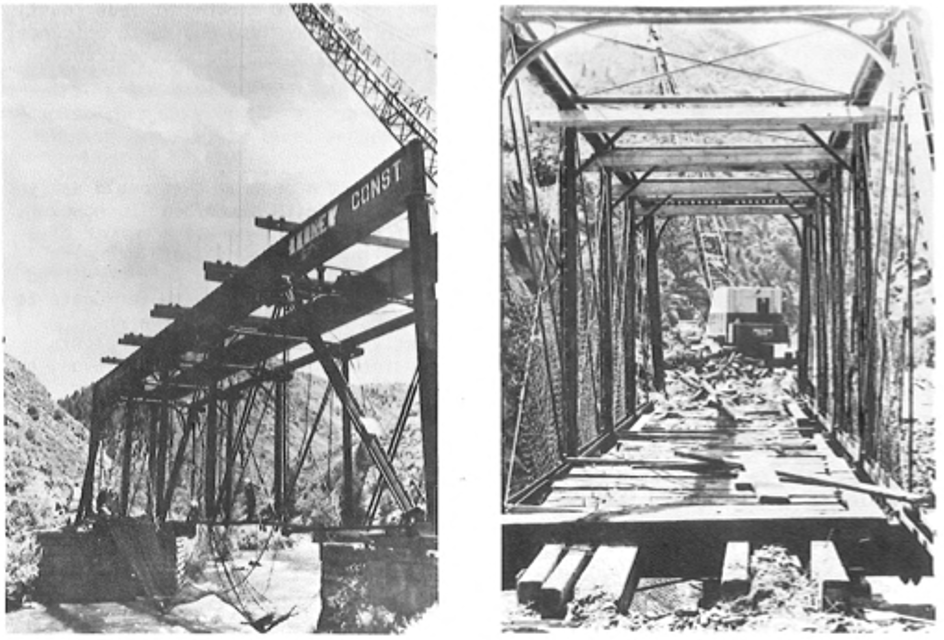
The motor of the Caterpillar roared to life that day, initiating a sound that was to become familiar as the canyon came alive with loaders, cement trucks, and cranes.  In two months’ time, the sixteen concrete piers were in place and, by September 1st, eight steel legs, placed by the Grett Steel Company, towered above Clear Creek, casting long shadows on the valley floor. 

Lindsey Ashby photo
The week of September 19th, 1983 was filled with excitement.  Beginning on Tuesday the 20th, one
hundred years from the day that the iron for the original bridge arrived in Denver, a mammoth Grove crane started the immense process of gently raising the primer-orange painted 30-foot sections of the bridge and guiding them into place on top of the towering legs.  Work began from the north abutment with the first, second, third, and fourth sections.  The center span was left agape temporarily and the 5th span was also set on its legs.  

On Thursday, September 22nd, the middle 60-foot lattice span was ready to be installed.  One crane lifted it off the truck that ferried it to the spot, and set the girder on the ground spanning Clear Creek, 75 feet below where it would soon be placed.  Two cranes on either side of the creek had their cables fastened to the bridge piece.  The span then ascended with the state flag of Colorado flapping in the fall sunshine all the way up until it came to rest on its fresh legs.  

Eventually two of the three remaining 30-foot sections were also put in place, but a special celebration was left for the eighth and final piece. 

Todd Hackett photo-Sept. 24, 1983