Tuesday, March 28, 2023

The Swan Songs of Central City - Part 1

The Swan Songs of Central City

-Part 1

by Kurt Maechner


Locomotive 71
Gondola 4319
Combine 20


Arrival and Departure

MONDAY, MAY 20, 1878
CENTRAL CITY, COLORADO

The excited chitter of conversation fills the air amongst the crowd around the new Central City depot of the Colorado Central Railroad.  A band, their instruments hanging at their sides, check that they are ready.  Firemen from the town and crisply uniformed members of the military are also on hand for the festivities.  Occasionally, members of the crowd strain their heads to look around other bystanders to peer down the track.

The anticipated train, the first of five this day, will traverse a great engineering feat.  Central City, 28 miles west of Denver, is one and a quarter miles up Gregory Gulch from nearby Black Hawk; Yet, to reach this ascendant point the railroad has to rise 500 feet in elevation.  The railroad has just completed a series of switchbacks where, like a moving see-saw, while always traveling upgrade, the train goes to a dead end, backs up to another dead end, and finally goes forward once more to its destination. 

Suddenly, the crowd hears it: the increasing sound of hard-working bursts from a locomotive’s smoke stack.  The pitch of murmuring voices goes quickly up.  The band scurries into formation.  Children are shuffled off the tracks.  Almost without warning, the chuffs of a narrow gauge engine become immediately louder as the diminutive iron beast slides into sight.  Like a victorious bugle call, its whistle pierces the air.  Shouts from the crowd explode like a cannon.  The band erupts into an exuberant marching melody and handkerchiefs are furiously waved as the train pulls between the crowd like the Israelites through a parted Red Sea.

Central City Opera House
The train of cars squeals to a stop.  The passengers, celebrants from all over, rush to join the celebratory crowd on the ground, eventually forming into a procession led by the band, firemen, and uniformed members of the military.  The scattered groups funnel into a parade and march downtown, eager to drink in triumphant speeches at the new opera house.

What other rough and tumble mining town can boast of an elegant opera house besides Central City?  The city known as “The Richest Square Mile on Earth” has hauled so much precious material out of its dirt that it has attracted more than just miners and their families.  Dignitaries, their wealth, and their fine tastes have come as well and “The Little Kingdom of Gilpin,” as Central is also known, banded together to construct, among its stately homes and sturdy businesses, a grand opera house, completed just two months ago.  

Today, the city and its visitors raucously celebrate not only this artistic performing arts gem, but the long-awaited arrival of a train, linking the “Little Kingdom” to the grand city of Denver with its cultured residents and, of course, the outside world.

Central City celebrated in style that day, but the spirit of triumph and glory did not last.

In the tradition of some fairy tales, a charming prince, through many trials, pursues a maiden and marries her, and the two go on to live happily ever after.  In other not so idyllic tales, a suitor chases his love, wins her, and then leaves her for perceived greener pastures.  This latter storyline sadly came to life for Central City.


Within just a few short years of the grand celebration of opera house and train above, a great exodus occurred from Central City as mines played out and Leadville, 56 miles southwest, boomed with silver.  The opera house, once the crown jewel of Central City, was slated for demolition.  While saved by an association, it was ignominiously demoted to a movie theater.  In 1917, the Gilpin Tramway, a small railroad that hauled ore from the many mines to the Colorado & Southern Railway, successor to the Colorado Central, closed down.  It was not long before the C&S ceased running trains over the switchback west of Black Hawk in 1925.  The former “Richest Square Miles on Earth” was now described this way: “Abandoned houses, made more desolate by forgotten furniture, stood under sagging roofs on every street.”  Two years after the death of train service to the town, the opera house was shuttered, and by July of 1931, the C&S finally tore up the famous switchback between Black Hawk and Central.

A death certificate seemed to have been signed for the once elegant mountain town.  One tiny seed of the glorious past remained in its broken-down theater, however, that would germinate a second life for both the city and a railroad.

Opera House Resuscitation

The decrepit, empty theater, known as the Central City Opera House, caught the attention of several individuals, including Anne Evans, the “round vivid blue eye[d]” daughter of the second territorial governor of Colorado and creator of the Denver, South Park & Pacific Railroad.  Evans joined forces with others who saw the theater as a diamond in the rough, to found the Central City Opera House Association.  The new organization renovated the stately performance hall while a cast and crew rehearsed the play Camille that was set to be presented for several grand opening performances.  The first passenger train on the Clear Creek Line since the cessation of regular passenger service in 1927 brought excited viewers to see the productions on July 19th and 20th, 1932.  Oil-burner C&S engine 70 had the honor to pull what would be the last passenger runs ever between Denver and Black Hawk.  As the track to Central had been torn up the year before, the trains reached Black Hawk where passengers were then ferried up the mountain to the opera house by a menagerie of vehicles from horse-and-carriages to Chevy, Hudson, and Durant automobiles.  

Opening Night

The smashing success of the Central City Opera House’s resuscitation brought a rediscovery of the preserved old-time mining hamlet of Central City and inspired annual summer gatherings first named the Pioneer Revival Festival.  These festivals sought to not only bring crowds from around the country to what Anne Evans envisioned as an American Salzburg, but also to bolster interest in the history of Central City as the “Oldest Living Gold Camp in the United States.”  

Where history is concerned, mining, gold camps, and railroads go together.  The first two, though greatly diminished in historic Central City, were still very much in evidence there in some active mines and remaining structures.  The latter of the three, in contrast, was long gone and Anne Evans sought to change this.  In 1940, surely seeing that the remaining C&S narrow gauge was soon to be a page in history, Anne spearheaded a campaign to get an old train donated for display in Central City.  Since narrow gauge railroads were an anachronism by this point, the odds of acquiring a few old pieces of equipment must have seemed less than formidable.  How hard could it be to convince a railroad to donate an engine and a few cars that they would likely send to the scrap heap in the near future?  

Anne found a friend in her hopes to get a train for Central City in Robert Rice, Vice President and general manager of the Colorado & Southern Railway based in Denver, to whom she queried about the possibility of receiving a donated display train.  By this time, the C&S had come under the umbrella of the Chicago, Burlington & Quincy Railroad and thereby needed approval from its parent company for the proposed donation.  Rice sent a note to Chicago, the CB&Q headquarters, to get permission that likely seemed just a formality.  Rice had C&S locomotive No. 9 in mind for Evans’ display.  The 2-6-0 had not long ago been taken out of service, spiffed up, and sent as a curiosity for the 1939-1940 New York World’s Fair.  Rice’s August 21st, 1940 note to his superiors read, “We would like to have [No. 9] returned, as the people of Central City are asking for such an engine to be placed there permanently as a relic.”  


Wednesday, March 1, 2023

1978 C&S News (1) Mountains near Alpine Tunnel named for Poor & Helmers

A wealth of railfan history exists in the archives of the Rocky Mountain Rail Report, the newsletter of the Rocky Mountain Railroad Club started in 1939.  Here is some miscellaneous South Park Line/C&S-related news from the 1978 editions.   

1978

Feb.


(C&S Denver shops)

THE OLD C&S SHOPS at 7th Street in Denver are being demolished. The brick structures date back to the turn of the century. 

C&S Denver roundhouse
April

(Poor, Helmers mtn. Alpine Tunnel)

* * * MT. POOR AND MT. HELMERS OFFICIALLY PROCLAIMED * * * 

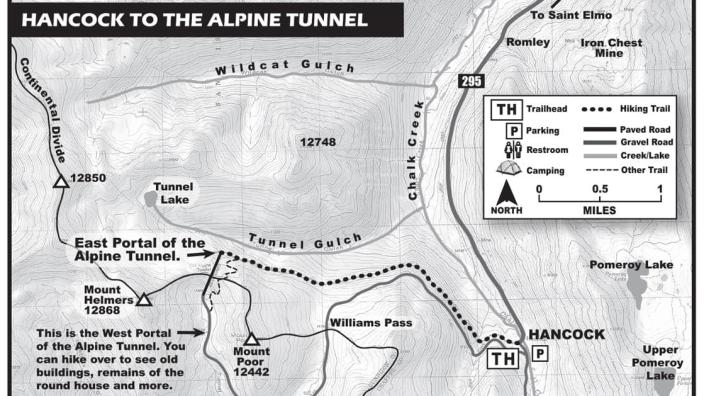
In recognition of the many years of labor, love and dedication to the preservation and documenting of the history of the Denver South Park & Pacific Railroad by Mac Poor and Dow Helmers, the United States Board of Geographic Names in Reston, Virginia has officially named two mountain peaks in the vicinity of the Alpine Tunnel in their honor. Mac and Dow were two of Colorado's most dedicated railroad historians, as well as fondly remembered club members. 

Mount Poor

Both peaks are located 28 miles east-northeast of Gunnison in the Sawatch Range in Chaffee and Gunnison Counties, at one of the most historic rail crossings of the Continental Divide. Mt. Poor, named after Mac C. Poor (1902-1972), is 12,440 feet in elevation and has the Alpine Tunnel on its northwest slope. Mac authored the book DENVER SOUTH PARK & PACIFIC and co-authored the PICTORIAL SUPPLEMENT TO DENVER SOUTH PARK & PACIFIC, two of the most thoroughly researched, in-depth studies ever done on the railroad. His years of effort brought a part of Colorado's narrow gauge history into the reach of those of us who could not explore the DSP&P on our own, or who simply were not cognizant of the colorful rail history in the mountains west of Denver. 


Mt. Helmers is named after Dow Helmers (1906-1976), and has an elevation of 12,858 feet. Alpine Tunnel is located on its northeast slope. Dow was, of course, an author and historian of the DSP&P, with his most popular work being HISTORIC ALPINE TUNNEL. He was an enthusiastic supporter for the preservation of the Gunnison region's rail history, and was a driving force in preserving what was left at the west portal of the Alpine Tunnel so that others could enjoy a part of the past. 

The naming of these two peaks is rather an unusual event in that they had never been previously named. Most naming of peaks is usually the result of a change from one designation to another. These names became official on February 9, 1978. A great deal of thanks is due all who actively promoted this most appropriate form of recognition to these two individuals

[ed. Below are some views of Alpine Tunnel and Mount Poor and Mount Helmers]


(C&S Denver shops)

ONLY A MEMORY - Scattered debris and neatly stacked piles of salvaged bricks are all that remain where the main C&S shop building stood at 7th Street in Denver. Five stalls of the roundhouse remain, the building being used by a private industry. 


June

PROGRAM NOTES: 

"A DAY IN THE LIFE OF 641 and 

"A C.&S.-G.W. EXCURSION" 

For the June program, Ron Ruhoff will present two of his "Photo musical Adventures"that are sure to bring back many a fond memory. The movie, "A DAY IN THE LIFE OF 641" depicts steam locomotive No. 641 on its daily freight run over the Colorado & Southern Railroad from Leadville to Climax. This branch was one of the last regular steam operations in the U.S., and at an elevation of over two miles. The second program, "A C.&S.-G.W. EXCURSION," shows a Rocky Mountain Railroad Club excursion on freight-only lines north of Denver. A C.&S. steamer takes the train from Denver to Longmont, the Great Western 91 completes the journey over the sugar beet lines of northeastern Colorado. 

Ron's reputation as a top photographer of the west, his long interests in railroads, and his talents at combining photos with music are well known and a clue to how fine the evening's entertainment should be! 

[Ed. C&S 2-8-0 641 operated the formerly narrow gauge Climax to Leadville route until 1962.  This was the last operating leg of the South Park Line, standard gauged in 1943]


July

As could have been predicted, Ron Ruhoff didn't disappoint a soul at the June meeting with his "double headed" 16 mm programs "A C&S-GW EXCURSION" and "A DAY IN THE LIFE OF 641." The full day's activities with a Rocky Mountain Railroad Club steam excursion north from Denver on the C&S and the GW was depicted from the moment the engine pulled out of the roundhouse in Denver until it disappeared into the twilight in an outstanding sunset scene at the end of the day. The sole C&S steam locomotive at Leadville was shown in the second program as it began its daily routine of making up a train in Leadville under a backdrop of snow-covered mountain peaks. With its consist assembled, the train climbed along the mountainside to Climax. After completing its chores at the highest point reached in the U.S. by an adhesion railroad, it turned around and returned to Leadville at the end of the same day. Both movies were accompanied by symphonic music, expertly coordinated to enhance the moods of the various sequences. Our thanks to Ron for presenting his record of some memorable Colorado railroad history. 

Friday, February 17, 2023

1977 C&S news (2) - Platte Canon exploration, Mason-Bogie presentation, new purpose for South Park bridge

A wealth of railfan history exists in the archives of the Rocky Mountain Rail Report, the newsletter of the Rocky Mountain Railroad Club started in 1939.  Here is some more miscellaneous South Park Line/C&S-related news from the 1977 editions.   

1977

September

(The Club explores C&S remains in Platte Canyon)

GREAT WEATHER AND the relatively unspoiled beauty of the Platte Canyon, combined to provide for an enjoyable day of exploring the remains of the Denver South Park & Pacific roadbed between Waterton, South Platte and Pine, during the Club's Platte Canyon Bunion Pounder of August 6. 

from article about its rededication

While a number of folks saw the canyon from the trucks, others boarded the bus for a ride around to South Platte. On the way, various points of interest were seen, and stops were made at the Westall Monument near Dome Rock, and at Buffalo Creek, where a perusal of Green's General Store was like stepping into a time machine. After provisions and post cards were obtained, the party continued up the picturesque valley to South Platte, where the photogenic South Platte Hotel still stands at the mouth of the canyon. 

Some remnants of the railroad were still evident 35 years after abandonment - an occasional spike, a telegraph pole, a rock wall, the bridges. Also, traveling the canyon but in a more adventurous manner, were several kayakers. One of them provided a few breathtaking moments for himself and those watching, as he flipped over and had a tough time coming up again in the swirling waters. 

A rest and lunch stop at Strontia Springs was not as elaborate as it could have been, were the resort still there, but the foliage of the side canyon provided a retreat from the sun. With the trucks furnishing an alternate mode of travel for those with tiring feet, the group continued on past the Mill Gulch bridge to Intake, where everyone took advantage of a ride the remaining distance to Waterton, for a mid-afternoon arrival. A visit to the control room and underground facilities at the dam provided an additional treat for those who desired to navigate what seemed like a thousand steps to the bottom of the structure. Everyone enjoyed themselves on this outing, and a word of thanks is extended to the Denver Water Department for their cooperation. 

October
(Presentation on Mason-Bogies)

At the September meeting, our knowledge and appreciation of one of the "work-horse" locomotives of the DSP&P, the Mason-Bogie, was greatly enhanced by an interesting and truly informative illustrated talk by Art Wallace. Art, a long time club member, and an almost life-long researcher of the Mason locomotives, provided some background information about the development of the steam locomotive in general, and how William Mason added locomotive building to his textile machinery manufacturing business to become the Mason Locomotive Works of Taunton, Massachusetts. We saw how, in the latter half of the 1800s and into the beginning of the 20th century, how Mr. Mason's creations became known for their pleasing designs and fine engineering, and how they figured into the "steam scene" chapter of the history of locomotive building. Our thanks to Art for such a good program. 


November
(Old South Park bridge to be repurposed for pedestrians near Denver Mile High Stadium)

THE HISTORIC MILL GULCH BRIDGE, or as it is now referred to, the Keystone Bridge, (it was built by the company of the same name) will have a new resting place near downtown Denver if all goes as planned. The Denver Water Board has offered to dismantle and move the old DSP&P bridge from the canyon, and reassemble it across the South Platte River near Denver's Mile High Stadium.

A permanent bridge is needed at the location to provide fans attending events at the stadium, a way in which to cross the river from certain parking areas. The Water Board has to replace the bridge in the canyon with a stronger one (which will use the same abutments) to allow movement of heavy construction equipment. It was the intention of the Board to disassemble the bridge anyway, and store it until a worthy recipient could be found. So it will now be preserved and used, although not in quite as picturesque a setting. 

Author's 2022 photo in Bailey


(Ed. This plan never came to be.  Instead, the bridge was put to use in Bailey, Colorado at the Helen McGraw Tatum memorial park.  You can see an article about my 2022 visit to the bridge here.)

Friday, February 10, 2023

Bert Renck Alpine Tunnel eating house ticket

 Here is a meal ticket for the Alpine Tunnel eating house made out to Bert (Herbert) Renck on April 22nd, 1909 from the Denver Public Library digital collection.


The description reads, "View of a meal ticket for the Alpine Tunnel Eating House reads: "L.H. Waters and Wife, Prop., Issued to H.D. Renck, 4/22/09." The edge of the ticket has monetary increments partially punched out as payment for meals."  It was submitted by Bob Richardson in 1951.


Saturday, February 4, 2023

Bert Renck, South Park fireman, shares his adventures at Alpine Tunnel

Bert Renck, born in Missouri, started railroad work on the Santa Fe in 1906.  In 1909 he went to Como, Colorado to work for the Colorado & Southern narrow gauge on "The South Park Line."  He fired on many parts of the line including the Fish Special between Denver and Grant, the Boreas Pass route from Como to Leadville, and the Gunnison Division which included running over Altman Pass through the Alpine Tunnel.  Famously, he was involved in a wreck outside of the east portal of the Alpine Tunnel (Covered in this part of my video).  

Later in life he would join with the likes of George Champion (another C&S employee who worked on the Alpine Tunnel route), Mac Poor, Dow Helmers, and Francis Trudgeon to meet up at the west portal for Alpine Tunnel Days and help with stabilization and reminiscing.  

I came upon his story when I bought a magazine on Ebay entitled Old West, Winter 1976 edition.  The article was titled "The South Park Narrow Gauge: a treacherous stretch of rails that you could slide on a while before you jumped the track and hurtled down the mountain" by Bert Renck submitted by Hank Givens.  

This is an audio of that article that I narrated.  I put images and video to match up with his story, though, of course, the time frame of the photos doesn't match up in many cases.  

Part 1 can be found here

I hope you enjoy another edition of C&S Tales with part 2 of Bert Renck's story!

Kurt

Friday, January 27, 2023

The Twisting Tale of the Georgetown Loop - Part 6 (The finale)

The Twisting Tale of the Georgetown Loop
-part 6

by Kurt Maechner

Here is Part 3    
    
Here is Part 5

SUNDAY, SEPTEMBER 25th, 1983
GEORGETOWN, COLORADO

Almost five months after their last visit, Mae Boettcher is back with her friend Katheryn Willard Biese.  They approach the remaining massive 30-foot-long span sitting on the ground.  An even more massive crane towers behind it and from its powerful hook numerous cables descend to wrap around the steel span.  

At one corner of the bridge piece is a small table, adorned with an oversized white table cloth hanging just a bit askew.  On the left of the table top is a silver bowl of ice with one bottle of champagne resting inside it.  To the right of this are a number of pristine glasses next to another champagne bottle.  

With Mae, Katheryn, and other important onlookers present, the final bridge span, adorned with numerous signatures, is christened, glasses are raised, and all eyes watch as the final gap between the north and south abutments is about to be erased.  With this raising, not only is the flag of Colorado attached, but the flag of the nation, gently undulating in the westward flowing wind, also proudly accompanies this historic move.  

Rising higher and higher, the span carries not only flags, but two passengers.  Two members of the Colorado Historical Society climb aboard wearing safety helmets and eagerly snap photos from on the bridge piece itself.  

At last, the Grett Steel Company employees settle the eighth span into place against the south abutment, and the Devil’s Gate Viaduct, while still in need of rails, spans the Clear Creek Valley for the first time in 44 years.  The happy crowd below now celebrates, as so many early visitors to the Loop did in its heyday, with a picnic.

With the bridge structure complete, work continued with railroad ties laid across in November ‘83.  However, as happened during the original Loop line’s construction, the winter weather in Colorado made work difficult for the crews.  It wasn’t until the spring of 1984 that rails were spiked down across the bridge. 

First Train Over the Viaduct

In the early morning of a cloudy Friday, June 1st, 1984 “a semi-secret unofficial test run” at 7:58am occurred with the Loop’s diesel.  Good news: it survived!

Media at the official first run -
July RMRail Report
With this successful test and confidence in the structure, the first public run of a train across the bridge occurred at 10:00am as Shays 8 and 14 pushed ex-D&RGW caboose 0586 and a gondola with very lucky passengers across the bridge from the south to north abutments.  This run was no secret.  Television and newspaper representatives were there to capture the historic occasion for posterity and free rides were offered to all.

The Rocky Mountain Railroad Club captured the enormity of the occasion in their Rocky Mountain Rail Report of July 1984 in a piece by Bob Griswold.

“Do a little wishful thinking! Try to imagine yourself riding in an ancient narrow gauge gondola car behind an honest-to-goodness operating 1922 Shay through a magnificent Colorado mountain canyon. Then try to think of those cool alpine breezes blowing down the canyon and the fleecey [sic] white clouds skimming the mountain peaks. Next, try to think of yourself looking over the side of the old car through the ties to the churning, rushing stream ninety feet below.

“Stop fantasizing! Now you can actually ride such an unbelievable train on the Georgetown Loop Railroad and across the famous Devil’s Gate Trestle.”

No. 14 blows off steam on the first official run- July RMR Report

Regular excursions began operating from Silver Plume over the bridge with the old Silver Plume station order board listing in all caps “DEVILS GATE NOW OPEN,” but the Loop was not entirely a loop as of yet.  The remaining mile down grade from the north abutment of the bridge west and the curve crossing Clear Creek one last time while angling back east under the high bridge were not yet complete.  

Work progressed that summer on this stretch.  The Burlington Northern railroad, which had absorbed the Colorado & Southern Railway officially in 1981, located a 50-foot bridge in Ashland, Nebraska for use on the final Clear Creek crossing.  This bridge was installed the same day as the first public run across the high bridge.  During the remaining summer months track was laid from the north abutment all the way to this bridge and around until it reached under the great high trestle.  With this, the Georgetown Loop was officially a loop once again.

It had taken a decade from the very first work train to reach the completion of the Georgetown Loop.  All that remained was the party, and, with plans of grand proportions, the party was fixing to be a Colorado Day celebration like never before.

WEDNESDAY, AUGUST 1, 1984
COLORADO DAY – 10am
GEORGETOWN, COLORADO

With the clock at 10am, the Clear Creek Secondary School Band launches into a rousing rendition of the “Star Spangled Banner.”  The music echoes off the valley walls as hundreds of onlookers, whose string of parked cars reach nearly to the town that gave the Loop its name, stand with hats off and hands over hearts.  They honor their country but also the 108th birthday of their state on this Colorado Day.

Nearly one year has passed since the last time Mae Boettcher stood on the ground beneath the Devil’s Gate Viaduct to christen the last bridge pier before it was installed on the grand structure.  With E. Warren Willard’s widow Katheryn Willard Biese again next to her today, she is standing inside the middle of The Georgetown Loop on a stunningly sunny day.  Ahead of her is a striped, raised platform with a brown podium astride the top, flanked on either side by poles holding the American and Colorado flags, both symbols of the ingenuity of the people who built Colorado, built such a spectacular railroad, and then built this railroad again.  600 people are in attendance for the dedication of the new bridge, though some believe there to be more.  There are so many visitors this day, in fact, that quite a few happy onlookers are even standing behind the stage for the festivities.  

In the distance farther behind the podium is the brand-new Georgetown Loop High Bridge standing again for the first time in 45 years and strung with long strands of patriotic red, white, and blue-colored balloons from one end to the other, designed by Ron Garrison, a balloon artist from Denver.  Since Mae’s last visit in the fall, rails have been laid westward across the structure, down the northern slope of the valley, across one more bridge over Clear Creek as it curves again eastward and underneath the High Bridge, completing the entire loop.  

With cheers and applause after the conclusion of the high school band’s performance of the national anthem, Mrs. Boettcher, Mrs. Willard Biese, and the crowd with seats available, sit down as the program begins with a welcome from Barbara Sudler, president of the CHS, followed by Roger D. Knight III, the CHS vice-chairman who honors significant donors with lifetime passes to the Georgetown Loop.  These passes, made of sterling silver, the precious metal that birthed the motive of the arrival of the railroad here and linked the two towns by this thread of rails, have the governor’s signature and the recipient’s name and pass number on one side and an 1884 replica railroad pass on the other.   The passes are given to Mae, Katheryn, and others who have given so much to see this triumphant day become a reality.  

Finally, three-term Colorado governor Richard D. Lamm steps up to the podium.

Gov. Lamm waxes eloquent, discussing a lamentable characteristic of civilizations that die.  This characteristic, he says, quoting famed Pulitzer Prize winning American poet Carl Sandberg “‘is that they forgot where they came from.’”  With triumph and a nod to the rebuilt Loop line, Lamm exclaims, “I am here to celebrate the fact that Colorado doesn’t and won’t forget where we came from.”  Mae and Katheryn clap their hands in delight along with the other 600 or more guests.

The two women have something else to applaud as well.  On this day, the Colorado Historical Society places two plaques.  One honors major benefactors, such as the Colorado General Assembly, the Atlantic Richfield, Boettcher, Burlington Northern, and Gates Foundations, and the Pauline A. and George R. Morrison Charitable Trust.   

The second plaque, though, is much more personal to the two women.  It reads, “The Devils Gate High Bridge has been reconstructed by the Boettcher Foundation in memory of E. Warren Willard longtime trustee of the Foundation and president of the Colorado Historical Society.”

As the ceremony proceedings conclude, it is time for the climax of the day: the inaugural ride on the High Bridge itself.  

Todd Hackett photo

Governor Lamm and his wife climb aboard the cab of locomotive No. 44, and 300 others clamber into the cars behind the steaming engine.  With a blast of a whistle, the train slowly chuffs upgrade, turning from the southern side of the valley, crossing the first bridge across Clear Creek, and continuing the 2 percent grade up the north side of the valley with I-70 safely overhead on the mountainside.  The train edges out onto the high bridge and, to the curious note of everyone around, stops.

What the onlookers back at the Georgetown boarding site cannot see behind the trees is that the fourth car in the train, a cattle car converted for passengers, has derailed.  Later the railroad would find out that the derailment was not due to the cattle car, but that “the new track was not level and properly ballasted.”

Once the shortened train of three open-air gondolas is ready to proceed, it continues out onto the high bridge, bursting glorious steam skyward as each of the tethered balloon strands are cut loose by the train and released to the Colorado heavens.  

Todd Hackett photo - balloon strands released


Mae Boettcher and Katheryn Willard Biese marvel as they look down at the stout viaduct beams below them.  What was an empty chasm for nearly half a century is now filled with a living breathing echo of history.  Engine 44 lets out a soaring blast on the whistle that bounces off the canyon walls, nearly drowning out the excited banter of the passengers around a man who had a hand in making this a reality.  Steve “Buzzsaw” Hart, the 17th Street pestering attorney who unceasingly pursued Cris Dobbins of the Boettcher Foundation for a contribution to build the bridge, is on this train grinning from ear to ear.  In the words of his biographer, “Steve was as proud as a new parent when he rode on the inaugural trip of the railroad over the restored high trestle in 1984.”
Todd Hackett photo

How can one capture all the stunning work that has happened since that bright, August Colorado Day in 1984?  From the development of the Everett and Lebanon Mine tours, the Devil’s Gate boarding area named the Pauline A. and Georgetown R. Morrison Valley Center and Theater, and the 2-stall engine house and maintenance facilities at Silver Plume, more volumes could be written, and maybe will someday.   Many more books could also be written on the numerous locomotives and cars that have graced the rails, the most curious of which was the one-season bittersweet resurrection in 2006 of C&S engine No. 9 that had actually run on the Loop in its original form.  

In the meantime, the resurrected Georgetown Loop continues to transport over 100,000 riders a year back in time to the early days of Colorado’s mining boom and to one of the most stunningly-constructed, hard-working, tenacious railroads that stretched its rails into the Rocky Mountains to bring its treasures to the outside world.  Today, through noteworthy vision, humble hard work, admirable sacrifice, and incredible teamwork, that same railroad remains a treasure in itself, proof that an impossible dream, like the American Dream, can indeed become possible.


Saturday, January 21, 2023

The Twisted Tale of the Georgetown Loop - Part 5

The Twisting Tale of the Georgetown Loop
-part 5

by Kurt Maechner

Here is Part 3    
    

Todd Hacket photo-end-of-track
before high bridge-1983
Thankfully, there was still Dobbins’ cohort in the Boettcher Foundation board, E. Warren Willard, the man whose comment had given some real hope that the money just might come to aid the Loop.  This hope was also cut short when three months after Dobbins’ passing, Willard died on September 19th, at the age of 83.   

It had been six years since the first train on the truncated Georgetown Loop, and still there was no way forward over that gaping valley.


In the meantime, while the CHS worked to get the funds to complete the Loop, the actual operators of the line were seemingly left out of the loop of these details or its timeline.  The Ashbys and their partners, while running a successful operation, continued to struggle financially as they carried the whole burden of operating expenses in addition to a yearly fee to the CHS for the rights to run it.  According to Lindsey, “We lost money at Georgetown for the first, whole bunch of years.  We made little off of it for a long, long time.”  As if this wasn’t enough, he and Rosa, while running this railroad plus the one in Central City, were still working full-time jobs, Rosa as a teacher and Lindsey with Marathon Oil, jobs without which they would never have been able to make the Georgetown Loop work.  

Henry Fonda

There were some public attempts to raise money to build the high bridge such as a plan to bring famed Academy Award winning film actor Henry Fonda to ride the line in the winter in the early 1980s and do a promo for the railroad.  Work went into the visit including fabricating a makeshift snowplow out of a smooth metal culvert for a diesel to deal with the snow on the tracks.  Disappointingly, all came to naught when Fonda got sick and was unable to make the visit.  He died not long afterwards. 

In 1981, it was finally time to let go of at least one burden, the Central City Narrow Gauge Railway.  The obstacles to extend the short line were insurmountable and the track was at last pulled up.  With the group’s focus now solely on the Loop, they brought Shay locomotive No. 14, among much other equipment, with them to Silver Plume.  

Without any knowledge of the plans for funds to construct the high bridge besides what could be garnered from information accidentally dropped, the Ashbys and their partners carried on hauling passengers from Silver Plume to the side of a forlorn abutment.  

And then, like a locomotive whistle in the distance piercing a silence, nearly three years after Dobbins’ and Willard’s passings, the hope these men had sparked suddenly came into view down the track.

The Million-Dollar Announcement

Saturday, May 15, 1982 was the watershed day.  While the loss of Dobbins and Willard was a blow to the railroad’s hopes, the hard work undertaken by many to inspire the Boettcher Foundation to give to this diminutive railroad finally paid off when the Boettcher Foundation made a public announcement that a million-dollar grant would be given to resurrect the Devil’s Gate Viaduct across the valley once again.  One of the great chronicles of the Loop’s resurgence, Georgetown and the Loop, put it this way, “Truly, Saturday, May 15, 1982 was a glorious day as it enabled those who had dreamed, planned, struggled and worked for so many years to see the completion of the rebuilding of the ‘Far Famed Georgetown Loop.’” 

The Impossible Bridge

With the money in place at last, activity in the valley took off.  The United Research Services Corporation accessed the C&S’s 1919 plans for strengthening the High Bridge to help guide their engineering plans for the new one.  While taking into account the need for changes to match updated safety requirements, URS was able to recreate the character of the bridge as closely as possible to the original.  In the meantime, the Union Pacific Railroad, which had provided the line with old, but usable rails previously, now gave one and half miles more along with ties.  These arrived in February near the construction site.  Most crucially, the construction job for the High Bridge itself was awarded to Flatiron Structures Company based out of Longmont, Colorado, who put the cost at $808,755.  

Before the full work could begin, though, an important ceremony took place.

MONDAY, MAY 2, 1983
GEORGETOWN, COLORADO

Just shy of one year has passed since the Boettcher Foundation announced the generous million-dollar gift towards the reconstruction of the Loop’s High Bridge.  On this day Mae Boettcher is handed a shovel.  

Mae Boettcher

Despite the spring date of May 2nd, 1983, a snowstorm has whipped through the valley likely requiring Mae to squint.  The stately, dignified widow of Charles Boettcher’s grandson, Charles II, is not here to shovel snow, but to turn the first shovel of dirt on the rebuilding of the Devil’s Gate Viaduct.  Surrounded by one hundred eager supporters, including numerous others who have played crucial roles in reaching this day, she feels honored to finally begin what she and her family and fellow trustees at the Boettcher Foundation had discussed for so long.

But today is really not Mae Boettcher’s day.  Today is the day to honor Mae’s late husband’s grandfather’s long-time employee, friend, and fellow trustee, E. Warren Willard, the man who served as president of the Colorado Historical Society, and as president of the Boettcher Foundation for nearly a quarter of a century.  It was Willard who, before his passing, had suggested the idea of a grant to build the High Bridge.  To honor his memory and his wish to protect and preserve Colorado history, the million-dollar grant to the Georgetown Loop was given in his name.  

Mae is not alone in turning over the symbolic first shovel of dirt.  While Willard himself cannot be here to enjoy this scene, his widow Katheryn Willard Beise can.  With likely a shiver in the spring storm, the two ladies, and John C. Mitchell, the current director of the Boettcher Foundation, drive their shovels into the hard ground and turn over the dirt.  

In a moment reminiscent of Lindsey Ashby’s trigger upon hearing of the Seabee’s interest in railroad construction, another starter pistol shot bursts out when Katheryn Willard Beise climbs the yellow, steel steps into a Caterpillar, while Mae and the others watch with anticipation, and starts the tractor’s engine, symbolically calling the workers to burst into action.  

The motor of the Caterpillar roared to life that day, initiating a sound that was to become familiar as the canyon came alive with loaders, cement trucks, and cranes.  In two months’ time, the sixteen concrete piers were in place and, by September 1st, eight steel legs, placed by the Grett Steel Company, towered above Clear Creek, casting long shadows on the valley floor. 

Lindsey Ashby photo
The week of September 19th, 1983 was filled with excitement.  Beginning on Tuesday the 20th, one
hundred years from the day that the iron for the original bridge arrived in Denver, a mammoth Grove crane started the immense process of gently raising the primer-orange painted 30-foot sections of the bridge and guiding them into place on top of the towering legs.  Work began from the north abutment with the first, second, third, and fourth sections.  The center span was left agape temporarily and the 5th span was also set on its legs.  

On Thursday, September 22nd, the middle 60-foot lattice span was ready to be installed.  One crane lifted it off the truck that ferried it to the spot, and set the girder on the ground spanning Clear Creek, 75 feet below where it would soon be placed.  Two cranes on either side of the creek had their cables fastened to the bridge piece.  The span then ascended with the state flag of Colorado flapping in the fall sunshine all the way up until it came to rest on its fresh legs.  

Eventually two of the three remaining 30-foot sections were also put in place, but a special celebration was left for the eighth and final piece. 

Todd Hackett photo-Sept. 24, 1983