Showing posts with label M.C. Poor. Show all posts

Wednesday, March 1, 2023

1978 C&S News (1) Mountains near Alpine Tunnel named for Poor & Helmers

A wealth of railfan history exists in the archives of the Rocky Mountain Rail Report, the newsletter of the Rocky Mountain Railroad Club started in 1939.  Here is some miscellaneous South Park Line/C&S-related news from the 1978 editions.   

1978

Feb.


(C&S Denver shops)

THE OLD C&S SHOPS at 7th Street in Denver are being demolished. The brick structures date back to the turn of the century. 

C&S Denver roundhouse
April

(Poor, Helmers mtn. Alpine Tunnel)

* * * MT. POOR AND MT. HELMERS OFFICIALLY PROCLAIMED * * * 

In recognition of the many years of labor, love and dedication to the preservation and documenting of the history of the Denver South Park & Pacific Railroad by Mac Poor and Dow Helmers, the United States Board of Geographic Names in Reston, Virginia has officially named two mountain peaks in the vicinity of the Alpine Tunnel in their honor. Mac and Dow were two of Colorado's most dedicated railroad historians, as well as fondly remembered club members. 

Mount Poor

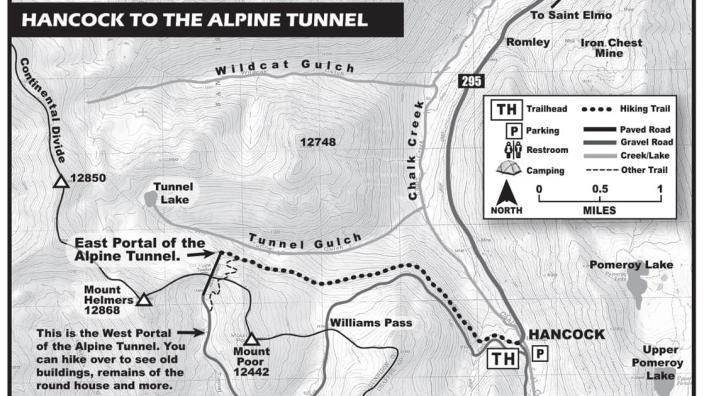
Both peaks are located 28 miles east-northeast of Gunnison in the Sawatch Range in Chaffee and Gunnison Counties, at one of the most historic rail crossings of the Continental Divide. Mt. Poor, named after Mac C. Poor (1902-1972), is 12,440 feet in elevation and has the Alpine Tunnel on its northwest slope. Mac authored the book DENVER SOUTH PARK & PACIFIC and co-authored the PICTORIAL SUPPLEMENT TO DENVER SOUTH PARK & PACIFIC, two of the most thoroughly researched, in-depth studies ever done on the railroad. His years of effort brought a part of Colorado's narrow gauge history into the reach of those of us who could not explore the DSP&P on our own, or who simply were not cognizant of the colorful rail history in the mountains west of Denver. 


Mt. Helmers is named after Dow Helmers (1906-1976), and has an elevation of 12,858 feet. Alpine Tunnel is located on its northeast slope. Dow was, of course, an author and historian of the DSP&P, with his most popular work being HISTORIC ALPINE TUNNEL. He was an enthusiastic supporter for the preservation of the Gunnison region's rail history, and was a driving force in preserving what was left at the west portal of the Alpine Tunnel so that others could enjoy a part of the past. 

The naming of these two peaks is rather an unusual event in that they had never been previously named. Most naming of peaks is usually the result of a change from one designation to another. These names became official on February 9, 1978. A great deal of thanks is due all who actively promoted this most appropriate form of recognition to these two individuals

[ed. Below are some views of Alpine Tunnel and Mount Poor and Mount Helmers]

  . 


(C&S Denver shops)

ONLY A MEMORY - Scattered debris and neatly stacked piles of salvaged bricks are all that remain where the main C&S shop building stood at 7th Street in Denver. Five stalls of the roundhouse remain, the building being used by a private industry. 


June

PROGRAM NOTES: 

"A DAY IN THE LIFE OF 641 and 

"A C.&S.-G.W. EXCURSION" 

For the June program, Ron Ruhoff will present two of his "Photo musical Adventures"that are sure to bring back many a fond memory. The movie, "A DAY IN THE LIFE OF 641" depicts steam locomotive No. 641 on its daily freight run over the Colorado & Southern Railroad from Leadville to Climax. This branch was one of the last regular steam operations in the U.S., and at an elevation of over two miles. The second program, "A C.&S.-G.W. EXCURSION," shows a Rocky Mountain Railroad Club excursion on freight-only lines north of Denver. A C.&S. steamer takes the train from Denver to Longmont, the Great Western 91 completes the journey over the sugar beet lines of northeastern Colorado. 

Ron's reputation as a top photographer of the west, his long interests in railroads, and his talents at combining photos with music are well known and a clue to how fine the evening's entertainment should be! 

[Ed. C&S 2-8-0 641 operated the formerly narrow gauge Climax to Leadville route until 1962.  This was the last operating leg of the South Park Line, standard gauged in 1943]


July

As could have been predicted, Ron Ruhoff didn't disappoint a soul at the June meeting with his "double headed" 16 mm programs "A C&S-GW EXCURSION" and "A DAY IN THE LIFE OF 641." The full day's activities with a Rocky Mountain Railroad Club steam excursion north from Denver on the C&S and the GW was depicted from the moment the engine pulled out of the roundhouse in Denver until it disappeared into the twilight in an outstanding sunset scene at the end of the day. The sole C&S steam locomotive at Leadville was shown in the second program as it began its daily routine of making up a train in Leadville under a backdrop of snow-covered mountain peaks. With its consist assembled, the train climbed along the mountainside to Climax. After completing its chores at the highest point reached in the U.S. by an adhesion railroad, it turned around and returned to Leadville at the end of the same day. Both movies were accompanied by symphonic music, expertly coordinated to enhance the moods of the various sequences. Our thanks to Ron for presenting his record of some memorable Colorado railroad history. 

Monday, September 5, 2022

1976 C&S news (1) - Otto Perry on Boreas Pass, caboose in Buena Vista

A wealth of railfan history exists in the archives of the Rocky Mountain Rail Report, the newsletter of the Rocky Mountain Railroad Club started in 1939.  Here is some miscellaneous South Park Line/C&S-related news from the 1976 editions.   

1976

January

Progress Report on the Denver South Park & Pacific Memorial Edition 

Ed Haley reports that printing is now finished on the first 324 pages of the book that is being reprinted by the Club. All photographic plates have been made, and a third color plate is currently in process. Pages up to 250 have been folded and collated. The binding operation, of course, cannot begin until printing, collating and folding of the pages is complete. To date, over 2,500 copies have been sold. If progress continues at its current pace, the book should be out in late 1976. 


February
(Otto Perry and Ed Haley bounce over ties on Boreas Pass)

The Otto Perry movies shown at the January meeting were, as usual, absolutely fascinating. In addition to the various scenes in the Rocky Mountain region, were beautiful action views of mainline steam farther east with Pennsylvania, New York Central and other eastern and midwestern lines being included.

Complementing the railroad shots taken in Colorado, were a few of Otto's scenery shots, Denver rail

Boreas Pass is quite different from Otto Perry's days!

transit sequences, some beautiful action closeups of an obscure hog wallow on some ranch that seemed to have caught Otto's eye, and some scenes of driving over Boreas Pass back in the days when the ties were still in place. Several amusing shots, although probably thought of as serious business at the time by those involved, showed Otto's car bouncing slowly along over the ties and Ed Haley out front with a hatchet, chopping down small trees and otherwise modifying the local vegetation to allow passage. Nowadays, some people probably drive up that same road, now graded, in their four-wheel-drive vehicles and pat themselves on the back when they reach the top. If they only knew what they are missing .... 

(Ed. - Does anyone know the whereabouts of this film??)


April
(Standard Gauge caboose placed on display in Buena Vista)


STILL ALIVE AND KICKING - an old wooden caboose has been obtained from the BN in Denver and moved by truck to Buena Vista, Colorado and parked in the downtown area. The car was placed on a length of track and is being cleaned up (the interior was sandblasted throughout) and used as a small store. 

(Ed.-This is not the caboose that is now on display outside the restored South Park Buena Vista depot.  The present one was donated in 2005)


The video below shares the story of how the depot was saved and moved in 2002.  It also includes a walk-through of the present caboose)


May
(Georgetown Loop double-header)

On September 11, special double-headed steam trips for the Club will be run on the Georgetown Loop Railroad. 

(Ed-Here's a good mystery I'm hoping someone might solve: The Loop only had No. 44 on site at this time.  IRCA No. 40 wouldn't come to the Loop until 1977.  Does anyone know if this double-header actually occurred and with what engines?  My guess is that there was a tentative plan to bring No. 40 earlier, but it didn't happen-that's just my guess.  If anyone knows more, please fill me in!)

Kurt


Progress Report on the republication of Denver South Park & Pacific

Printing of the last few pages of the 1976 edition of Mac Poor's "Denver South Park & Pacific" (the reprint of the original 1949 edition) is taking place as this newsletter is being printed. The printed sheets have been folded and collated as they come off the press and the gathered pages should be ready to be sent to the bindery in June. With a couple of months for binding and another for inspection, packaging, and shipping, the first of the books should begin reaching their destinations in late September or early October, providing unexpected problems do not arise to delay production. Do not delay mailing in your order for the book if you wish to take advantage of the pre-publication bargain price of $19.00. When the first books are received from the bindery, the price will be raised to $24.00. For quality and content, this book will be far superior to many of the $30.00 to $35.00 railroad books on the market today. 


Sunday, July 17, 2022

Bert Renck, South Park fireman, shares his adventures on the narrow gauge

Bert Renck, born in Missouri, started railroad work on the Santa Fe in 1906.  In 1909 he went to Como, Colorado to work for the Colorado & Southern narrow gauge on "The South Park Line."  He fired on many parts of the line including the Fish Special between Denver and Grant, the Boreas Pass route from Como to Leadville, and the Gunnision Division which included running over Altman Pass through the Alpine Tunnel.  Famously, he was involved in a wreck outside of the east portal of the Alpine Tunnel (That portion will be covered in my forthcoming part 2 video).  

Later in life he would join with the likes of George Champion (another C&S employee who worked on the Alpine Tunnel route), Mac Poor, Dow Helmers, and Francis Trudgeon to meet up at the west portal for Alpine Tunnel Days and help with stabilization and reminiscing.  

I came upon his story when I bought a magazine on Ebay entitled Old West, Winter 1976 edition.  The article was titled "The South Park Narrow Gauge: a treacherous stretch of rails that you could slide on a while before you jumped the track and hurtled down the mountain" by Bert Renck submitted by Hank Givens.  

This is an audio of that article that I narrated.  I put images and video to match up with his story, though, of course, the time frame of the photos doesn't match up in many cases.  

I hope you enjoy another edition of C&S Tales!

Kurt

Wednesday, July 13, 2022

1975 C&S News (1) - Charles Ryland, Stolen engine bells, Loop bridge studies, 1903 Loop footage

 A wealth of railfan history exists in the archives of the Rocky Mountain Rail Report, the newsletter of the Rocky Mountain Railroad Club started in 1939.  Here is some miscellaneous South Park Line/C&S-related news from the 1975 editions.  

1975

Part 1

January

(Theft! Stolen railroad passes)

ON AUGUST 23 a collection of railroad passes was stolen from the home of member Charles Ryland. Some have appeared in antique shops and through the help of some members and friends a number  have been recovered.  Among those not yet located are an 1879 Colorado Central #679, a Denver Pacific 1870 issued to Casement, several Colorado Midland Indian passes, a Denver, Lakewood & Golden 1899 and many others. Any information about these or others will be appreciated.  A list is available from Charles Ryland at 1914 - 19TH St., GOLDEN, COLORADO 80401. 

(Ed. Charles Ryland, a WWII vet and a former president of the RMRC, was the man who persuaded M.C. Poor to let the Club publish his DSP&P book when the original publisher demanded Poor cut the book in half.  Poor said in 1965, "The silver lining to my dark cloud was none other than Charlie Ryland)

(Theft again! Stolen engine bell)

Unloading Potosi & Rio Verde No. 4 in the early '70s 

CAN YOU HELP?? - On or about December 6th, the bell on Mexican Engine No. 4 at the Colorado Railroad Museum was appropriated by persons unknown. Due to the substantial weight of the bell and the fact that it was welded on, it can be assumed more than one person was involved in this theft. The Colorado Railroad Museum would greatly appreciate any information in regards to recent attempts to sell or otherwise dispose of an engine bell.  The museum is looking for any clues that will help locating the historic piece.  

(Ed. This is the engine, Potosi & Rio Verde No. 4, that was "thrown in the pot" when Bob Richardson of the Colorado Railroad Museum agreed to do the work to get an original Thunder Lake engine from Mexico to a Wisconsin museum.  For all the work, Richardson got DSP&P No. 191 from Wisconsin for CRRM, along with a narrow gauge Mexican engine.  This engine was later sold to the Huckleberry Railroad in Michigan.  See the April edition below for the outcome of the theft)

February

(early filming on the original Georgetown Loop)


"Rivers of Silver, Ribbons of Steel" 
As we were about to print this newsletter, we received confirmation that Mr. William L. Loeffler of Long Island, New York will be here for the February meeting and will present a 25 minute, 16mm sound production covering a 100 year retrospective look at the narrow gauge empire in the Rockies. From color sound track of the Durango-Silverton run back through black and white newsreel footage and animated stills including early filming of the Georgetown Loop.  Mr. Loeffler has prepared a TV production complete with narration.  This should provide a fine climax to the Otto Perry showing. 

March

(Early footage of Kenosha Pass and the Loop presented)

The February program was a double barrel "shot in the arm" for narrow gauge enthusiasts and others who "packed the house" for the double feature presentation. Leading off the program portion of the meeting were scenes from the famous Otto Perry movies including the San Juan at various locations along its rout.  Rocky Mountain Railroad Club excursions including a Rio Grande narrow gauge trip over a dozen cars including the Silver Vista, the South Park at Kenosha Pass, the Pikes Peak  Cog Railway prior to the elimination of steam power and many more views to numerous to mention. 


Following the Otto Perry selection we were privileged to view a showing by Mr. William L. Loeffler of "Rivers of Silver, Ribbons of Steel", a 25 minute 16mm color and sound motion picture production concentrating on the history of the narrow gauge railroads in the west.  The film is designed for showing to viewers in a television audience who are not familiar with mountain railroading.  It is an enjoyable retrospective look at the reason for the narrow gauge form of railroading and the importance it played in the development of the western U.S. including scenes with rare sequences of a Uintah train working up Baxter Pass, a rotary snowplow operation on Cumbres Pass, and a tourist train running over the Georgetown Loop filmed by the Biograph Studio in 1903.  (Ed. You can see this footage here)

Recent films taken of the Silverton train portrayed how it is still possible to ride a train similar to those of years ago that provided the only decent form of transportation into the mountains.  We are indebted to Mr. Loeffler, who produced the film, for arranging his personal schedule so that he could show the film at the meeting.  Mr. Loeffler teaches motion picture production and is involved with educational TV.  He is presently with the Department of Communication Arts of the New York Institute of Technology, Long Island, New York and stopped in Denver for the meeting while on his way to the west coast.  When the use of the Georgetown Loop, Uintah and Cumbres Pass footage for the production of the film was completed, Mr. Loeffler donated it to the Rocky Mountain Railroad Club film library. The sequences are of high quality and were meticulously copied from the original 35mm nitrate film in the Library of Congress.  It was certainly an enjoyable evening for all and we thank Mr. Loeffler for his time and effort in brining “Rivers of Silver, Ribbons of Steel” to Denver for our viewing pleasure.

(Studies underway to reconstruct the Loop High Bridge)

A LITTLE CLOSER EVERY DAY - Preliminary engineering studies are underway for the rebuilding of
The High Bridge

the high bridge on the Georgetown Loop. The bridge will be designed to resemble as closely as possible the original structure. Construction would begin as soon as the required funding can be obtained. 

(Ed. Funding to rebuild the bridge would not become a reality for roughly seven more years-1982-when the Boettcher Foundation gave one million dollars to the project)

April

(DSP&P book reprint in progress)


PROGRESS REPORT ON REPUBLICATION OF DENVER SOUTH PARK & PACIFIC - Ed Haley reports that the work is going "full steam ahead" with the Denver South. Park & Pacific. All 209 photographs included in the original book have been acquired with the exception of five. Of these, three are being replaced by almost exact duplicates, one is being eliminated and will be replaced by a photo more compatible with the text, and one we are still trying to acquire from Life Magazine. We have added 28 more excellent photos to the 209 in the original book and will possibly add four more. 

Four plates required for reproducing one of the paintings in color have been made and proofs are on hand. A second color reproduction is at the engravers now. Negatives for reproduction of photographs in the first third of the book have all been made and proofs received. Negatives for the photos in the second third of the book have been shot and proofs are being made. Photos for the final third of the book are in order and ready to be taken to World Press. World Press has been doing its own camera work and proofs received indicate a remarkable improvement over reproductions in the original book. As of this date there has been no actual printing. The Club has received orders for 1,508 books. Watch for our advertisements in all of the railfan and modelers' magazines. 

(Stolen engine bell found!)

GOOD NEWS - The bell stolen off the Mexican Engine in early December at the Colorado Railroad Museum has been recovered.

June

(First annual rail fan weekend at the Georgetown Loop)

Also in June we are pleased to announce that the State Historical Society and the Georgetown Loop Railroad Company are having their first annual rail fan weekend at Silver Plume, Saturday and Sunday, June 21 and 22, starting at 10:00 A.M. each day. $5.00 per person each day. Steam will be operated. 


(Colorado Rail Annual)

** BOOK REVIEW **
THE SOUTH PARK LINE, A Concise History, by Chappell, Richardson, and Hauck. (Colorado 
Rail Annual No. 12.) 280 pages, illustrated, maps. 

This well-produced volume covers the famous South Park line briefly, but adequately. Gordon S. Chappell
has written the history of the line during its construction period and early years of operation. The period of Union Pacific control and subsequent receivership was prepared by Cornelius W. Hauck, while Robert W. Richardson has covered the Colorado and Southern operations, and the final abandonment. A pictorial section on Alpine Pass includes the famous snowplow trails, and a well-deserved tribute to railroad photographer, Richard B. Jackson, provides additional excellent illustrations. A locomotive roster and some miscellaneous information completes the book, which is highly recommended to anyone interested
in this famous Colorado railroad. The book is available from the Colorado Railroad Museum, Box 10, Golden, Colorado 80401, at $14.75 per copy, postpaid. Colorado residents, please send $15.34, to include sales tax. 


Sunday, July 3, 2022

1974 C&S News (2) - The Loop electrified? Plans to build to Blackhawk, Platte river bridge moved, C&S 20 on TV

A wealth of railfan history exists in the archives of the Rocky Mountain Rail Report, the newsletter of the Rocky Mountain Railroad Club started in 1939.  Here is more miscellaneous South Park Line/C&S-related news from the 1974 editions.  

1974

Part 2

January

(Rumor: The Georgetown Loop will be electrified!)

Norwegian electric narrow gauge

JUST OVER A FEW MOUNTAINS to the southwest on that same day activity was beginning to pick up on the Georgetown Loop restoration project. Navy Reserve Seebees were fulfilling their once a month duty obligation preparing the site for this summer’s work. Another weekend visit by them in May will be followed by a six week stay beginning in June. Much work still remains to be done, including finishing touches on the two bridges, tracklaying, and setting the station at Silver Flume on a foundation. It is hoped to have some revenue operations underway by late summer. There is one rumor about the loop that needs to be squelched, a rumor reportedly to be circulating particularly among its fans. It is absolutely untrue that a test section of a quarter mile of electric overhead is being installed from Silver Plume down toward the first big curve to study the feasibility of electrifying the historic line. 

June

(Finally, Poor's DSP&P gets a reprint!)

RAILROAD CLUB TO REPRINT "SOUTH PARK" BOOK - At the last meeting of the officers and


directors of the Rocky Mountain Railroad Club, it was decided to reprint M. C. Poor's famous history, "Denver, South Park & Pacific." This will provide the Club's contribution to the Colorado Centennial in 1976, and will also be a memorial to the late M. C. Poor, a long-time Club member. All the original text will be included, and it is expected that practically all the original pictures will be used, although new plates are to be made of the photographs, and if a few of the originals cannot be located, comparable illustrations will be provided. 

While it is planned to reprint the book in 1976, no other Rocky Mountain Railroad Club books are to be reprinted, according to present plans. At present, a price has not been established, and we request that no money be sent to the club for this book until a descriptive brochure is received, at which time a prepublication special price will be announced. The reprint edition will not be numbered, and it is uncertain at this time as to the quantity that will be published. 

(Ed. Just five years previously, the Club explained why they would not do a reprint of the book.  Mac Poor himself also agreed.  After Poor's passing in 1973, it seems openness to the idea emerged)

(Shay 14 in action at Central City)

THAT DIDN'T TAKE LONG - The Shay locomotive that arrived In Central City at the end of April is already hard at work pulling trains on the Colorado Central. 

(Ed. The shay arrived in April of 1974)

July

(8mm movies of C&Sng)

PROGRAM NOTES: The club is privileged to present, through the courtesy of James R. Jackson and Al Chione, a program for the July meeting which will consist of some very old and rare 8mm movies of Colorado railroading.

These excellent movies were taken between 1937 and 1941 by Jim Jackson’s father, Richard B. Jackson, a Rocky Mountain Railroad Club member until his death in 1971, and one of the noted railroad photographers who recorded Colorado engines and trains before World War II. Included are Denver & Rio Grande Western operations on the Silverton Branch, the Cumbres Pass, Marshall Pass, and Black Canyon lines and the Santa Fe Branch. There are also some views of Rio Grande Southern trains operating over that spectacular line and some extremely rare Colorado & Southern narrow gauge scenes at Leadville, on Boreas Pass, and in Clear Creek Canyon.  If you liked Otto Perry’s fascinating films last month, which speak for themselves, or if you missed them, here is another opportunity to see some fine Colorado railroad photography of years gone by. 

(New diesel and cars arrive at the Georgetown Loop)

1984 photo of No. 15 

RESTORATION WORK ON THE GEORGETOWN LOOP is now in full swing since the arrival of the Seebees in mid-June. Before their departure in early August it is hoped that track laying up into Silver Plume will be completed and that the depot there will be on a foundation. More equipment for the operation has been received. The last weekend in June saw the arrival of ex-Oahu Railway No. 15 diesel switcher from California. Formerly of the Camino, Cable & Northern, the engine is a sister to the diesel unit used on the CATS line and will be used in the construction phase of the loop. Also just received is an ex-Camino, Cable & Northern ex-Lake Tahoe and Railway & Transportation Company narrow gauge coach and an excursion car from the Colorado Central. 

(Plans to lay track toward Blackhawk; TV show filmed on the Colorado Central)

C&S No. 20 in 1990

CENTRAL CITY RAIL ACTIVITIES - The Shay locomotive at Central City has been in charge of passenger operations since its arrival in April. With the acquisition of that engine, it is hoped tracklaying can continue down toward Blackhawk. The track presently stops at the sight of a trestle whose cost of replacement is too prohibitive for the line. Track can now be layed (sic) around the end of the gulch in a curve that the Shay, unlike the other conventional locos on the CC, will have no trouble negotiating. 

Central City and the Colorado Central were recently involved in the filming of a TV show to be seen later this summer. Production crews, along with stars Charlie Rich, Ann Murray and the "Chicago” Rock Group spent June 26th filming scenes around town and on the train. The Shay and C&S combine No. 20 were the railroad stars. The engine was operated by George Claymore, a retired veteran of 51 years service with the Rock Island and currently an engineer on the CC. Tentative broadcast of the one hour special is August 16th on ABC. 

(Ed. C&S combine No. 20 was placed on display in 1941 along with C&S engine 71 and C&S gondola 4319)

August

(DSP&P reprint update)

“SOUTH PARK" BOOK WORK PROGRESSING - Material to be used in the brochure that will announce the republishing of the original "Denver, South Park & Pacific" by Mac Poor was turned over to the printer on August 1st. World Press will begin work on that immediately. 

(Ballast train on the Georgetown Loop)

THE BALLAST TRAIN has completed work on the Georgetown Loop. Tamping and aligning the track is currently being done, The Seebees departed the last week in July.

December

(More DSP&P reprint updates)

This year the Club has embarked on republishing the DENVER, SOUTH PARK AND PACIFIC, a memorial edition to Mr, Mac Poor. This will keep the Club busy in the coming year. The response of reprinting it has been great, with very little on the negative side. This reprinting will enable a lot of younger railfans and other people who never had an opportunity to own the original to obtain one and read of the early days of railroading in Colorado.

ORDERS FOR THE DENVER, SOUTH PARK AND PACIFIC reprint have been arriving at a steady rate. We thank you for this support.  It is most gratifying and will assist measurably in meeting the initial expenses involved. 

A point we would like to clarify, which was not mentioned in the brochure mailed with last month’s newsletter, but was mentioned briefly in the June 1974 Rail Report, is that the reprint will not be numbered. 

Volunteer workers have put in over five hundred hours mailing 4,250 brochures announcing the republication of DENVER, SOUTH PARK & PACIFIC.  These are in addition to the brochures already mailed to the Club members. Our thanks to Jack and Kay Riley, John and Elsie Ingles, Pee Wee Smith, Dick Kindig, Cleta Poor (who also graciously allowed us to use her basement) and Wan and Ed Haley, Thanks also to Bill and Sylvia Gordon who mailed brochures to the people on the Club’s trip list. 


Sunday, May 29, 2022

1973 C&S News - M.C. Poor passes, High Country RR is born, DSP&P 191 returns to CO

A wealth of railfan history exists in the archives of the Rocky Mountain Rail Report, the newsletter of the Rocky Mountain Railroad Club started in 1939.  Here is some miscellaneous South Park Line/C&S-related news from the 1973 editions.  No C&S-related info showed up in the 1972 editions

1973

May

(Mac Poor's Passing)

MEMBERS OF THE RMRRC will be saddened to hear of the passing of Mac Poor, one of Colorado's
foremost railroad historians, and the author of one of the most famous railroad histories ever published, "DENVER, SOUTH PARK & PACIFIC” (1949), He died Tuesday, April 17, 1973 at St. Joseph Hospital in Denver, after a short illness. 

Mr. Poor was a long time member of the Rocky Mountain Railroad Club, and was well liked by all those who knew him, either personally, or as a fellow railfan and history buff.  He was also a member of the Denver Posse of the Westerners, the Colorado Consistory A & A S R, the Union Lodge #1 of the Odd Fellows, and was active in the Highlands Methodist Church. 

Poor holding up the result of his 10 year journey

Born in Caledonia, Washington County, Missouri, on June 28, 1901, Mr. Poor lived in Chicago for many years, retiring in Texas in 1950, and moving to Denver in 1952. 

His interest in the South Park Railroad began with visits to Colorado in the early 1930's.  In 1938, he began gathering material for a complete history of the famous branch of the Colorado & Southern Railway.  Ten years of devoted work went into the compilation and preparation of this material and his book was published by the Rocky Mountain Railroad Club in 1949.  It has since become one of the most sought after railroad books in the World. 

In 1959, he co-authored “PICTORIAL SUPPLEMENT TO DENVER, SOUTH PARK & PACIFIC”, and had previously written short histories of the Denver, Boulder & Western Railroad and the Argentine Central Railway. 

He was buried in Bonham, Texas. Mr, Poor is survived by his wife, Cleta, and a brother, George L. Poor of Sunnyvale, California.  A Mac Poor Memorial Fund has been established at the Highlands United Methodist Church, West 32nd Avenue and Osceola St, Denver, Colorado 80212, 


April

(High Country Railroad is Born)

HIGH COUNTRY RAILROAD at Heritage Square, Colorado's newest railroad, a 24" gauge, 1 ½ mile scenic tourist line, is the result of the efforts of 5 Rocky Mountain Railroad Club members. Stuart Anderson. Jim Ehernberger, Ed Gerlits, Dave Gross, Dan Peterson and non-member Jim Karins. 

Three years ago, they acquired 2 German built 0-4-0's and during the course of time completely overhauled one of the locos to an extent she never enjoyed before. Resplendent in 11 coats of orange and black automotive enamels, with new electric headlight, flues, steam fittings, lubricators. etc., the group invited the RMRRC members to share in their enthusiasm of operating for the first time over a short piece of track on the Anderson Farm near Boulder. 

The group subsequently faced the problem of what to do with a completely overhauled locomotive. Does one just play with her or put her to work in come capacity? The group chose to formally incorporate and find a place to operate. Soon they emerged with a lease from the Woodmoor Corporation, tore up the old 3' gauge of the former Magic Mountain RR, graded and relaid the track to 2’ gauge. Two new excursion cars were commissioned and built by the Great Western Ry in Loveland, Colorado, a private car was acquired and shipped from Indiana, air brakes applied to the cars and by October 1, 1972, the High Country RR was in full operation. 

The line, complete with high fills, deep cuts, trestle, show shed and whistle echo's winds around the foothills, around Lake Heritage and back through the woods on its return to the station. The line overlooks Golden and Denver and has beautiful scenic vistas. 

Heritage Square can be reached by traveling West on 6th avenue to U.S, 40, then West on U.S. 40, ¾ mile to the entrance. The railroad will be operating daily service from May 1, 1973 to October 31, 1973. The fare is $1.00 for adults and $0.50 for children and under 5 free. The address is: High Country Railroad, P.O. Box 404, Heritage Square Station, Golden, Colorado 80401 

(The High Country Railroad is not directly C&S-related, but is listed here because the previous them park railroad at Magic Mountain, which later became Heritage Square, included the use of two ex-C&S cars refrigerator car 1116 and boxcar 8308.  Both were converted to rider cars.  There was a brief hope that the original Magic Mountain train was to run again, but the 2-foot gauge High Country Railroad was built instead. -Ed.)

(DSP&P 191 Returns to Colorado!)

How 191 will look decades after her return

THUNDER LAKE LUMBER CO. (Rhinelander, Wisc.) No. 7 Ex DSP&P No. 51 narrow gauge 2-8-0 has been obtained by the Colorado Railroad Museum and is now on display at Golden, Colo. The Museum negotiated a trade whereby obtained an Ex Thunder Lake Lumber Co. engine built in 1925 from the Ferrocarril Mineral de Chihuahua and traded it to the logging museum in Rhinelander for the Ex South Park locomotive. 

(This post tells about the day of her arrival.)


Saturday, April 30, 2022

1969 C&S News - Steam returns to Central City! Reprints of DSP&P book-NO! and why

A wealth of railfan history exists in the archives of the Rocky Mountain Rail Report, the newsletter of the Rocky Mountain Railroad Club started in 1939.  Here is some miscellaneous South Park Line/C&S-related news from the 1969 editions. 

Note: No C&Sng-related information was found in the 1968 editions.

1969

April

(Colorado Central Narrow Gauge Railroad starts its second, though first full, season)

A trestle on the Central City switchback

Colorado Central Narrow Gauge Railroad that began operations late in 1968 has over 1 mile of track on the old C&S roadbed at Central City using an 2-8-0 brought up from El Salvador.  More track will be placed this season, including plans for a high trestle. 


October

(Club Day at Central City)
1973 photo-by Jim Pallow
Rocky Mountain Railroad Club Day on the the Colorado Central Narrow Gauge Railroad. On Sunday, October 19, 1969, the Colorado Central Narrow Gauge Railroad at Central City will be in opera¬tion for members of the Rocky Mountain Railroad Club. Send in $2.00 to the Club at Post Office Box 2391 and receive by return mail a Colorado Central Railroad Pass which will entitle you to ride the railroad as often as you wish between the hours of 10:00 a.m. and 5:00 P.M. on October 19 only. Kids five and under ride free. All others must have one of the $2.00 passes. Photo runbys will be made at various times during the day for the benefit of photographers and recorders. Your officers would appreciate having a good turnout at this event. Come along and bring a friend. 


December

(Why can't the Club reprint more copies of Poor's DSP&P book?!!!)

Denver, South Park & Pacific. Twenty years ago this month, the publication, of Mac Poor's monumental history, Denver, South Park & Pacific, established the Rocky Mountain Railroad Club as one of the foremost publishers of railroad histories. In 1955, the club brought out Morris Cafky's Rails Around Gold Hill, followed by the Pictorial Supplement to Denver, South Park & Pacific in 1959. Our latest publishing venture, again authored by Morris Cafky, was the renowned Colorado Midland. All four publications have been financial successes and each has become a collector's item in spite of larger and larger printings of each successive volume. 

In the ensuing years many requests have been received from persons wanting the club to reprint the original South Park book.  For various reasons the club has deemed such a reprint impractical.  Because of this, the club has been subjected to much criticism.  The anniversary of the book’s publication seems like an excellent occasion to inform our members of the circumstances under which this first publication was accomplished.  Back in 1947, many months were spent in search of a publisher for Mac Poor's manuscript after the Railway & Locomotive Historical Society had turned it down because it was too large a work for them to handle.  We too were turned down by many publishers because of its size and in desperation our directors and officers voted to attempt the job on our own without the aid of a publisher and the services of Lou Doughty and his World Press were engaged.  A deal was made with Mr. Doughty in which he agreed to print up a two-color brochure for about $500 announcing the book for sale on a pre-publication basis, and should this sales program fail he would accept half the loss and we would owe him $250.  After a few months we had taken in around $6,000.00 which was about $3,000.00 short of what was required to print, bind, package and mail 1,000 copies.

Although they had no idea of where the required money was to come from should we fail, the four club officers and five of the six directors signed a contract for the printing, and the great project was launched.

The World Press was a relatively small company and was unable to tie up the considerable weight of type metal required for setting the very extensive text.  Thus the type set for earlier sections of the book was melted down after pages had been run, to provide type metal for the later sections of the book.  Because of this one fact, the club had to decide well in advance how many copies to have run without knowing the book would be a great success.  Also because of this, we were unable to print any additional copies when the book did sell out in the fall of 1950.  This may sound like a “shoestring” operation, and that is exactly what it was.  We were not in the publishing business then, and we are not in it today. 

With each successive publication, the club increased the quantity of books printed, without decreasing the quality.  There was much wrangling among the directors and officers before we were able to arrive at a figure of 2,750 copies of Rails Around Gold Hill, with some members stating publicly that the club would never sell that many.  The 4,000 copies of the Pictorial Supplement to Denver, South Park & Pacific was considered a very bold venture at the time.  By the time Colorado Midland came along the directors and officers dared to gamble on 6,000 copies and this book was in stock and available for the very reasonable price of $14.00 for approximately three years.  It should be pointed out that the cost of such a venture is in the neighborhood of $70,000, which is a great deal of money and responsibility for a group of amateur publishers to be confronted with. 

One of our recent club presidents was most anxious to reprint the original South Park book using the photo copy offset process, thinking that such a reprinting would take the heat off the club.  Samples had previously been obtained using this process and the quality of the reprint came nowhere near that of the original.  On a cost-per-page figure added to present day binding costs, the club would have to pay from $20 to $22 per copy.  It was decided at a board meeting that our reputation as an organization that issues only quality railroad histories would be lost and that once the buying public saw what they were paying $25 to $27 for, the club would end up with a large number of low quality books (we would have to print around 5,000 to obtain this price), a damaged reputation and a big printing bill.

None of the people involved in the original printing have any books they are holding for later sale at a price even higher than those quoted today (around $400).  The club is not interested in what the price goes to since there are no books to sell.  Those involved in the original publication are admittedly proud that the book was such a success.  We only wish that at the time the club had been sufficiently affluent to have printed 5,000 copies.  As it was, we were extremely fortunate in being able to put out 1,000.

R. H. Kindig 
E. J. Haley 
Editors 

Friday, April 22, 2022

1967 C&S News - Plans to rebuild the Loop, Alpine Tunnel marker stone placed, 1898 complaints about the South Park Line

A wealth of railfan history exists in the archives of the Rocky Mountain Rail Report, the newsletter of the Rocky Mountain Railroad Club started in 1939.  Here is some miscellaneous South Park Line/C&S-related news from the 1967 editions. 

1967

January

Union Pacific Donates $10,000 to aid Georgetown Loop Rebuilding Project

The Union Pacific late last month presented a $10,000 check to the Colorado State Historical Society to further the organization’s plans to rebuild the famous old Georgetown Loop. UP president Ed H. Bailey made the presentation to the Society, saying he hoped the donation would "aid in the study of the part railroads have played in the opening and development of the west." 

The move was actually history repeating itself since the railroad was involved in financing the original line, which lifted tracks in a spectacular combination of curves and trestles from Georgetown to Silver Plume. The most famous portion of the construction, a spot where rails crossed themselves several hundred feet up the mountain on a high curving trestle, was the most publicized piece of rail construction in the country during the time it was in operation. 

The loop line between the two high mountain towns was constructed as soon as it became apparent that rich mineral deposits in the Silver Plume area would require rail service if they were to be fully exploited. The Colorado Central finished its line into Georgetown in August, 1877. With the boom up the hill in Silver Plume, UP's fast-dealing Jay Gould purchased the CC and began construction on the precipitous extension. The line operated variously under UP, Burlington and C&S heralds until 1939 when a mining decline combined with the threat of a U.S. involvement in World War II brought its abandonment. 

A gash on the side of the mountain and a Historical Society marker are all that remain today of the spectacular construction.  (Ed. We would all do well to remember and give thanks for how far things have come!) The Society, under the leadership of Stephen H. Hart, president, and James G. Rogers, chairman of the board, has been talking reconstruction of the loop for several years. Interstate 70, which now stretches westward from Denver to the Silver Plume town limits, was planned to by-pass the railroad's construction area in the event the dream would see reality. 

The depot has been saved (see Rail Report #88, December, 1966) and will eventually become part of the project. The old building is now being used as headquarters by the Loveland Basin Ski Patrol. Patrol leader Ed Schroeder reports that the move has been completed, and that restoration work will start just as soon as manpower is available. 

Georgetown, in the meantime, is enjoying a mild boom, with several near-by ski areas to attract business to refurbished hotels and restaurants during the winter, and a well planned round of summer activities -- plus a variety of mountain grandeur that attracts local people as well as visitors to Colorado. An enlightened town council controls all building and remodeling to make certain that the entire town will present itself to the public much as it did on that bright summer day 90 years ago when the railroad arrived. 

The Rocky Mountain Railroad Club has given its full support to this venture and we hope to be on the first train to chuff into Silver Plume, recreating the time, the spirit and the atmosphere that must have accompanied the first, first train these many years past. 

April 

Rebirth of the Georgetown Loop?

Representatives of the State Historical Society of Colorado met with the Denver Federal Executive Board on February 7, 1967, and discussed the establishment of a State Historical Park in the valley between Georgetown and Silver Plume, to be known as the Georgetown Loop Mining Area Restoration Project. It is planned to build a state park from the city limits of Georgetown to the city limits of Silver Plume, and from Interstate 70 across Clear Creek to Sunrise Mountain. It is the plan to open the most suitable of the old mines. The tracks into some mines are still in place and people will be able to ride a mine car into the mine. The narrow gauge railroad loop will be restored and will provide about a 4-1/2 mile ride for tourists.  The Historical Society hopes to get matching funds from the Bureau of Outdoor Recreation, the Historic Preservation Act and the Highway Beautification Act to build the picnic areas, trails and high way rest areas. 

It is anticipated the cost will amount to one million dollars.  As reported in a previous newsletter, the Union Pacific Railroad has presented a $10,000 check to the State Historical Society of Colorado to further the organization’s plans to rebuild the famous old Georgetown Loop . 

September

(Alpine Tunnel Days and placement of the Mac Poor Informational Marker)

from Historic Alpine Tunnel (L: Dow Helmers, R: M.C. Poor)

On Saturday and Sunday, August 26 and 27, the Annual Alpine Tunnel Days celebration was held at Pitkin, Colorado. A most impressive program was planned, with Dow Helmers , Art Pearson, Mac Poor, Don Smith, F. B. Trudgeon, and Charlie Webb presenting the programs for the two days. The number of people attending exceeded all expectations and it was necessary to move the meetings in Pitkin to larger quarters to accommodate all those present. Bad weather, unfortunately, forced cancellation of quite a bit of the activities planned. 

A marker has been placed at the West Portal of the Alpine Tunnel (Ed. on August 27th, 1967). The marker, approximately 20” x 40", is of Colorado Rose-red granite, and was quarried near Lyons, Colorado, by the G & L Granite Co.  The sketch on the marker, a train emerging from the West Portal, was drawn by W. T. Harks.  The marker was made by the Erickson Memorial Company.

 The marker was named the "Mac C . Poor Informational Marker. " Mr . F. B. Trudgeon, Tunnel Days Chairman tells us, “The purpose in naming it after Mac C. Poor, author of the book, D. S. P.& P., was to publicly recognize him for his many years of research and effort in publishing his book on this historic narrow-gauge railroad. By his initiative he leaves for this and future generations, an authentic story on the struggles, triumphs and demise of this fascinating railroad that faithfully served many early day Colorado Mining camps." 

(Ed. "The marker was conceived and sponsored by Francis B. Trudgeon"-Historic Alpine Tunnel)

Source

(Ed. At some point the marker sustained damage as seen in the above photo.  I have never found an explanation for the reason for the crack at the top right of the historical marker.  Most attribute it to vandalism, but it begs the question who would have hauled such a large instrument which could do this type of damage up to this remote place, unless it was done with a rock or happened naturally through a rock/snow slide)


Comments on the South Park

In reading some old newspapers from a by-gone era, some interesting comments were discovered in "The Whooper", an independent paper published in Kokomo, Colorado  Vol. I., No. 34, Friday, October 21, 1898:

"Kokomo needs a vigilance committee, needs one badly too, The South Park train leaving Leadville takes baggage for this place but does not deliver it until 5:27 that day, carries it to Como and back. This will break the people who patronize this road of sucking eggs and add to the passenger business of the D. & R.G., also their express business.  A vigilance committee would have work to do to compel the Park to live up to its common carrier contracts, you can’t do it, that is, not easily by law." 

October

More on the South Park

Another item discovered in"The Whooper”, an independent paper published in Kokomo, Colorado, Vol 1 , No. 34, Friday, October 21, 1898:

"O Lord, how long, how long? are we to suffer with this railroad called the South Park.  Kokomo is very unluckily situated on a side track a few hundred yards from the main track and every morning for the past week the train en route from Leadville to Denver has stopped on the main track and compelled passengers, agent and everyone who patronizes it, to wade out through the snow to meet it.  We say train but we are in a quandary as to what to call it for it is composed of a passenger coach, a mail coach, an ore car, a hog car, a box car or any dilapidated thing that happens to have wheels, It is neither passenger freight and by no means an accommodation but it calls forth the damnation of all who are compelled to patronize it.  Como, Breckenridge and Kokomo are the three towns between Leadville and Denver on this line that have aught else than a section house and a barn.  Here, we very happily state, we have another railroad and several houses and being one of the principal points of interest on this railroad, they at least might condescend to deliver the mail for we gladly welcome any communications from the outside world even if all we do get is exchanges and several letters which on opening are found to contain a bill and on the bottom “Please remit.  This our third notification, we do not wish to press you but etc.”

“The people of Kokomo will gladly welcome a change at the first of the year just for variety’s sake not that they expect a better service, it has always given the best of satisfaction – to the officials.

“A subscription is being taken up for the engraving of an epitaph on the tomb of the passing management which will read ‘Just Behind the Times’.”


Sunday, March 20, 2022

1960-1961 C&S News - Leadville operations, caboose 1006

A wealth of railfan history exists in the archives of the Rocky Mountain Rail Report, the newsletter of the Rocky Mountain Railroad Club started in 1939.  Here is some miscellaneous South Park Line/C&S-related news from the 1960-1961 editions.

1960

January

C&S 99201 at CO RR Museum, early 1990s
"Pictorial Supplement to Denver South Park & Pacific" is selling well, and the Book Treasurer Bryant McFadden reports that over 3000 copies had been sold early in February. 

May

The regular monthly meeting of the Rocky Mountain Railroad Club will be held on Wednesday, June 8, 1960, at the Farmers Union Auditorium, East 16th and Sherman, Denver, at 8:00 P.M. We will see some of
Otto Perry's interesting movies— some we have never seen before, including pictures of the Colorado & Southern standard gauge rotary on the Leadville-Climax line, photographed in action this year (Ed. This rotary, intended for use on the Alpine Tunnel route but found to be too heavy, was used on both narrow and standard gauge C&S lines, including Boreas Pass.  99201 was donated to the Colorado Railroad Museum by the C&S in 1972). 

August

It is with pleasure that we can now announce the attainment of a goal toward which we began working some years ago—we have now paid the last of our obligations for our recent book, "Pictorial Supplement to Denver South Park & Pacific," by club members Kindig, Haley, and Poor. The three authors have agreed to donate all the profits from the sale of the remaining copies of this book to the treasury of the Rocky Mountain Railroad Club—an amount that will eventually add several thousand dollars to the club's funds. New members or others who are interested in obtaining a copy of this book may still secure copies from the club, at 2561 South Cook Street, Denver, 10, Colorado. Free brochures describing the book are also available at this address. 

November

Our new book, "Pictorial Supplement to Denver South Park and Pacific" reached the break-even point by summer, and the remaining 300-odd copies will further improve the club's financial status as they are sold. 

1961

January

If you are still thinking about obtaining a copy of "Pictorial Supplement to Denver, South Park and Pacific", you'd better get in motion. There are less than 300 copies available from the club. 

February

Those of us who live around Denver have many times noticed the long lines of steam engines in the C&S yards, waiting to be scrapped. These engines have been photographed many times, and it was well known they weren't long for this world. Which they weren't. Only 3 engines (all CB&Q) remain in the scrap line — #4947, #4952, and #4994. All the rest have been sent to a scrap dealer in Houston, Texas. There were 18 in all, sent in 3 shipments with 6 locomotives in each shipment. The first shipment was sent between Christmas, 1960, and New Year's — the next shipment 3 weeks later — and the last shipment went the week of February 5, 1961. The C&S locomotives included in these shipments were: 

#605 #804 #608 #805 #629 #806 #631  #807 

#632  #808 (CB&Q 5509)

C&S SG 641 on display, early 1990s
#634 #809 #644

#647

#648 

#904 #909 #914 

This leaves only 2 C&S locomotives in usable condition in the vicinity; #638 and #641. #641 works the
Leadville to Climax run, and #638 makes infrequent runs around Denver. 

******** 

Not all Burlington engines wind up in the scrap line, however. Some of the old engines which escaped and are now on display are: 

CB&Q #967 Built in 1899 — Minden, Nebraska (Pioneer Village) 

C&S 71 1964
CB&Q #710 Built in 1909 — Lincoln, Nebraska (Pioneer Park) 

CB&Q #3001 Built in 1930 — Ottumwa, Iowa (Ballingall Park) 

C&S #9 Built in 1882 — Hill City, South Dakota

C&S #60 Built in 1886 — Idaho Springs, Colorado

C&S #71 Built in 1897 — Central City, Colorado

FW&D #304 Built in 1906 — Wichita Falls, Texas (City Park) 

FW&D #501 Built in 1910 — Childress, Texas (Depot) 

April

As a result of our recently receiving a number of requests for information concerning the Climax-Leadville run of the C&S, the following is offered to those desiring to view or photograph this standard-gauge operation! C&S 2-6-0 #641 is handling the run at the present time and will probably continue to do so for the remainder of 1961.

The runs from Leadville to Climax are usually made during the first parts of the week. The #641 is ready to go at 8:00 a.m., with the crew called for 8:00 a.m. Climax is reached by 11:30 a.m. Considerable switching is done here, after which the train returns to Leadville. (Ed. The Climax to Leadville stretch was the last remaining stretch of South Park/C&S narrow gauge, operating until August 1943 when it was standard gauged.  The standard gauge branch was the last regularly scheduled steam operation by a Class 1 railroad in the US.  The C&S dieselized the operation in 1962).

August

We are now about to close the sales book of the "Pictorial Supplement to Denver, South Park & Pacific". There are only about 60 copies remaining to be sold, out of the 4,000 printed, and orders are coming in every day. 

C&S 1006 1960s

Colorado & Southern's narrow gauge caboose #1006, on display at Silver Plume, has been recently renovated. The C&S provided the materials, and a few devoted members of the NMRA provided the labor. The caboose was put up on rails, new doors and windows added, and the entire inside and outside was painted. (Ed. the caboose was put on display in 1941 near the Silver Plume depot where it sat on four pieces of wood.  It appears to have been moved around a few times.  When Mac Poor and Ed Haley visited the caboose in 1945, Poor described its condition this way: "There it sits on four crossties, forlorn and neglected, as if waiting for the inevitable end, which somehow seems close at hand."  Thankfully, that was not the case and we are indebted to the various groups who re-rescued her throughout the years including today's Colorado & Southern Railway Society).


C&S 1006 1962


Saturday, March 12, 2022

1939-1958 C&S News - Club founding, books, and films

A wealth of railfan history exists in the archives of the Rocky Mountain Rail Report, the newsletter of the Rocky Mountain Railroad Club started in 1939.  Here is some miscellaneous South Park Line/C&S-related news from the 1939-1958 editions.

June 1939

For the benefit of our new friends and prospective members, we'd like to give a brief account of our club and its aims and purposes. To make a long story short, we're a group of hobbyists who have never outgrown our childhood fascination for "Choo-choo trains". At 8 P.M., the second Wednesday of each a month, we meet in the Auction Room of the Union Pacific Freight Depot and talk over matters of general interest to railroad fans, with special programs arranged beforehand for each meeting. Our aims are to impartially publicize ell the railroads of the Rocky Mountains, and to assemble and preserve the history of the famous old abandoned mountain lines before they fade into oblivion. We are proud to list among our most active members some of the most outstanding locomotive photographers to be found anywhere....Some of our members are veterans who once worked on some of the famous old lines such as F&CC, South Park, etc., and their reminiscences alone are well worth your attendance.

September 1939


Helen and her husband
CLUB NEWS

That the railroads of the Rocky Mountains present a fascinating and thrilling panorama of interest for all
of us who are fortunate enough to be Colo­rado railfans is becoming increasingly apparent at every club meeting. One of the highlights that forcibly impresses us with this fact was the showing by Miss Helen McGraw, at our July meeting, of her moving pictures of a trip over the famous old South Park narrow gauge to Leadville. Everyone who was present on that occasion will agree that not only did Miss McGraw have abundant supply of excellent scenes at her disposal to portray, but that her photography was fully equal to the occasion. To see again the ancient little engines and cars snaking their way around myriads of curves as the slim tracks wind over the rugged heights that will never again hear the chuffing of the little locomotives, we are convinced that Miss McGraw has captured and pre­served a vista of mountain railroad his­tory of the first magnitude. Railroad fans who have seen this film shown will unanimously agree that as far as we're concerned, nothing has ever come out of Hollywood to compare with it.

1949

Have you ordered your copy of DENVER, SOUTH PARK AND PACIFIC? The manuscript is at the printers; proofreading begins soon. Don't delay — get that order in the mail today to Les Logue, Treasurer, 3227 Bryant St., Denver 11, Colo.

1955

Morris Cafky was able to hasten com­pletion of his manuscript, “Rails Around Gold Hill,” which is announced in the enclosed brochure. This book will, I am sure, still further enhance the reputation which the club has acquired with pub­lication of “Denver South Park & Pacific.”

1956

Next, the board highballed the second section of “South Park,” with Ed Haley, Dick Kindig, Mac Poor and Francis Rizzari running the show. If you have anything which will be of interest— photos, passes, stories, data, etc.—please get in touch with one of the committee right soon.

Earl Carter of the C.&S. didn’t turn us down on a Leadville-Climax trip. But, we still have to solve the problem of how to get passenger cars up there, without it costing us a fortune. We’ll give you lots of notice. Looks like August or September. (ed. This stretch was now standard gauge but was originally the last remaining segment of the South Park narrow gauge until widened in 1943.  Based on the book Journeys to Yesteryear which chronicles all the club's activities, it appears that this excursion never took place)

March 1957

Beyond June, our plans are tentative, but we hope to present programs on such subjects as the Gilpin Country Tram, the Denver, Laramie and Northwestern, the Boulder Valley Railroad, the San Luis Valley Short Lines, the Ohio Creek Palisades of the D.S.P.&P., and many other subjects, both historical and contemporary. So, if you have a pet railroad or railroad subject, please let us know about it, so that you can be a part of our future program plans. The other members will be happy to hear what you know about Colorado's railroads.

Also March 1957


In the latter part of 1949 the Rocky Mountain Railroad Club published a 493-Page history of the DENVER SOUTH PARK & PACIFIC RAILROAD. The publi­cation of this book resulted in a great number of rare old photographs, etc., coming to light. In fact so many fine historical pictures eventually made their appearance that a growing demand arose for their reproduction in book form. Because of this demand the Club has decided to produce a Pic­torial Supplement to "Denver South Park & Pacific."
The purpose of this letter is to enlist the aid of any person who might have additional material of this nature, or know where similar items may be available. Wishing to leave no stone unturned, the Rocky Mountain Railroad Club's Book Committee is using this means to contact all those interested in early Colorado railroad history who might possess or know of photographs and material such as tickets, keys, train orders, time­ tables, passes, advertising, etc., pertaining to the following railroads:
    Denver South Park & Pacific
    Colorado Central (narrow gauge only) Georgetown Breckenridge & Leadville Denver Leadville &     Gunnison
    Union Pacific Denver & Gulf
    Colorado & Southern (narrow gauge only)

We are very much interested in borrowing any usable item connected with the above mentioned railroads. ABSOLUTELY NO COPIES of any photographs sub­mitted will be made, and they will be retained only long enough to have plates made for use in printing this book.

Each photograph used will carry full credit lines indicating the original photographer (if known) and the present owner. The Rocky Mountain Railroad Club will guarantee proper and careful handling and the safe return of all material submitted. The brochure announcing the publication of this Pic­torial Supplement to Denver South Park & Pacific will appear in due time. NO orders for this book will be accepted until this brochure has been distributed.

Address all mail concerning photographs and related material to

Mac C. Poor, 4115 King Street,
Denver 11, Colorado. Sincerely,
THE ROCKY MOUNTAIN RAILROAD CLUB Book Committee.
Richard H. Kindig, Chairman.


1958 

In the publications field, work is rapidly progressing on the pictorial supplement to Denver, South Park and Pacific, and an announcement of the price and publication date will be sent to the members this spring. Orders will be taken for the book at that time.