A few years back my family and my in-laws went to a Christian family camp called Trail West just outside of Buena Vista. One day we were all taken on a jeep ride (we got to drive ourselves which was a blast) on a jeep road which ended in St. Elmo. After a stop there to walk around and feed chipmunks we headed back via the old South Park right-of-way. This is a video of the stretch east from just outside of St. Elmo to the townsite of Alpine, later renamed Fisher. I mostly point out the spot on the line as noted in the railroad overlay on Google Earth (you can find this overlay on the dspphs.org site-It's an awesome tool!). Unfortunately, I didn't know of many specific photos from railroad operation days except at Fisher. At Fisher I put in some Then and Now images that line up fairly well with my view from our jeep.
Enjoy!
Here's a video from farther east showing some of the grade from the Cascades area.
I found some interesting footage of Central City from 1977. It shows the Colorado Central Narrow Gauge Railroad's boarding site apparently after hours or on a day off. At first there are shots of C&S 71 and combine No. 20 on static display. The focus then shifts to Shay No. 14 (this is the year that No. 40 followed No. 44 over to Silver Plume leaving No. 14 as sole power) and the rider cars for the tourist railroad there. No. 14 arrived at the CCNG in 1974 from the defunct Camino Cable & Northern. The Shay was purchased because of its ability to negotiate a sharp curve that the CCNG planned to construct to avoid rebuilding Mountain City trestle.
The former C&S mainline over Boreas Pass is a unique experience as it is the only place where one can drive directly on the narrow gauge right-of-way over a mountain pass exactly as the steamers of the C&S did until the scrap train in 1938. I recently came upon a nice video produced by the DSP&P Historical Society. It includes some stunning drone footage of sections of the Boreas Pass grade such as Windy Point, original rock work, and the Boreas Pass section house.
As a supplement, here are two videos of a drive my family took over Boreas Pass. Along the way, former railroad locations, structures, and wreck sites are pointed out. Google Earth maps showing the right-of-way en route are shown as well to help get a sense of the location and engineering of the line.
Part 1: Como to Windy Point
Part 2: Windy Point to Boreas Pass Summit
Unfortunately, I haven't completed the video coming down the western side of the pass.
Here is a short video of a walk my family took on the re-laid track at Windy Point.
A wealth of railfan history exists in the archives of the Rocky Mountain Rail Report, the newsletter of the Rocky Mountain Railroad Club started in 1939. Here is some more miscellaneous South Park Line/C&S-related news from the 1978 editions.
1978
July
(High altitude car testing on Leadville-Climax branch)
GP 40X No. 90000 with EMD Test Car at Malta, Colorado prior to movement to Climax, Colorado for high altitude testing. After leaving Climax on the Leadville - Climax branch, the train passes French Gulch Tank. A remnant of the days of steam, the tank still holds water after all these years. February, 1978.
August
(Club to Walk the Argentine Central and Ride the Loop)
ROCKY MOUNTAIN RAILROAD CLUB DAY AT THE GEORGETOWN LOOP HISTORIC MINING AREA - Whether you wish to use your feet or your seat, Saturday, August 26 will be THE day to visit the Georgetown Loop Historic Mining Area, when the club will hike a portion of the Argentine Central Railroad bed and ride the rails of the Georgetown, Breckenridge and Leadville Railway.
We have made special arrangements for an all-day unlimited ride ticket on the GB&L. A full freight consist will be used, with the train departing Silver Plume on the hour from 10:00 A.M. to 5:00 P.M., and on the half-hour from the platform at the lower end of track. If all goes well, there will be steam powered double heading on several of the afternoon runs, with photo runs on the 4:00 P.M. and 5:00 P.M. trips. Your $5.00 ticket (regular one- ride fare is $3.50) or $2.50 child's ticket (ages 5-15 inclusive) will provide the holder with unlimited rides throughout the day. The railroad is now 2 ½ miles long, and has been extended almost to the abutment of the high bridge. The train does stop to let off and pick up passengers who desire to tour the Lebanon Mine, which just opened this year. $1.00 tickets for this tour may be obtained at the railroad's ticket offices or at the mine.
The other portion of the day's activities will consist of a hike from Silver Plume over the old roadbed of the Argentine Central Railway. When the railroad was constructed, the Argentine Central was the highest adhesion railroad in the U.S., climbing 16 miles to the top of Mt. McClellan (over 13,000 feet) on 6 percent grades and numerous switchbacks. Built in 1905 for freight and tourist service, the line gained national fame but never the¬ less, survived only until 1918. Our walk will leave Silver Plume, about 1/3 mile west of the Silver Plume depot on the south side of 1-70, at 9:00 A.M. Leading the group, will be Dan Abbott, Argentine Central enthusiast and author of the book STAIRWAY TO THE STARS. The hike is about a four-mile round trip over a roadbed that is in remarkably good condition, with no cross¬ country up-hill type hiking involved. Although the railroad has been gone for almost 60 years, an occasional spike or trace of a tie can still be found, several interesting mine loading structures still stand, and stone walls and a "terraced" 15-foot-high stone retaining wall in excellent condition can be seen.
Good walking shoes are recommended, of course, and a pair of binoculars might even come in handy on this leisurely hike. It will take about two hours to reach Pavilion Point, our destination high above Georgetown. There, hot foot and cold drinks will await our arrival as Ranniger's Roadbed Commissary will be in full operation next to the old stone chimney, and the last remnant of the Pavilion that was once situated there. After hearing and observing the train operating in the valley, one-thousand feet below, and engaging Jim's delectable Ballast burgers and accompaniments, everyone will then head back down grade for an afternoon of riding the GB&L. A charge of $3.00 per person for the hike will provide for a handout and map of the Argentine Central, as well as the hot lunch. We ask that you order your tickets in advance, or pick them up at the August meeting, so Ranniger's Roadbed Commissary can plan ahead and that we will have ample handouts. Railroad tickets ($5.00 adult, $2.50 child 5-15) need not be ordered in advance, but should be purchased at Silver Plume depot on August 26. Just mention that you would like a ticket for the Rocky Mountain Railroad Club Day.
We think this should be a real fun time, so come on up and take the walk, ride the train, or both. Bring the whole family. Friends and guests are welcome, of course. Any questions, call Darrell Arndt at 321-2723, till 11:00 P.M.
September
(Argentine Hike review and doubleheaders on the Loop)
GREAT WEATHER greeted the participants of the club's Argentine Central hike out of Silver Plume on August 26th. Led by Dan Abbott, the group negotiated some 2 1/2 miles of grades and switchbacks to reach Pavilion Point, where Ranniger's Roadbed Commissary was ready and waiting to do business. Plenty ofJ im's tasty Ballast burgers, home-cooked beans, chips, cookies and lemonade were provided to eliminate the hunger pains. Whether sitting under the trees, or out on the point where one could look down the valley on Silver Plume and the Georgetown Loop 1,000 feet below, the old stop on the railroad provided a very scenic spot to enjoy lunch. Upon return to Silver Plume, many took the opportunity for a ride on the Georgetown, Breckenridge and Leadville Railway, or several rides with the unlimited ride ticket. Doubleheading was done on a number of runs, with a photo run on the 5:00 P.M. trip. Don Smith and members of his German Band provided music on the train, much to the delight of the passengers. We would like to thank all those whose efforts and contributions made the day so enjoyable, especially Dan Abbott, Ranniger's Roadbed Commissary, Lindsey Ashby and his crews, Roy Altenbach, Centennial Publications, and Don Smith and friends!
October
(Dick Kindig shares slides of the C&S Clear Creek Line)
It was no surprise that Dick Kindig came through with a very interesting program of slides. We saw the Southern Pacific's famous narrow gauge operation in California, then the West Side Lumber Company while it was in operation. Of particular interest to those of us who never saw it intact were scenes of the C&S line in Clear Creek Canyon. Views included the Forks and at the High Bridge on the Georgetown Loop. Dismantling shots of the narrow gauge line were also shown. Rio Grande Southern selections included Lizard Head Pass, trestles and activity at the Ridgeway depot. The San Juan was quite a passenger run, and views of it along its route were well received. We certainly do thank Dick for sharing some of his photographic encounters with us. He provided memories for some, and an education for others who had not experienced first hand, a segment of the West's more colorful period of railroading.
November
(Mill Gulch Bridge in Platte Canyon Removed)
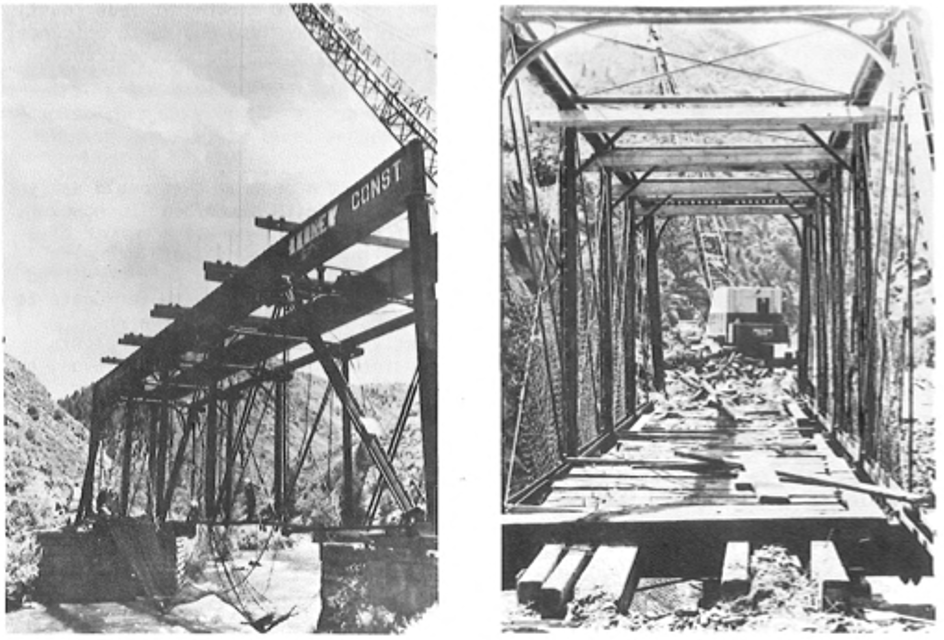
THIS WAS THE SCENE in the Platte Canyon this summer, when crews began to dismantle the Mill Gulch Bridge (or as it is now often referred to, the Keystone Bridge).
Mill Gulch Bridge in the process of removal. Photos from Rocky Mtn. Rail Report Nov. 1978
The Denver Water Department is in the process of widening the narrow gauge roadbed farther into the canyon, to permit access by heavy construction equipment, so the bridge had to be replaced. The large girders at the top were used to support the structure as it was carefully taken apart. They were then lowered onto the abutments to become the main supports for the new bridge. The old bridge is now in storage, and is to be given to the Forest Service, who has indicated it will be used near the Keystone Ski Area. The 10-mile long Platte Canyon was the only major canyon in the foothills near Denver, that had been available for hiking, biking, fishing, etc., with no competition from the automobile. It was closed to all public access this summer, and it may be years before it is open again. This bridge was a highlight on the club's Platte Canyon Bunion Pounder walk/ride trip last year.
(ed. Mill Gulch Bridge today)
(Calls to paint coach on display with C&S 74 in Boulder)
AFTER MANY YEARS of contending with the elements, the narrow gauge display in Boulder's Central Park is sorely in need of some attention in the way of paint. This year, the city decided to have the locomotive No. 30 painted, but the coach and caboose were left untouched. So the Boulder Historical Society has taken it upon itself to try and get the coach painted before bad weather sets in. It is in need of assistance, however, in the form of either time or money. Mike Rowe is the coordinator on the project, and will set up a work day in November, and would appreciate hearing from anyone who could spare just a little time on a yet-to-be-determined Saturday or Sunday to help get the job done.
When a date is set, he will then notify those interested. Paint will be provided, of course, and plans are to return the coach to a Pullman green color. Mike can be reached during the day, at the Boulder Historical Society, 449-3464, or at home in the evenings at 442-2164. The more who can help, the quicker it will go on this worthwhile project.
December
(Shay No. 8 comes to the Georgetown Loop)
COLORADO AND THE GEORGETOWN, BRECKENRIDGE & LEADVILLE RAILWAY gained another steam locomotive recently, with the arrival of ex-West Side Lumber Company's 3-foot gauge Shay Locomotive No. 8 at Silver Plume on October 12. The locomotive was trucked all the way from Banks, Oregon, and presented some challenging problems during the move, Parts had to be removed to get it down to a truck-able load, and it took several weeks to make the journey (and a truck with 11 axles and 66 tires!!). It is hoped to have it operational on the Georgetown Loop by the middle of next summer.
The C&S depot in Dumont that has been used recently as storage for a rafting company is about to move. The rafting company needs a better structure and so donated the station to the Moffat Road Railroad Museum which plans to move it to their site in Granby.
It's unclear what happened to 2022 plan for the Rocky Mountain Railroad Heritage Society to purchase the depot. They claimed on their site to have already signed papers last year.
The Moffat Road Museum has already raised a significant amount of money for the moving and is still working on funds for a foundation and other restoration needs.
The video below tells the story (along with an error, claiming the station was used on the Moffat Road.
This website has more detail as well as current photos.
Their plan is to move the depot in August or September of 2023. While it is exciting the depot will hopefully have a good home, it is a bit sad that it will be leaving the Clear Creek area where it served the C&S narrow gauge. On the other hand, if it was to be demolished, it's better that it moves.
Back in the fall I had a chance to explore the C&S' Platte Canyon route starting in Bailey. I hadn't really heard much about the Helen McGraw Memorial Park until I went and I didn't know that it had some great C&S-related items. I put this video together to showcase two main structures there: the former Mill Gulch bridge and the Glen Isle way station. They also have a wooden C&S caboose, but it's standard gauge. Unfortunately, the park is hidden behind a number of retail buildings and I think it would be easy to not know it's there.
Unfortunately, the Black Hawk and Central City Railroad entered into bankruptcy after just a short life. While noted rail historians P.R. Griswold, Richard Kindig, and Cythia Trombly stated in a 1988 book they authored that it was “a joy to see and hear [71] operating on its short section of track,” this joy couldn’t keep it running. It was not the first tourist railroad in history to flounder and, regardless of the causes, flounder it did. After just three years and almost 55,000 riders, the line from Central City was abandoned for the third time in its history when in 1990 the Gilpin County Historical Society took the railroad out of the owner’s control.
What remained in the aftermath was to deal with the now idle locomotive and rolling stock. Dan Quiat took the lead and moved his two C&S cars, the “Colorado Yukon” and the flatcar, off the property to a storage location in Denver, leaving the original display train behind. From 1990 to 1993, the engine, gondola, and combine sat disregarded at the old boarding site, its longtime former display location. The property itself was now owned by Glynn Alegre, the man whose financial gift boosted the movement to return 71 to Central City from the Loop and to bring her back to operation in 1986. In the early 1990s, other movements in town were soon to affect what Alegre did with his property.
Times were changing for Central City. History and Opera Festivals alone, it seemed to some, could no longer keep the old mining town alive, and so gambling became its new hopeful savior.
Casinos came to the City of Central 1991 and Glynn Alegre sought to sell the land on which 71 and her train rested to a casino and asked the Gilpin County Historical Society to move the train. The Society, however, did not meet Alegre’s deadline, and the man who christened No. 71 on her inaugural day in 1987, felt compelled to pursue legal action against the society to get her moved. Lest this cast a poor light on Alegre, it should be noted that he was not just a fair-weather friend to the train. In fact, he sought to preserve aspects of the railroad after the BH&CC’s bankruptcy.
1993 at the Couer d'Alene Mine museum
Thankfully, the case was settled and the Society transferred No. 71 and coach 20, minus gondola 4319, to yet another display track outside of a mining museum on the opposite side of the valley. The museum was housed in the Couer d'Alene Mine which was restored in 1994.
In the fall of 1995, there was once again talk of resurrecting the train or at least moving it. The Gilpin County Historical Society welcomed propositions, to which both Central City and Black Hawk responded. The ensuing debacle was called a “train war” by a local Colorado news source, The Mountain Ear. Central City offered a sum of $90,000 for the train. Black Hawk upped the ante by offering $95,000 as well as a plan for the train’s maintenance. One of Black Hawk’s casinos with a train motif also jumped into the bidding with a promise of tens of thousands of dollars in donations towards the engine’s yearly care.
The bidding was contentious to say the least as Central City had already made known that it would pursue legal action against the Gilpin County Historical Society if the train went to Black Hawk. To counter this, the Black Hawk Casino Owners’ Association offered to cover the society’s legal costs if Central City followed through on its claim.
On Saturday, April 20th, after hours of consideration, the historical society emerged to declare that there would be no sale of the train, only lease propositions. More board and city council meetings ensued.
In the end, Central City kept her train. The conclusion was that Harvey’s Wagon Wheel Casino, later the Grand Z Casino and Hotel, got No. 71 and her combine, placing them high up on a raised platform where they struck a grand pose. On the positive side, this site was more central to the town, and thus the train was less prone to vandalism, and also more prominent for visitors to see. Sadly, C&S gondola 4319, with her makeshift roof removed, did not make the cut and was moved to Russell Park near Eureka Street. While 71 and her combine received periodic maintenance, the gondola, the last of its kind, slowly deteriorated. Thankfully, C&S 4319 was later leased in 2018 by the South Park Rail Society. The group moved it to their growing historical renovation in Como, Colorado, the former C&Sng division point on its South Park Line, where the car received a thorough restoration.
4319 at Russell Park-Tim Bain photo 2015
As of this writing, C&S 71 seems to have reached its final resting place with combine 20 on its pedestal outside a casino in Central City, but one cannot bet on it. Proposals to get the engine running have popped up through the years with some regularity. An unsuccessful 1996 proposal by Jarrett Carlson, who worked with his grandfather Floyd Cothran on the line in the late 1980s, sought to run the engine out of Black Hawk. A group in the mid 2010s, calling itself The Blackhawk and Central City Narrow Gauge Restoration Project, claimed to want to rebuild and run a tourist line for the third time out of the old Central City boarding site, including the occasional use of No. 71. In 2019, Court Hammond himself re-emerged as Chief Operations Officer of the proposed Central City Railroad and Mining Museum. He and others held an informational meeting in Central City to lay out their plans, garner support, and answer questions, all of which depended on, as their website stated, “repatriation” of C&S No. 71. Anticipating their eventual success, the group even laid 1500 feet of track in the fall of 2021, enough to potentially display and evaluate the engine and combine, at the old boarding site off Spring Street.
Will Colorado & Southern 71 ever steam again? Some are adamant that it will never happen, citing that it would cost less to build an operating replica than to restore 71 herself. Still others have active plans, as of this writing, to bring the locomotive back to life once more. One thing is for sure, though. In every case, it seems a saved C&S relic rarely stays in one place for long, and something suggests 71 may be, in time, on the move once more.
No. 71 in the early 1990s forlorn, but hopeful for a better future