Showing posts with label abandoned railroad. Show all posts

Saturday, September 14, 2019

West Portal of Alpine Tunnel 1991 video

In the late '80s, I discovered the Alpine Tunnel in a magazine I bought at a rummage sale.  Fascinated, I then devoured Historic Alpine Tunnel and Poor's DSP&P book from the local Ohio library.  My parents, recognizing my growing passion for the subject, took our family out to visit this amazing place for the first time in 1991.  This is the home movie filmed on a Panasonic VHS-C video camera, complemented by cheesy Windows Movie Maker title slides that I added years later.  I'm not sure where the original file with the audio is, so I added new music over some old soundtrack.
Enjoy!  (Some points of curiosity in the video are listed below)


Some points of curiosity:


  • The snow sheds at the portal were still scattered over the approach to the portal (today all of the wood has been removed)
  • The rails were still under the snow shed debris (all of these rails were later removed and reused on the rebuilt track near the station complex).
  • A small replica of the arch had been erected in the beginning of the cut to the portal.  If I recall correctly, a school teacher and class had created this (this has since been removed).
  • Water all around it was the water still trickling out from the tunnel.
  • The stone facing of the portal was so covered in sliding dirt and rock that someone had created a makeshift rectangle of wood to keep some tiny access to it.
  • The turntable was in nearly complete ruin (Today much has been restored and track has been relaid on the approach)
  • The other turntable in the remains of the engine house had not yet been excavated.
  • No track had been rebuilt yet on the roadbed.
  • A random length of rail was laying on the former roadbed leading to the engine house.
  • The coal bin had not been restored.  One can see a side of it had collapsed.
  • From the back of the station/telegraph office you can see the collapsed privy that today has been fully restored.
  • The cellar in the ground near the front of the collapsed boarding house has not yet been restored.
  • The railroad has come and gone and restorations have occurred, but the one constant is: those little marmots are still all over the place! :)


Tuesday, January 15, 2019

East Portal of Alpine Tunnel by Drone

This video was one of my first with a drone (technically my 3rd. First time was a practice, second time was a quick one) so it is certainly lacking in drone proficiency.  My angle was too "straight down, " I had no idea why some of it was so blurry, and my camera movements were jerky.  With all that out of the way...sorry about that.

However, it is the first drone of the eastern tunnel entrance that I am aware of and shows the rock slide area above the portal and how it has fallen over the years.  There is a short jaunt over the side of the ROW fill near the tunnel.  I had hoped to recognize some of the debris down there, but alas, the footage was blurry.  A few later clips show a spot farther east along the shelf right-of-way with some rock cribbing I hadn't noticed on previous trips.

Sunday, December 9, 2018

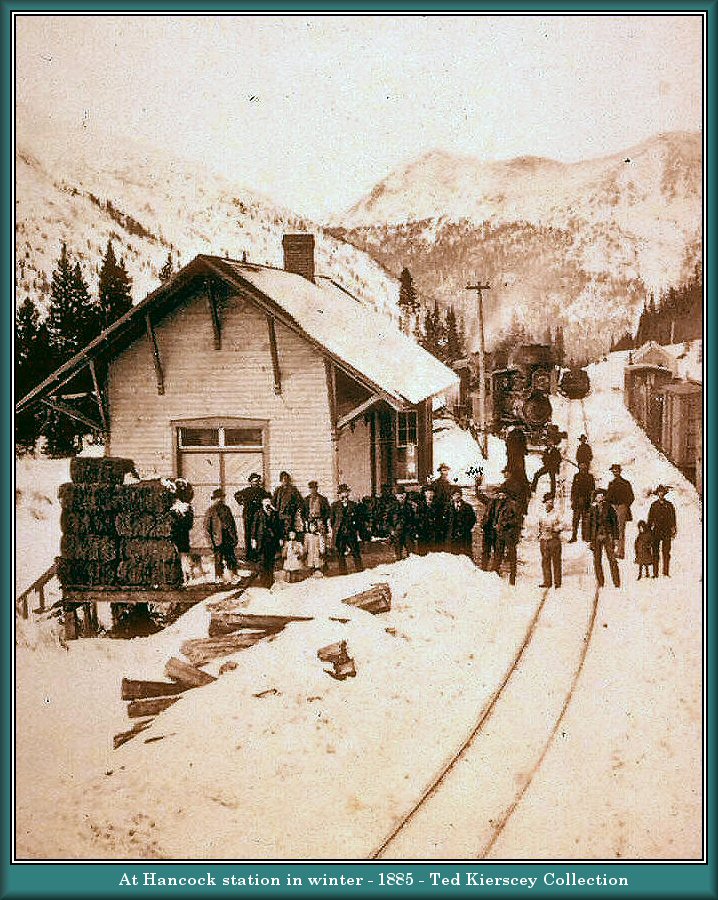
Replica of the Hancock Depot in Fairplay?

Back in 2003, when my wife and I drove through Fairplay, we passed what appeared to be a depot.  From the condition of the building, I surmised that it must be a recreation, albeit one that looked very much like a South Park depot.  It housed a business, a bank, if I recall.

Recently, I came across a photo of this structure online.  The website is titled Stourbridge Lion's Travel Log and is run by a couple named Darren and Lisa where they chronicle their railroad journeys through the world.

In one of their trips, they visit Colorado and include the following photo:

rradventures

The caption given for this photo reads, "Our next stop is to get a photo of the Replica Depot in Fairplay, CO of the DSP&P (Handcock)."

I have no idea how they got the information that this was a replica specifically of the Hancock depot.  It certainly does look like it, though, as the following photo demonstrates.
The Narrow Gauge Circle
rockymountaindreamhomes.com


Does anyone know the background of this replica depot?

It appears that the replica depot was being used as a real estate office (this may have been true when I saw it in the early 2000s-I don't recall for sure the bank idea).

According to Rocky Mountain Dream Homes it "sold for $272,000 on Nov 2, 2018."  The description from this site is as follows: "Best commercial location in the heart of Fairplay - styled to look like an old train depot, complete with ticket office, covered porches and vaulted ceilings - brand new roof and wood floors in south side office. Lower level features a 3/4 bath, mini-kitchen, large open space and three storage rooms. Zoned Town Center possible new ventures include residence, commercial, etc. Parking on both sides of the building and the lot extends to the back alley. Could be sold as is, office furnishings."

Below are a few interior shots.  Many more can be found here.


Saturday, November 24, 2018

Train to the East Portal of Alpine Tunnel in Train-Time video

I've come across a number of online videos of the ride to the west portal of the Alpine Tunnel, but never the eastern approach, probably due to the fact that you can't drive the stretch between Hancock and the tunnel.  I really wanted to fill this gap, first for myself, because I love this side of the pass with its undisturbed grade, and also for others who haven't had the chance to see the stunning scenery and the courageous engineering of the railroad.

I got ahold of a GoPro and a chest attachment in order to make this happen.  Walking with my family (and sometimes carrying one member of it-you will see her red raincoat-covered arm occasionally) I filmed the entire length from Hancock to the east portal.

This video was filmed in July 2018.  I chose to speed up the footage to mirror the same time (30 minutes) that it took a train to travel the same distance according the C&S's schedule of October 1910.

The Denver, South Park & Pacific/Colorado & Southern line from Hancock to the east portal of the Alpine Tunnel, the highest tunnel in the world in 1881 when completed, was abandoned in 1910 in part because this stretch of railroad on the eastern side of the tunnel was so costly to maintain due to the difficulty of clearing snow from this side of the mountain.


I know it's a long video, but every bit of this route is a marvel.  I'm working on a shorter "highlight" version as well that will also incorporate still photos, including those of the interpretive signs that are posted along the way.

Sunday, November 18, 2018

A Tale of Two Tunnels: Where the rails to the Alpine Tunnel ended up

When the rails from Quartz to roughly a mile below Alpine Tunnel's west portal were finally pulled 13 years after trains stopped running, they were all piled up at the former Quartz townsite.  What became of these discarded rails?  Apparently, they went off to help another tunnel.

Author's collection
In September of 1923, the Denver & Salt Lake Railroad began construction of its own tunnel that, like the Alpine Tunnel, would pierce the Continental Divide.  Roughly one month after work commenced, a note was printed in the Pitkin Miner of October 5th that read, "Two cars of rails were loaded at Quartz last week and shipped to Denver.  They are to be used in the construction of the Moffat Tunnel."

So, these rails started out their life serving a Colorado mountain tunnel and went on to do the same in their second life.

Sources:
A Documentary History of the South Park Line: Vol. 5: The Gunnison District, Part II by Daniel W. Edwards, 2016.  Page 165.
"Facts About the Moffatt Tunnel" Steamboat Pilot, 24 March 1926. From Colorado Historic Newspapers Collection.

Sunday, October 28, 2018

Sherrod Loop 2018 video

When the DSP&P/C&S right-of-way from Pitkin to the west portal of Alpine Tunnel was converted for auto traffic, they bypassed the Sherrod Loop (or Curve) leaving the grade undisturbed all these years.   Some time ago, the United States Forest Service laid some track on the beginning, straight segment of the curve.  I think this must have been started either some time in the 1990s or early 2000s.  When I was at Sherrod in 2003 some of the rails were not yet spiked down.


The first stretch of the videos was shot with a GoPro mounted on our ATV as we travel from the site of Woodstock to the start of Sherrod Loop.  I wish I could have gotten aerial shots of the location with the drone I brought, but time limitations with our rental made this unfeasible.  Instead I took screen videos of Google Earth traversing the loop's terrain.  At the end, I walk the relaid track.  Pardon the bounce as I was using a traditional camera.  Should've used the GoPro!  Hindsight :)

Balloon Loops

It is easy to forget that the concept of the balloon loop (or switchback, though not in the traditional railroad sense) was an engineering innovation in scaling mountains.  It involved the concept of a route doubling back on itself, thereby gaining more distance in which to continue to gain more elevation.  Sherrod Loop allowed the Denver, South Park & Pacific Railroad (later, Colorado & Southern Railway) to gain elevation on its way to the Alpine Tunnel in Colorado.  After going upgrade along the mountain for many miles, passing Alpine Pass, the railroad makes a sharp turn, completely reversing it's direction, allowing it to continue the climb higher and higher to the summit and tunnel.


A Water Tank at Sherrod?

I was not aware that there was a water tank at Sherrod, but on the narrow gauge discussion forum it was pointed out that Colorado Rail Annual #31 says:
Sherrod MP 163.8
A wooden tank, 16' x 12', was constructed in 1898. Water was gravity-fed from a spring higher up the mountain.
One person posted this photo of what he surmised to be the base of this tank:


Sunday, September 23, 2018

One Mile from East Portal of the Alpine Tunnel

I have been wanting to try out using a drone, so this summer I rented one and used it in a couple of different spots near the Alpine Tunnel.

The video below is a mix of drone footage and photos.  This shows a portion of the grade just after it exits from roughly 2 miles of wooded right-of-way and begins to cling to the mountainside before reaching the eastern portal of the tunnel.  I've always loved this section of the roadbed.  I, of course, love the western side of the pass too, but because the east side was never converted for auto traffic, you can feel the narrow-ness of the grade a bit more.  This was one of my first uses of a drone so please pardon the jerky motion of parts of the video.


Historical photos:
1. James Ehernberger Colleciton
2. Tom Miller Collection

Sunday, September 16, 2018

Ride the C&S over Rocky Point: 2018 video

Imagine riding the Colorado & Southern Railway upgrade from Como, over the summit of Boreas Pass on the way to Breckenridge, Colorado.  Here I walked one of the few portions of the right-of-way that was not turned into an auto road.  This spot, between Como and the summit of the pass, was called Rocky Point.  It demonstrates the incredible beauty and inherent danger of narrow gauge railroading.  A short piece of restored track graces the spot.  I have heard that groups will occasionally ride a push car over this little stretch.  This was one of my first uses of a GoPro, so please forgive the rocking motion of the footage.

Audio is from: Sounds of Steam Locomotives No. 3: Colorado Narrow Gauge Stack Music. "Three Little Engines and 33 Cars."

Sunday, August 19, 2018

Split Rock 1880s-2018

We returned not too long ago from our family trip to Colorado.  I amassed great quantities of photos of videos of C&S sites and will share them as I have the chance to process them.  Here is the first one I had the chance to work on: a before and after of Split Rock near the palisades. 


Here my daughter and I attempted to recreate in 2018 a photo from what I think would be the late 1800s.  The original photographer must have been up just a little higher than I was.  I can line up the mountains and the rock cliffs perfectly, but then "split rock" is a bit off.  I have fades where I line up the mountains and some others where I line up the split rock. Historical photo from the James Ozment collection.

Sunday, January 28, 2018

Two attempts to reopen the route through the Alpine Tunnel

When the C&S closed down various lines, some communities rallied for a resumption of service. But did this ever occur after the closing of the route through Alpine Tunnel in 1910? Apparently, there were two such attempts.

The first happened in 1912. Since the Colorado Supreme Court was successful in getting the railroad to reopen service between Como and Breckenridge, some thought they could accomplish the same for the line between Como and Gunnison.

The Rocky Mountain News of Denver related a conversation between a Gunnison lawyer by the name
of D.T. Sapp and the C&S Vice President, A.D. Parker. The paper commented that “Sapp stated that Parker had said the C&S would not consider reopening the line from Como until arrangements could be made if possible for penetrating the continental divide at a lower altitude than the Alpine pass.”

The second attempt at forcing the hand of the C&S in this matter came two years later. In 1914 “A True Bill of Indictment was brought against the C&S for Non-feasance. This indictment was made for the failure of the railroad to operate its Gunnison branch in violation of its function as a public carrier.”

Nothing seems to have ever come of these attempts to my knowledge. The author Daniel W. Edwards comments that these “are the only references the writer has found indicating that efforts were made after 1910 to get the C&S to reopen the route through Alpine Tunnel to Gunnison.” (164)

Source: Daniel W. Edwards. A Documentary History of the South Park Line: Vol. 5. The Gunnison District, Part II, 2016. 164-165

Photo: Author's Collection

Saturday, January 27, 2018

C&S narrow gauge mileage is growing! Update

* This is an update to a previous post.  On December 30th, 2017, a short section of track was laid at Pine, Colorado.  See below for details.

In the first half of the twentieth century, the years went up, but the mileage of the C&S kept going down.  Minus the Climax to Leadville line, the last narrow gauge C&S-owned rail to be pulled would be from Chatfield to Denver completed by December 1942, leaving the route standard gauged and finally the narrow gauge rails at Union Terminal and the yards at Denver, finished by the 15th of April in 1943.

The big finale, of course, was when the narrow gauge rails were uprooted from the now standard gauged Climax to Leadville route after the final narrow gauge run on August 25th, 1943.  Technically speaking, C&S rails still held on from Gunnison to the Baldwin Mines, albeit under the "new" ownership of the D&RGW, but were eventually gone by the 1950s. 

It struck me, however, that there is more C&S narrow gauge trackage today than over fifty years ago.  The mileage of this lost railroad has actually increased since the mid twentieth century as tourist routes have sprung up and historical displays and re-creations have dotted the Colorado landscape.

I don't have exact amounts in terms of mileage, but I thought it would be curious to recount the number of places that now (or still) sport C&S narrow gauge track.


Original track still in place

Length of Alpine Tunnel


Reconstructed track on original roadbed

Silver Plume to Devil's Gate Viaduct

Wye on Kenosha Pass

Rocky Point on Boreas Pass

Snowplow park, Breckenridge

Como


Alpine Tunnel


Sherrod Curve

Display Parks
Tracks are on or in the vicinity of former C&S roadbed

Boreas Pass


Silver Plume (The caboose is now indoors under restoration, so I'm not sure the status of the track at present)

Central City

Idaho Springs
Pine
On December 30th, 2017 a short stretch of track was built on the old right-of-way to display a narrow gauge gondola in honor of the South Park's heritage in Pine, once the location of a coaling dock.  The car is a D&RGW high side gondola, acquired from Lindsey Ashby.
Shelly Means photo, December 30, 2017


Reconstructed track that was later removed

Central City towards Black Hawk-twice rebuilt and removed
First time
Second time

Georgetown depot 
(I don't recall what is still here.  At one point Central American Railways #44 was displayed on track outside the old Georgetown depot.  I know #44 is gone, but I am not sure if track remains)


And the great news is: the mileage keeps growing!  Especially in Como this year!


References:
Poor, Mac. DSP&P pp. 412-3
Midyette, Jason. "A gondola for Pine." The Bogies and the Loop, January 2018.

Saturday, January 6, 2018

The last train from Alpine Tunnel was in...1915?

We know that the last train through Alpine Tunnel was in the final months of 1910, but did any other rail car ride over those rails from Hancock to East Portal or West Portal to Pitkin?  If we don’t count whatever cars were used to dismantle the line in 1923-1924, there may have been a few others.

Today when you visit the Alpine Tunnel, you notice the ubiquitous presence of ATVs.  The former South Park railroad grades are quite the playground these days.  However, this is apparently not a new phenomenon.  The April 21st, 1915 Buena Vista newspaper records an entertaining, albeit dangerous, incident involving a party of individuals riding a push car from East Portal downgrade to Romley.

At least seven people, a mix of men and women, seem to have been enjoying the thrill of riding a push car starting from the tunnel, when the car got out of their control.  One man tied a rope to himself and the car and jumped, hoping to slow it down so that some others could jump more safely.  Several riders did take the leap, sustaining various injuries.  The human brake finally succeeded in stopping the car after dragging the hero a full mile.  Shockingly, he only sustained minor injuries.

Besides the particulars of this event, it suggests that riding a car on the grade was not an unusual occurrence.  The article starts out nonchalantly with the words, “While returning from a trip to Alpine tunnel Monday...” as if this was hardly a rare happening.  Also one passenger was a certain “Miss Worthington, a school teacher from near Chicago.”  Other passengers included the wife of a school superintendent and a couple with their daughter.  This not was not a bunch of hoodlum teens pulling a prank, but a load of respectable adult citizens.

Records and photos indicate that the scrapper ferried the rails downgrade from the east portal on a horse drawn sleigh because of the snow, so unlike his work on the western slope, he did not seem to have used a rail car for his graveyard work.

So, what was the last set of steel wheels on the steel rails of the eastern approach to Alpine Tunnel?  It’s very likely it was a push car on a thrill ride.

Source:
Edwards, Daniel W. A Documentary History of the South Park Line: Vol. 5: The Gunnison District, Part II, 2016.


Saturday, December 2, 2017

Video of Kenosha Pass tracks and interpretive signs

I stumbled upon this video of the tracks at Kenosha.  While I've driven the main road over Kenosha I have never had the chance to stop and see the tracks there.  The Youtuber who posted the video seems to think these are abandoned tracks.  As most of you know they were rebuilt many years ago as a display and to run a handcar if I recall correctly. 

The author of the video walks along the tracks (beginning at roughly 2:14) and also has shots of the interpretive signs which I had not seen before.  At the end of the video he is walking along a dirt walking path.  My hunch was that this might be more of the C&S grade.  Does anyone know offhand if that is correct? 

According to this page on the South Park Rail Society, these tracks, along with the stretch at Windy Point on the Boreas Pass route, were laid by the Denver, South Park & Pacific Railway Historical Society.  Oddly, I don't see any reference to these locations on the DSP&PHS site. 

Additionally, the Forest Service website has a page dedicated to this railroad display and gives a few good close ups of some of the interpretive signs there.

Sunday, November 5, 2017

The Flawed Fever for Narrow Gauge

This is not a C&S-specific post, but the topic of what caused the demise of narrow gauge railways in Trains Magazine's September 2015 magazine with great interest because of a unique article entitled "Railroading's Biggest Blunders."  Dan Machalaba chronicled an unlucky 13 "faux pas that shaped the industry."  Of particular interest to me and those of us who are fascinated by the C&S, number 8 on Machalaba's list was
the US in general is quite interesting.  I read


"The Flawed Fever For Narrow Gauge."  


Here is the text of that segment:

"Narrow gauge fever swept the U.S. between 1870 and 1885.  The miles of narrow gauge lines in the country peaked in 1885 at more than 11,000, about 9 percent of American rail mileage.  For a brief time it was possible to travel by narrow gauge railroads from Ohio to Texas.

"The craze soon fizzled.

"Narrow gauge lines failed to compete with standard gauge railroads.  By 1900 most narrow gauge lines had been converted to standard gauge or abandoned.

"What happened?

"The narrow gauge movement was based on the faulty premise that small railroads (usually 3 feet between the rails) were cheaper to build and more economical to operate than standard gauge of 4 feet, 8 1/2 inches.  Proponents argued that narrow gauge lines could reduce construction costs compared with standard gauge railroads by using sharper curves, steeper grades, lighter rail, and lower-weight locomotives.

"Agricultural interests wanting cheap transportation and towns bypassed by standard gauge railroads embraced narrow gauge.  Some advocates even tried to put together a network of 3-foot-gauge railroads dubbed 'The Little Giant Line.'

"'The were like religious converts,' says Grant, the Clemson history professor.  'This was the coming
of narrow gauge.'

"The anticipated savings in capital didn't materialize.  Labor costs were similar to standard gauge.  The costs of reloading freight between narrow and standard gauge lines proved to be greater than expected.  The craze was soon over.  Narrow gauge railroads turned out to be a big waste of time and money."


Above photo from Peterson Portal

Tuesday, October 24, 2017

Drone footage of the C&S right-of-way in Central City

I have long been interested in the two resurrections of the C&S railway in Central City.  I wrote an article in The Bogies and the Loop not too long ago chronicling both endeavors.  I've also written some posts about it as well including looking at C&S post abandonment mileage, a look at some 1968 shots of the first reincarnation, a look at the curious track engine used on the second reincarnation, and a look at combination car No. 20.  The article on the five remaining C&S locos also discusses these tourist routes in the history of engine 71.

But just the other day I happened on a very unique video on Youtube where someone used a drone to film the entire length of the abandoned Blackhawk and Central City Narrow Gauge Railroad right of way (as the tourist route was named in the late 1980's).  Never having had the chance to walk this old grade, the video gives a great sense of the route as it snakes around the mountainous terrain.

The video begins at the spot where No. 71 and her gondola and combine were first put on display in 1941.  The spot also served as the boarding site for the next two tourist railroads that used the grade.  Directly across the street is a parking lot that has a hill next to it.  That hill, made of mine tailings, is actually on top of the second Central City depot.  The mine tailings simply buried the building over the years.

No. 71 was moved next to a casino.  Can anyone spot it in the video?  I haven't noticed it yet.


The Rocky Mountain Flyers, who produced the video have the following as a caption: "Second run of our Litchi waypoint mission to film the rail bed of the old Black Hawk to Central City Railroad. Hopefully to become an active line again. Google Earth programmed mission, tweaked in Litchi hub, flown on Phantom 3 4K drone in the mountains of Colorado."

I would love to know what "Hopefully to become an active line again" means!

I found out that they also posted the same video again but zoomed in.


Friday, October 13, 2017

Argentine Pass Then and Now

The always fantastic Then and Now, Images of Colorado and the West posted this before and after of the end-of-track of the Argentine Central.  Notice the Colorado and Southern excursion coaches behind the Shay locomotive.  Also, it is interesting to note the old wagon? trails that still remain.  The photo was taken by Christi Couch.


One of the comments on the Then and Now page also shed some interesting background:

"The Argentine Central is a wonderful bit of Colorado Mining history. A short distance from Denver. 

"The only train that didn't run on Sunday as Wilcox, original owner was a preacher (on top of his mining interest). The railroad claimed to be the highest in the US, with it's extension to McClellan Mt. 2nd owners had grand plans for that portion to continue to Gray's and Toreys. Where a Hotel and a grand spotlight would be built. A survey was all that was done with that idea.

"A fun hike is to follow the old grade from Silverplume. Can hike it all the way to Pavilion Point. A hotel was built here we're riders could stop for the night. Later in the days of the Argentine Central. As you hike, you can here the Georgetown Loop whistling down in the valley. Shay #9 working away.

Argentine Pass, as the Leavenworth Valley is known today, is adopted by the Rising Sun 4x4 club. Lots of fun outings with the Clear Creek Ranger District, cleaning the trail and learning about it's awesome history!"

Saturday, July 29, 2017

C&S Narrow Gauge Mileage is growing!

In the first half of the twentieth century, the years went up, but the mileage of the C&S kept going down.  Minus the Climax to Leadville line, the last narrow gauge C&S-owned rail to be pulled would be from Chatfield to Denver completed by December 1942, leaving the route standard gauged and finally the narrow gauge rails at Union Terminal and the yards at Denver, finished by the 15th of April in 1943.

The big finale, of course, was when the narrow gauge rails were uprooted from the now standard gauged Climax to Leadville route after the final narrow gauge run on August 25th, 1943.  Technically speaking, C&S rails still held on from Gunnison to the Baldwin Mines, albeit under the "new" ownership of the D&RGW, but were eventually gone by the 1950s. 

It struck me, however, that there is more C&S narrow gauge trackage today than over fifty years ago.  The mileage of this lost railroad has actually increased since the mid twentieth century as tourist routes have sprung up and historical displays and re-creations have dotted the Colorado landscape.

I don't have exact amounts in terms of mileage, but I thought it would be curious to recount the number of places that now (or still) sport C&S narrow gauge track.


Original track still in place

Length of Alpine Tunnel


Reconstructed track on original roadbed

Silver Plume to Devil's Gate Viaduct

Wye on Kenosha Pass

Rocky Point on Boreas Pass

Snowplow park, Breckenridge

Como


Alpine Tunnel


Sherrod Curve

Display Parks
Tracks are on or in the vicinity of former C&S roadbed

Boreas Pass


Silver Plume (The caboose is now indoors under restoration, so I'm not sure the status of the track at present)

Central City

Idaho Springs


Reconstructed track that was later removed

Central City towards Black Hawk-twice rebuilt and removed
First time
Second time

Georgetown depot 
(I don't recall what is still here.  At one point Central American Railways #44 was displayed on track outside the old Georgetown depot.  I know #44 is gone, but I am not sure if track remains)


And the great news is: the mileage keeps growing!  Especially in Como this year!


Reference:
Poor, Mac. DSP&P pp. 412-3

-->