Sunday, March 16, 2025

SG C&S coach and caboose in Nederland, CO

 Here is an oddity that I came across on a family vacation back in 1992. The town is Nederland, Colorado. It has three standard gauge cars. One is a C&S/CB&Q wooden coach and dining car. Next is a C&S caboose, and the other is a mail/circus car. 

The cars are still there serving as a coffee shop. Here is the website of Train Cars Coffee and Kava.

An article from the Mountain Ear states that the shop includes "a 1906 Pullman Coach dining car, an 1872 Union Pacific Railroad post office car, and a 1910 caboose, which survived the South Platte Flood of 1965".


I love the classic C&S Columbine herald on the window.


Sunday, March 9, 2025

Clear Creek roadbed photos between bridge 703 and 705.

 Below are photos of the roadbed between bridges 703 and 705. The walking trail on the opposite side of the creek gives good access to photos of these spots. The roadbed itself can be reached by crossing the highway bridge on foot outside of the western end of Tunnel 5. Once you climb over the road/bridge wall, you can reach a walking trail intended for rock climbers (there is a small foot bridge at the beginning). After that it would take some 'off-roading' to walk to the roadbed where bridge 705 crosses to that side. I've not done it myself, but it seems feasible for the agile folks.

This segment is a little west of Forks Creek.

The photos cover the segment from the circled area in the map through to near the bridge abutments.


Above is some substantial rock cribbing above the roadbed.


Rock cribbing can be seen above the roadbed here.

A closer shot of the cribbing above the railroad grade.


Saturday, March 1, 2025

Exploring Clear Creek Canyon on the C&S: Bridge No. 703 (video)

In a previous video I showed the location of Forks Creek today. In a subsequent video, I showed the site of Bridge 705, with abutments still in place. This next video shows the grade between these two points. 

In this video we explore the remains of the Colorado & Southern Railway's Clear Creek District route starting from Forks Creek and headed west toward Idaho Springs. We visit the site of bridges No. 703 and 704. While much of the roadbed is gone, one can still imagine the route of the old narrow gauge through the canyon. Later the railroad bed reappears and rock cribbing is still evident.

Sunday, February 23, 2025

Concerning news about the possible move of the Pitkin depot

Justin Kerns recently informed me of a developing situation about the possible move of the Pitkin depot.

Below is the content from Facebook:

**Historic Train Depot for Sale in Pitkin! 🚂🏛️**

Attention history enthusiasts and entrepreneurs! The iconic Train Depot in the Town of Pitkin is now available for sale. This historic gem offers two purchasing options:

1. **Relocate the Depot** to a town that truly values its historical significance for **$350,000**.

2. **Acquire the entire property** for **$700,000**, using it as a residence or short term rental.

Recently, a decision was made by the Pitkin City Council to NOT rezone the Train Depot property for commercial purposes.  The possibility of establishing a charming coffee shop or a museum, inviting many tourists to appreciate the rich history of this remarkable building is off the table because of Trustee Tom Gibb and Trustee Ramon Reid.

🚨 Important Update from the Pitkin Trustee Meeting 🚨

On Feb 18 2025, the trustees discussed a critical agenda item regarding the preservation of our historic Train Depot and the proposed rezoning of the property to commercial. The decision ended in a split vote: Jerra Garitson, and Ed Pianalto voted in favor of the rezoning, while Tom Gibb and Ramon Reid voted against it.

As the new owner, I regret to inform you that this change will lead to the removal of the Train Depot, significantly altering the historic landscape of Pitkin. I had hoped to be well into the renovation process by this summer, but those plans are now on hold.

The Train Depot is not just a building; it represents a piece of Pitkin’s history. Its preservation is essential for maintaining the town's unique character and cultural heritage.

Historic properties often serve as landmarks that contribute to a community’s identity. Their removal can lead to a loss of historical context and a sense of place for residents.

The decision to rezone the Train Depot for commercial use raises questions about how it will affect local tourism. Historic sites often attract visitors, and their preservation can be a boon for local businesses.

The outcome of the trustee meeting regarding the Train Depot is a pivotal moment for Pitkin. While the decision may facilitate some commercial development, it also raises important questions about community identity, historical preservation, and the balance between growth and heritage. Exploring alternatives, and fostering open dialogue will be essential in navigating this change and ensuring that the town’s history is honored as it evolves.

Your opinions matter! If you have thoughts or concerns about this decision, please feel free to reach out to me directly. You can also contact the town clerk at thetownofpitkin@gmail.com. Trustee Ed Pianalto edpianalto@yahoo.com trustee Tom Gibb tomgibb20@gmail.com trustee Ramon reed pitkinramon@gmail.com Trustee Jerra Garetson jerragaretson@gmail.com Let’s engage in a constructive dialogue about the future of our town!


#Pitkin #HistoricPreservation #CommunityEngagement #TownMeeting 

Sunday, February 9, 2025

Photos of Bridge No. 705 today

 Below are still shots of the location of Bridge No. 705 on the C&S' old Clear Creek Line. There are also shots of the rock cribbing along the roadbed leading to the former bridge.

Stone cribbing along the west abutment.


A close-up of the east abutment


The west abutment


The west abutment

Looking down on the west abutment. Narrow gauge rail ends can be seen in the concrete


Narrow gauge rail ends in the west abutment concrete


Looking from the west abutment toward the east abutment


the west abutment, looking east


The east abutment from across Clear Creek


Same as above

A close up on the east abutment

The west abutment look west


The east abutment is at the right. The west abutment is in the center of the photo


Rock cribbing leading to the east abutment


Rock cribbing and roadbed. The east abutment is hidden by the tree at left

Graffiti at the west abutment can be seen above the roadbed.


Tuesday, January 28, 2025

Exploring Clear Creek Canyon on the C&S: Bridge No. 705 (video)

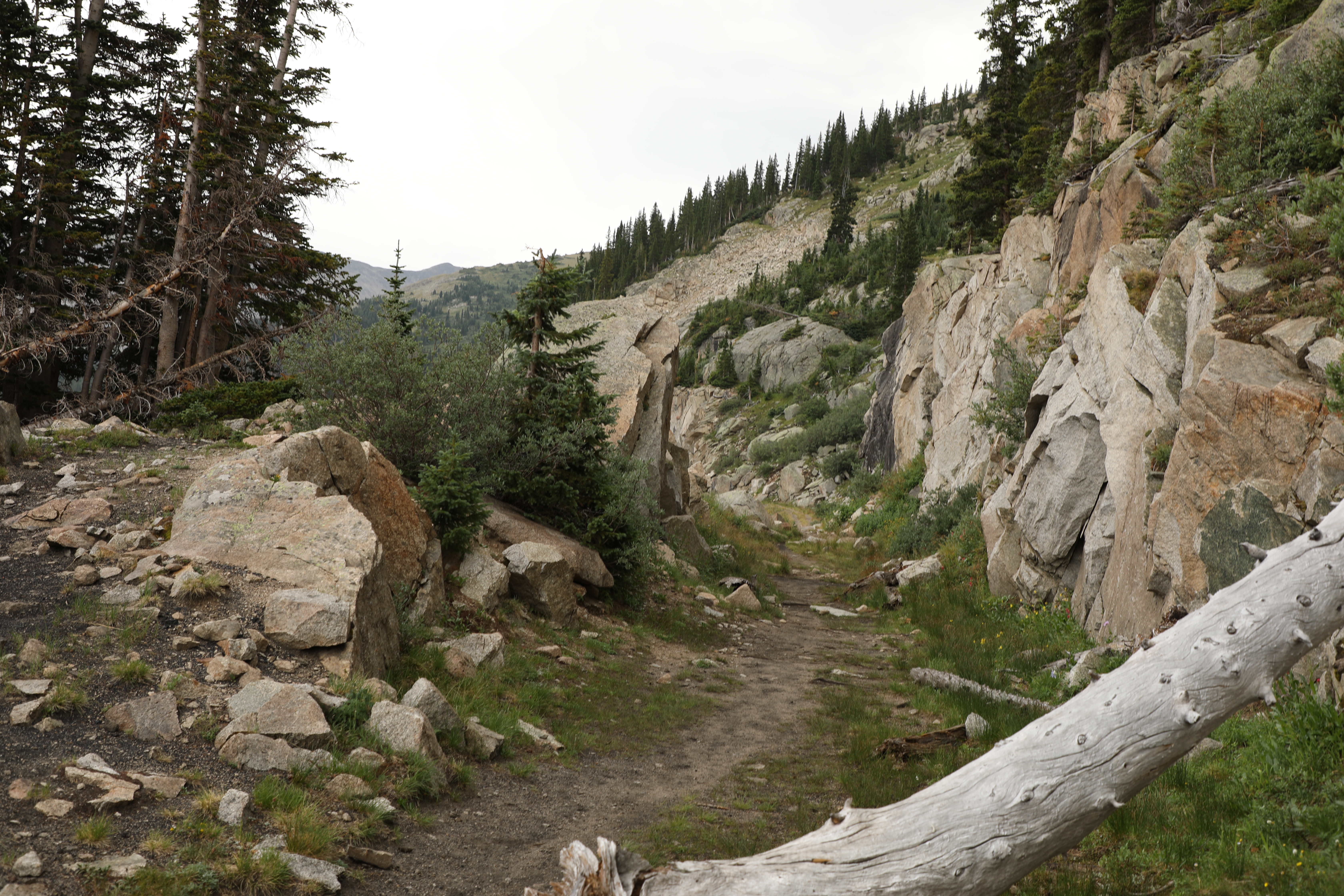
In May 2024 my family and I explored a short segment of the C&S narrow gauge grade in Clear Creek Canyon where the railroad went around a mountain that the road tunnels through. This segment is a little short of a mile west of Forks Creek. 

Part of the C&S grade is now a walking trail. The site of bridge No. 705 (previously No. 5) is also explored. The bridge abutments can be seen off of the side of the trail. You can also see a good amount of rock cribbing from the railroad.

Sunday, January 12, 2025

The Almost-Last-Train Through Alpine Tunnel

All photos from my 2018 visit to East Portal
If you have ever visited either the western or eastern (non-vehicle-using) approaches to Alpine Tunnel you are well aware of the amount of rocks that litter the former roadbed.  Some rocks are quite small and some are veritable boulders.  One can only imagine the challenges faced by section crews in operation days who had to keep the line clear for regular freight and passenger runs.  

Imagine, instead, a section crew trying to clear the line after more than half a year of no maintenance whatsoever.

Such was the problem facing the C&S in the summer of 1911 as the railroad attempted to figure out a way to move some stranded cars and other scrap left in Gunnison, on the west side of the pass, after cessation of traffic between Quartz and Hancock in November of 1910.  The last trains had run over the pass in December of that year, but could one more train make it? The tracks were still in place. Maybe one more last train could be run to solve the problem of these stranded cars. The question facing management, then, was this: in what condition was the tunnel, the tracks, and the right-of-way after roughly 6 months of no maintenance on the remote mountainous line?

C&S Railway Superintendent William M. Bacon took a personal trip to Alpine Tunnel on June 28th, 1911 to inspect its condition himself. What he discovered at the bore quickly put the idea of a final train out of the question: six hundred feet of ice at a depth of 8 to 9 feet extended before him in the darkness of Alpine Tunnel. He came to the conclusion that the ice would not melt even at the height of that summer.

The other, quite literal, roadblock consisted of rock slides between the tunnel and Quartz on the west side of the pass.  Bacon had traveled to the pass on the eastern approach so did not witness these slides himself. Still, he had heard of the obstacles and concluded that the cost of removing them was another strike against an attempt to bring the stranded cars and scrap over the pass in one final funeral train.

It is curious to note that, had this run occurred, the engines employed would not have been able to make a water stop at the top of the pass.  The west portal tank had already been removed in December of 1910. In February 1911 the C&S reinstalled it in Webster, east of Kenosha Pass, replacing the previous tank at that site. 

In the end, that almost-last-train through Alpine Tunnel never ran. Superintendent Bacon’s inspection sealed that possibility. Instead, the C&S forked over the money to send its cars and scrap on the Rio Grande.  The D&RG hauled it all over their Marshall Pass route and, presumably, up to Buena Vista where the cars were returned to C&S rails.


Source:

The South Park Line: A Concise History. Colorado Rail Annual No. 12 by Chappell, Richardson & Hauck.